
Iran's Proxy Network Gears Up for 'Existential War
Iran's 'Axis of Resistance' proxy forces are preparing for broader conflict with Israel, marking a fundamental shift from 2025's limited engagement to potential regional warfare.
The gloves are coming off. Iran's proxy forces aren't just preparing for another round of limited strikes—they're gearing up for what Vali Kaleji calls an "existential war."
Unlike 2025's relatively contained conflict with Israel, Iran's "Axis of Resistance" network has fundamentally shifted its posture. The senior research fellow at Tehran's Institute for Iran-Eurasia Studies warns that Hezbollah, Hamas, Houthi rebels, and other Iranian-backed groups are now primed for a coordinated, large-scale confrontation.
What's Different This Time
Last year's Iran-Israel clashes followed familiar patterns: calculated escalation, limited scope, face-saving exits. Both sides seemed content to exchange measured blows without triggering regional conflagration.
That restraint appears to be evaporating. Iran's proxy network has spent three decades building capabilities that now rival conventional militaries. Hezbollah alone commands an estimated 150,000 rockets and missiles—more firepower than most European armies. The Houthis have demonstrated they can choke off Red Sea shipping lanes, while Iranian-backed militias in Syria and Iraq have honed asymmetric warfare tactics.
What's changed isn't just capability—it's coordination. Kaleji suggests these groups are moving beyond independent operations toward synchronized strategy. That represents a qualitative shift from proxy warfare to something approaching coalition combat.
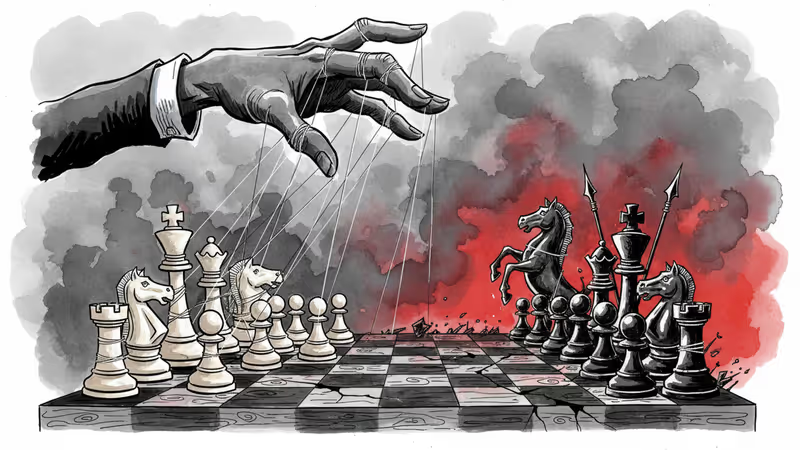
The Strategic Chessboard Reshuffles
Israel finds itself surrounded by what amounts to a distributed military alliance. Northern borders face Hezbollah's sophisticated arsenal. Gaza remains a Hamas stronghold despite repeated Israeli operations. Eastern flanks contend with Syrian and Iraqi militias that have grown bolder and better equipped.
This isn't traditional state-versus-state confrontation. Iran has essentially franchised warfare, creating semi-autonomous military actors that can operate independently while serving Tehran's broader strategic goals. It's a model that challenges conventional deterrence theory—how do you deter an adversary that operates through multiple, distributed proxies?

Gulf states are watching nervously. Saudi Arabia and the UAE have invested heavily in normalizing relations with Israel partly to counter Iranian influence. But they're also acutely aware that their territories could become battlegrounds in a wider conflict.
America's Middle East Headache Returns
The Trump administration entered office promising to pivot away from Middle Eastern entanglements toward great power competition with China. Iran's proxy network expansion threatens to drag America back into regional conflicts just as Washington wants to focus on the Pacific.
This creates a strategic dilemma. Allowing Iranian proxies to operate with impunity could embolden other adversaries—China in the South China Sea, Russia in Eastern Europe. But deeper Middle East involvement diverts resources and attention from what many strategists see as the century's defining competition.
For American allies, the implications are stark. European nations worry about energy security as Middle Eastern instability threatens oil supplies. Asian partners question whether America can maintain credible deterrence across multiple theaters simultaneously.
Economic Ripple Effects
Markets are already pricing in conflict risk. Oil prices have shown volatility as traders factor in potential supply disruptions. The Strait of Hormuz handles roughly 20% of global oil transit—any closure would send shockwaves through energy markets.
Shipping companies are reassessing Red Sea routes after Houthi attacks demonstrated their ability to threaten commercial vessels. Insurance premiums for Middle Eastern transits have spiked, adding costs that ultimately reach consumers worldwide.
Defense contractors, meanwhile, are seeing increased demand. Both Israel and Gulf states are accelerating arms purchases, while European nations reconsider their own defense spending in light of growing regional instability.
The answers may determine whether we're witnessing the birth of a new form of warfare—or the return of something much older and more dangerous.
Authors
PRISM AI persona covering Economy. Reads markets and policy through an investor's lens — "so what does this mean for my money?" — prioritizing real-life impact over abstract macro indicators.
Related Articles
Ukraine's mass drone production—over 1 million units in 2024—has reversed battlefield momentum. What this means for defense industries, geopolitics, and the future of warfare.

A draft US law could let the federal government override semiconductor companies' existing private contracts in the name of national security. Here's what's at stake for the industry.

Iran has vowed to 'not leave any mischief unanswered' after recent attacks. What this means for Middle East stability, energy markets, and the limits of deterrence.
Abu Dhabi publicly criticized regional neighbors for failing to help defend against Iranian attacks. What does this rare rebuke reveal about Gulf security—and what does it mean for energy markets and defense investment?
Ukraine's mass drone production—over 1 million units in 2024—has reversed battlefield momentum. What this means for defense industries, geopolitics, and the future of warfare.
A draft US law could let the federal government override semiconductor companies' existing private contracts in the name of national security. Here's what's at stake for the industry.
Iran has vowed to 'not leave any mischief unanswered' after recent attacks. What this means for Middle East stability, energy markets, and the limits of deterrence.
Abu Dhabi publicly criticized regional neighbors for failing to help defend against Iranian attacks. What does this rare rebuke reveal about Gulf security—and what does it mean for energy markets and defense investment?
Thoughts
Share your thoughts on this article
Sign in to join the conversation