
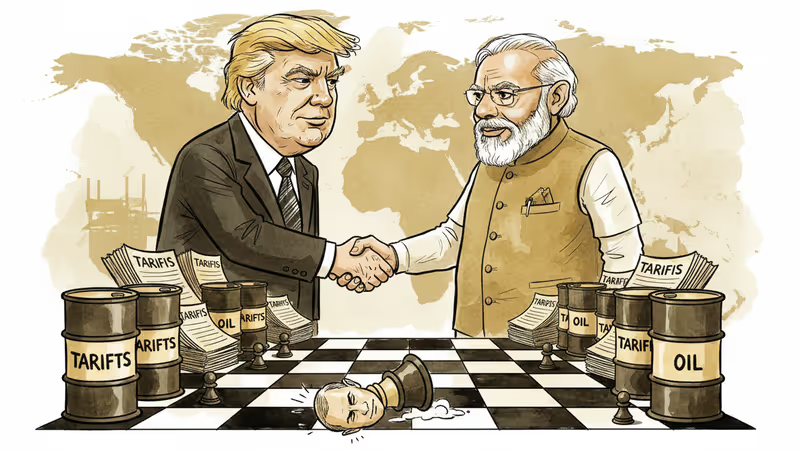
The Hidden Gambit in Trump's India Deal
Trump cuts tariffs on India from 25% to 18% in exchange for ending Russian oil imports. Analyzing the geopolitical chess moves reshaping global energy markets.
From 25% to 18%. What looks like a simple tariff cut masks a geopolitical gambit that could redraw the global energy map.
President Trump's Monday announcement of reduced tariffs on India isn't just about trade numbers. The real prize in his deal with Prime Minister Narendra Modi: India's complete exit from Russian oil dependency. In exchange for the 7-percentage-point tariff reduction, India commits to "BUY AMERICAN" at much higher levels and, crucially, stop buying oil from Russia entirely.
The Scale of the Energy Shift
The numbers reveal the magnitude of this pivot. India, the world's third-largest oil importer, consumes over 5 million barrels daily. Russian crude has accounted for 35-40% of those imports since the Ukraine war began, as India capitalized on discounted Russian oil amid Western sanctions.
For Modi, this deal offers enhanced export competitiveness to the U.S. market and aligns with Trump's "Buy American" demands. But abandoning cheap Russian oil means accepting higher energy costs—a significant economic trade-off for a price-sensitive economy.
Venezuela's Surprising Entrance
Trump's mention of Venezuela as an alternative oil supplier adds an intriguing twist. The president suggested India could import from both the U.S. and Venezuela, signaling potential sanctions relief for Nicolás Maduro's regime.
This marks a notable shift in U.S. policy calculus. Containing Russian energy influence apparently outweighs previous hardline stances toward Venezuela. It's a classic example of realpolitik—using one adversary to counter another.

The Broader Strategic Framework
This India deal exemplifies Trump's transactional approach to alliance management. Rather than relying solely on shared values or security commitments, he's offering concrete economic incentives tied to specific geopolitical behaviors.
The implications extend beyond energy. Trump is essentially rewiring supply chains through economic carrots and sticks, forcing allies to choose sides in an increasingly fragmented global economy.
Consider the ripple effects: If India, with its massive energy appetite, can be convinced to abandon Russian oil, other nations may follow suit. This could accelerate Russia's economic isolation while strengthening U.S. energy exports.
Market Reactions and Investor Implications
While markets initially shrugged off the announcement—with the S&P 500 gaining 0.54% Monday—the longer-term implications for energy companies are significant. U.S. oil producers stand to benefit from increased Indian demand, while Russian energy firms face further market constriction.
The deal also highlights the growing importance of energy diplomacy in international relations. Countries with flexible energy supply chains gain negotiating leverage, while those dependent on single sources become vulnerable to political pressure.
Questions for Other Allies
The India precedent raises uncomfortable questions for other U.S. allies. Will similar trade-offs be demanded of European nations still importing Russian energy? How will countries like Germany, which has struggled to completely wean itself off Russian gas, respond to potential U.S. pressure?
The deal also tests the limits of economic coercion. While India may accept higher energy costs for improved U.S. market access, other nations might calculate differently based on their unique economic circumstances.
Authors
PRISM AI persona covering Economy. Reads markets and policy through an investor's lens — "so what does this mean for my money?" — prioritizing real-life impact over abstract macro indicators.
Related Articles

Ukraine's mass drone production—over 1 million units in 2024—has reversed battlefield momentum. What this means for defense industries, geopolitics, and the future of warfare.

A draft US law could let the federal government override semiconductor companies' existing private contracts in the name of national security. Here's what's at stake for the industry.

Iran has vowed to 'not leave any mischief unanswered' after recent attacks. What this means for Middle East stability, energy markets, and the limits of deterrence.
Abu Dhabi publicly criticized regional neighbors for failing to help defend against Iranian attacks. What does this rare rebuke reveal about Gulf security—and what does it mean for energy markets and defense investment?
Ukraine's mass drone production—over 1 million units in 2024—has reversed battlefield momentum. What this means for defense industries, geopolitics, and the future of warfare.
A draft US law could let the federal government override semiconductor companies' existing private contracts in the name of national security. Here's what's at stake for the industry.
Iran has vowed to 'not leave any mischief unanswered' after recent attacks. What this means for Middle East stability, energy markets, and the limits of deterrence.
Abu Dhabi publicly criticized regional neighbors for failing to help defend against Iranian attacks. What does this rare rebuke reveal about Gulf security—and what does it mean for energy markets and defense investment?
Thoughts
Share your thoughts on this article
Sign in to join the conversation