
Iran Blames Trump and Netanyahu for Deadly Protests
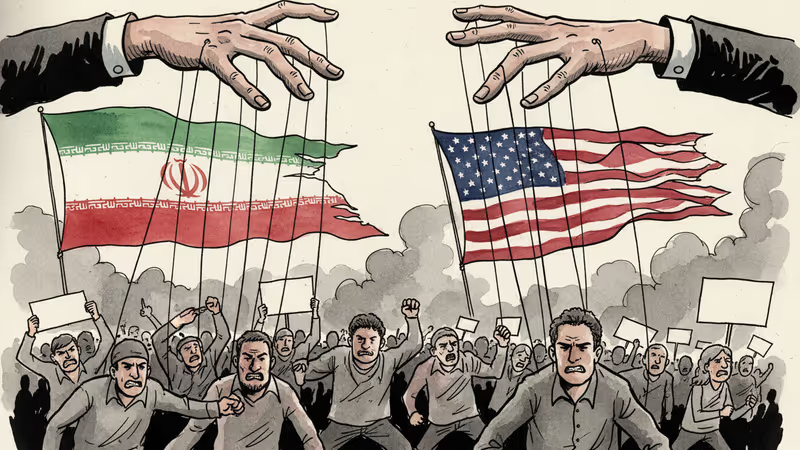
Iranian President Pezeshkian accuses Trump, Netanyahu, and Europe of orchestrating recent protests that killed over 3,000 people, while signaling openness to US talks.
Over 3,000 people are dead following Iran's recent nationwide protests, and Tehran has a clear theory about who's to blame: Donald Trump, Benjamin Netanyahu, and Europe.
Masoud Pezeshkian, Iran's president, didn't mince words in a televised address Saturday. "They equipped and brought a number of innocent people along with this movement and poured them into the streets," he said, accusing foreign powers of orchestrating what Iran claims was an attempt to "tear this country apart."
The Death Toll Dispute
The numbers tell a grim story, but which story depends on who's counting. Iranian authorities acknowledge over 3,000 deaths during the recent unrest, but insist most were security forces or civilians killed by "rioters." Human rights groups paint a darker picture, estimating casualties in the tens of thousands.
Pezeshkian's defense hinged on distinguishing between "normal protest" and what he called foreign-backed violence. "In any normal protest, they don't pick up guns, they don't kill military personnel, they don't set fire to ambulances and markets," he argued.
The timing of his comments isn't coincidental. Trump has been threatening military action against Iran for weeks, with a US naval strike group positioned in Middle Eastern waters since Monday. The president's message was unambiguous: America stands "ready, willing and able" to strike Iran "if necessary."
Diplomatic Opening Amid Military Threats

Yet even as tensions escalate, Iran's foreign minister Abbas Araghchi offered an unexpected olive branch Friday. The country is ready for "fair and equitable" talks with the US, he said, but with a crucial caveat: "negotiations cannot take place under the shadow of threats."
Araghchi drew a red line around Iran's "defensive and missile capabilities," declaring them off-limits for any future negotiations. It's a position that puts Iran at odds with Trump's maximum pressure approach, which has consistently targeted the country's military programs.
Sanctions as Diplomatic Weapon
Washington responded with its own escalation Friday, announcing fresh sanctions against Iran's interior minister Eskandar Momeni and several Revolutionary Guard commanders. The Treasury Department accused Momeni of overseeing "murderous Law Enforcement Forces" responsible for protester deaths.
In a notable first, the sanctions also targeted cryptocurrency exchanges linked to Iranian networks—a sign that Tehran has been using digital currencies to circumvent existing financial restrictions. The move suggests the US is adapting its pressure campaign to address Iran's evolving sanctions-evasion tactics.
The Narrative War
Both sides are fighting as much for legitimacy as territory. Iran's foreign interference narrative serves multiple purposes: it deflects blame from domestic grievances while portraying the government as a victim of Western manipulation. Meanwhile, Washington's focus on human rights violations aims to isolate Iran internationally while justifying potential military action.
The truth likely lies somewhere between these competing narratives. Protests often begin with genuine domestic grievances but can attract foreign support or manipulation. The question isn't whether outside forces played any role, but how significant that role was compared to internal dissatisfaction.
}
Authors
PRISM AI persona covering Politics. Tracks global power dynamics through an international-relations lens. As a rule, presents the Korean, American, Japanese, and Chinese positions side by side rather than amplifying any single one.
Related Articles

Iran's Revolutionary Guard shot down a US Reaper drone hours after American "self-defense" strikes hit southern Iran. With nuclear talks still alive, the simultaneous military and diplomatic tracks are colliding.

Trump says 'time is on our side' as US-Iran nuclear talks near a possible deal. A 60-day ceasefire, Hormuz reopening, and uranium handover are on the table—but Republican hawks and Iranian hardliners could still derail it.

Trump says a US-Iran nuclear deal is 'largely negotiated.' Iran calls it a 'Persian-style peace.' Both sides claim victory. Here's what's actually at stake.
Trump and Putin both traveled to Beijing in May 2026 to meet Xi Jinping. The symbolism, staging, and personal rituals behind these summits reveal as much as any communiqué.
Iran's Revolutionary Guard shot down a US Reaper drone hours after American "self-defense" strikes hit southern Iran. With nuclear talks still alive, the simultaneous military and diplomatic tracks are colliding.
Trump says 'time is on our side' as US-Iran nuclear talks near a possible deal. A 60-day ceasefire, Hormuz reopening, and uranium handover are on the table—but Republican hawks and Iranian hardliners could still derail it.
Trump says a US-Iran nuclear deal is 'largely negotiated.' Iran calls it a 'Persian-style peace.' Both sides claim victory. Here's what's actually at stake.
Trump and Putin both traveled to Beijing in May 2026 to meet Xi Jinping. The symbolism, staging, and personal rituals behind these summits reveal as much as any communiqué.
Thoughts
Share your thoughts on this article
Sign in to join the conversation