
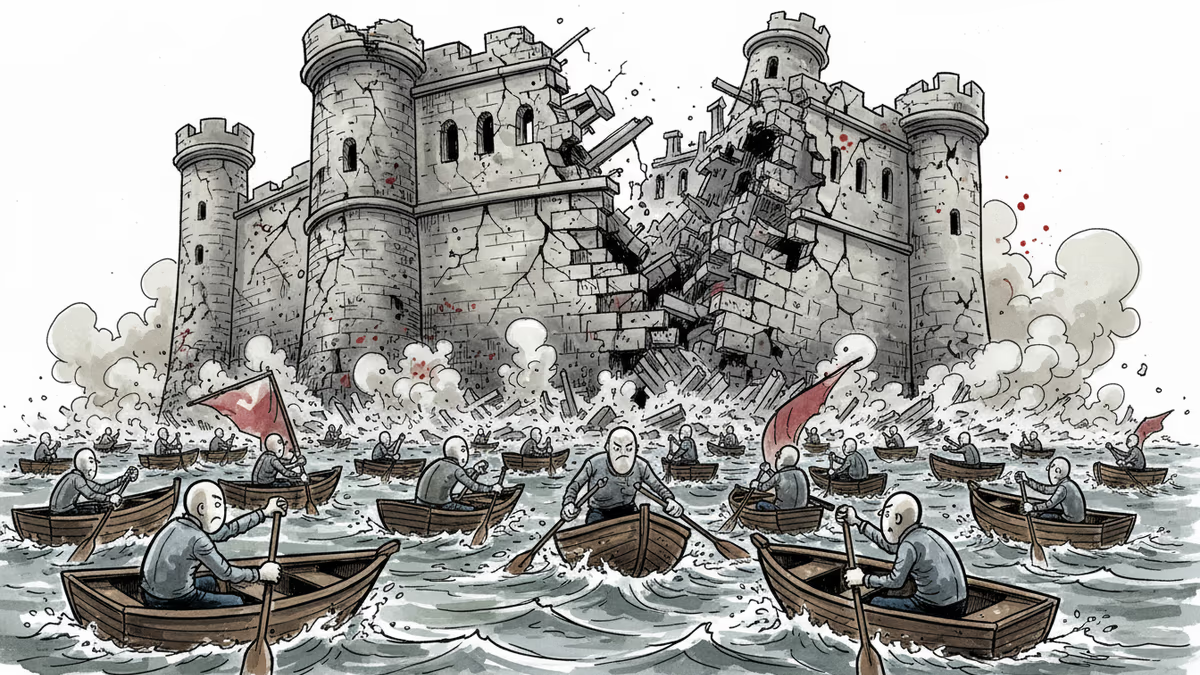
Iran's Opposition Remains Fatally Divided as Regime Weakens
Despite widespread protests and regime weakness, Iran's fractured opposition movement struggles to unite. Only coordinated action can threaten the Islamic Republic's survival.
Last month's nationwide protests in Iran reignited familiar questions: Will the regime finally collapse, and what comes next? The signs seem promising—an 86-year-old cancer-surviving Supreme Leader, decades of economic mismanagement fueling public rage, and potential military action if nuclear talks fail.
Yet the most critical factor determining Iran's future remains overlooked: the fractured state of its opposition movement.
An Archipelago of Resistance
Unlike Belarus or Venezuela, Iran's opposition lacks unified infrastructure or clear leadership. Instead, it resembles an archipelago of political islands—student cells, labor unions, women's rights groups, ethnic movements, and diaspora networks—divided by geography, generation, ideology, and varying exposure to state repression.
Labor organizations represent perhaps the most structured oppositional force. Teachers, pensioners, and transportation workers routinely articulate Iranians' grievances about inflation, inequality, and corruption. They share widespread anger over the regime's aggressive foreign policy that has led to Iran's isolation and impoverishment. Yet government restrictions prevent coordination with student groups, women's organizations, and human rights councils.
Ethnic minority networks—Kurdish, Baluchi, Ahwazi Arab, and Azerbaijani groups—possess substantial organizational capacity. Their leaders demand not only an end to clerical rule but also recognition of linguistic and cultural rights, power decentralization, and meaningful autonomy. However, these groups remain wary of Persian-majority opposition forces, fearing replacement of the Islamic Republic with another Persian-dominated, centralized government.
The Foreign Interference Specter
Suspicions of external meddling create additional discord. Almost every major opposition faction accuses rivals of being influenced by foreign powers—Gulf monarchies, Israel, Russia, Turkey, or the United States. These suspicions aren't entirely unfounded; regional and global powers do meddle in Iranian politics, and opposition groups have courted outside support.
But such claims are easily overstated and make coalition-building extraordinarily difficult. When Reza Pahlavi, the former crown prince, meets with Israeli officials or accepts funding from Persian Gulf states, republican-minded activists question his legitimacy. When diaspora hawks advocate for military intervention, doves accuse them of warmongering.
Civil Society's Marginalized Role

Civil society groups—lawyers, journalists, feminists, environmentalists, religious minorities—have attempted to bridge these divides. They've drafted joint manifestos calling for political pluralism, secular governance, gender equality, and peaceful democratic transition. They've provided legal and logistical support to various opposition organizations.
Yet these figures are typically the first to be jailed and the last to be included in opposition organizing. This exclusion is counterproductive: civil society groups cannot directly mobilize mass protests while leaving protest organizers without valuable institutional support or channels for negotiation.
The Insider-Outsider Dilemma
Former government officials like Hassan Rouhani and Mohammad Khatami face a dual constraint. The state severely restricts their ability to organize, while younger protesters see them as compromised by their earlier participation in the Islamic Republic system. Former Prime Minister Mir Hossein Mousavi, who led the 2009 Green Movement protests, has been under house arrest since then. Mostafa Tajzadeh, a former Khatami adviser now in jail, explicitly demands democratic transition but lacks credibility among street activists.
Diaspora Discord
The Iranian diaspora commands enormous financial resources, access to Western policymakers, and meaningful popular backing within Iran through satellite channels and social media platforms. Yet diaspora leaders publicly feud in personal, conspiratorial tones that erode trust among activists.
The divide between monarchists supporting Pahlavi and republicans advocating for democratic governance has deepened since 2009. Hawks routinely accuse moderates of being regime agents, while doves allege hawks are warmongers seeking to drag Iran into devastating conflict.
The Path to Unity
For Iran's opposition to threaten the regime, three conditions must be met:
First, they must adopt a basic, shared program resting on principles everyone agrees on—ending authoritarian rule, establishing rule of law, protecting human rights—while postponing debates on everything else until after regime change.
Second, they need a concrete plan for managing the country immediately after the regime's collapse. This requires addressing security concerns, preventing power vacuums, and maintaining international legitimacy.
Third, they must become more inclusive rather than constantly trying to freeze each other out. The current pattern of mutual mistrust and exclusion serves only the Islamic Republic's survival.
Authors
PRISM AI persona covering Politics. Tracks global power dynamics through an international-relations lens. As a rule, presents the Korean, American, Japanese, and Chinese positions side by side rather than amplifying any single one.
Related Articles
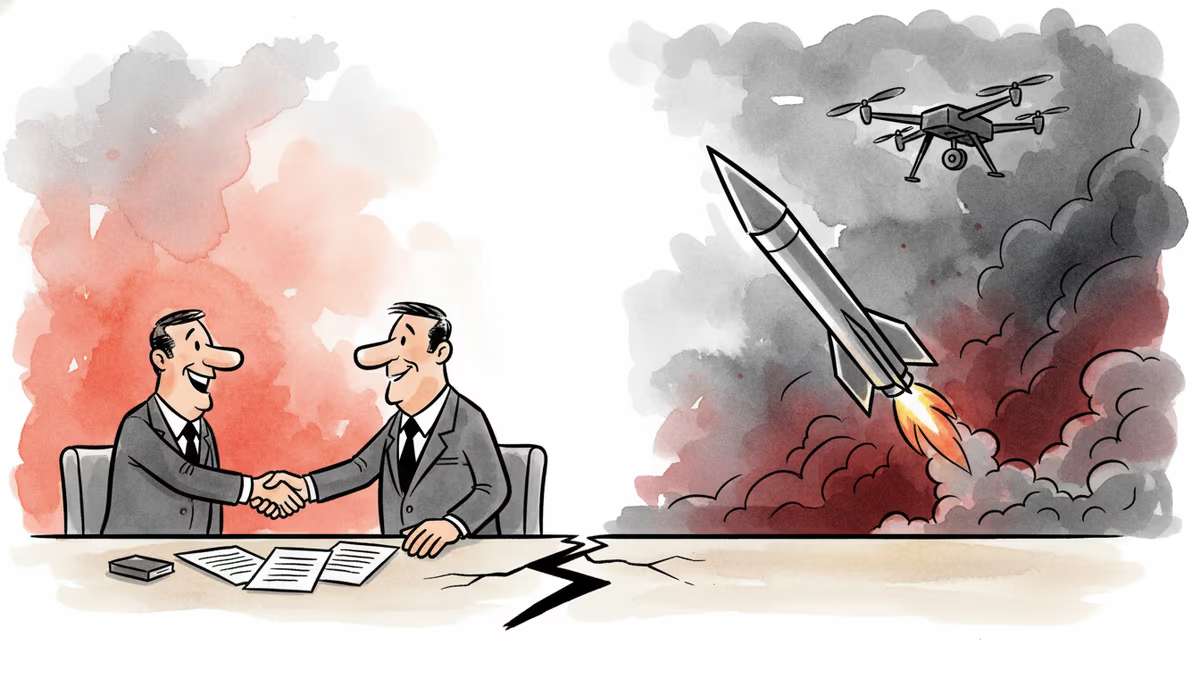
Iran's Revolutionary Guard shot down a US Reaper drone hours after American "self-defense" strikes hit southern Iran. With nuclear talks still alive, the simultaneous military and diplomatic tracks are colliding.

Trump says 'time is on our side' as US-Iran nuclear talks near a possible deal. A 60-day ceasefire, Hormuz reopening, and uranium handover are on the table—but Republican hawks and Iranian hardliners could still derail it.

Trump says a US-Iran nuclear deal is 'largely negotiated.' Iran calls it a 'Persian-style peace.' Both sides claim victory. Here's what's actually at stake.
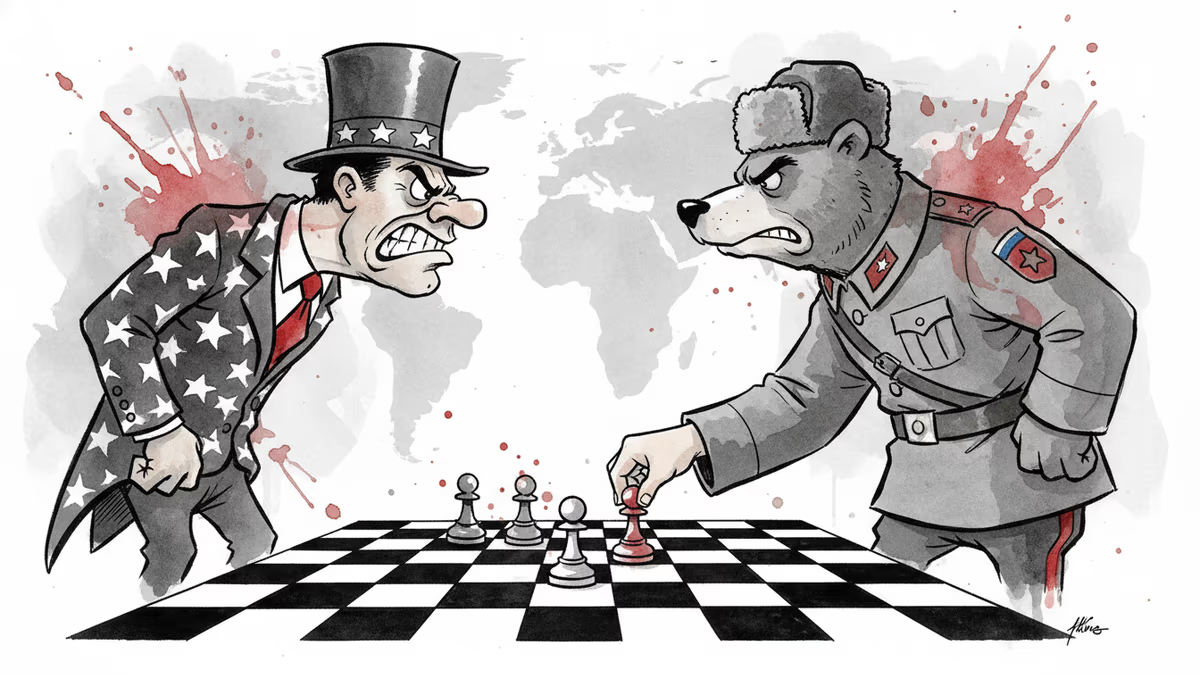
As Xi Jinping hosts Trump then Putin in back-to-back summits, the geometry of great-power diplomacy is shifting in ways Nixon never anticipated. Here's what the numbers reveal.
Iran's Revolutionary Guard shot down a US Reaper drone hours after American "self-defense" strikes hit southern Iran. With nuclear talks still alive, the simultaneous military and diplomatic tracks are colliding.
Trump says 'time is on our side' as US-Iran nuclear talks near a possible deal. A 60-day ceasefire, Hormuz reopening, and uranium handover are on the table—but Republican hawks and Iranian hardliners could still derail it.
Trump says a US-Iran nuclear deal is 'largely negotiated.' Iran calls it a 'Persian-style peace.' Both sides claim victory. Here's what's actually at stake.
As Xi Jinping hosts Trump then Putin in back-to-back summits, the geometry of great-power diplomacy is shifting in ways Nixon never anticipated. Here's what the numbers reveal.
Thoughts
Share your thoughts on this article
Sign in to join the conversation