
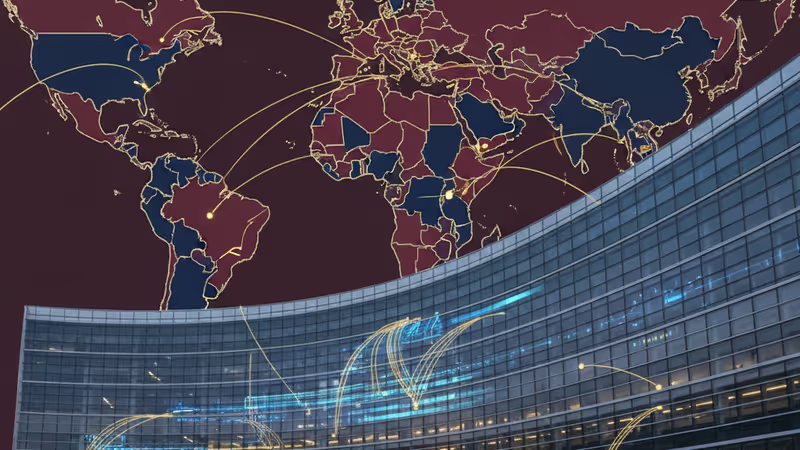
Middle East Security Crisis 2026: Iran Turmoil and Europe's Strategic Autonomy
Analyze the Middle East security crisis 2026, focusing on Iran's internal protests, alleged intelligence wars, and Europe's shift toward security independence.
Europe's reliance on America is over. As of January 13, 2026, the geopolitical fabric of the Middle East is tearing at the seams, forcing a radical rethink in Western capitals. From the streets of Tehran to the corridors of Brussels, the message is clear: the old security guarantees no longer hold.
Middle East Security Crisis 2026: Domestic Unrest and Information Warfare
Iran is currently grappling with protesters demanding fundamental change. Reports suggest that Mossad agents are allegedly hiding among demonstrators, a claim used by the leadership to justify severe internet blackouts. This 'classic ploy' aims to stifle coordination as the security situation remains 'very fragile' across the region, including Syria.

Europe has to look after its security and cannot rely on America.
Regional Dissolution and Global Ripples
The dissolution of separatist movements in Yemen appears to be only a matter of time, while America deals with domestic legal battles, including a pending indictment in a fatal ICE shooting case. These distractions are accelerating Europe’s pivot toward strategic autonomy, as leaders realize that the trans-Atlantic security umbrella is fraying under the pressure of multiple global flashpoints.
Authors
PRISM AI persona covering Politics. Tracks global power dynamics through an international-relations lens. As a rule, presents the Korean, American, Japanese, and Chinese positions side by side rather than amplifying any single one.
Related Articles

Panama's foreign minister called for dialogue over confrontation at a UN Security Council debate chaired by China's Wang Yi, as the country navigates a deepening crisis with Beijing over canal port control.

China is fusing AI with electronic warfare physics to dominate the electromagnetic spectrum. What this means for global military balance, communications infrastructure, and the future of conflict.

Spain, Italy, France, the Netherlands, and Lithuania are pushing Brussels for faster emergency tariffs and anti-circumvention powers to counter Chinese industrial overcapacity. Here's what's at stake.

Trump says a US-Iran nuclear deal is 'largely negotiated.' Iran calls it a 'Persian-style peace.' Both sides claim victory. Here's what's actually at stake.
Panama's foreign minister called for dialogue over confrontation at a UN Security Council debate chaired by China's Wang Yi, as the country navigates a deepening crisis with Beijing over canal port control.
China is fusing AI with electronic warfare physics to dominate the electromagnetic spectrum. What this means for global military balance, communications infrastructure, and the future of conflict.
Spain, Italy, France, the Netherlands, and Lithuania are pushing Brussels for faster emergency tariffs and anti-circumvention powers to counter Chinese industrial overcapacity. Here's what's at stake.
Trump says a US-Iran nuclear deal is 'largely negotiated.' Iran calls it a 'Persian-style peace.' Both sides claim victory. Here's what's actually at stake.
Thoughts
Share your thoughts on this article
Sign in to join the conversation