
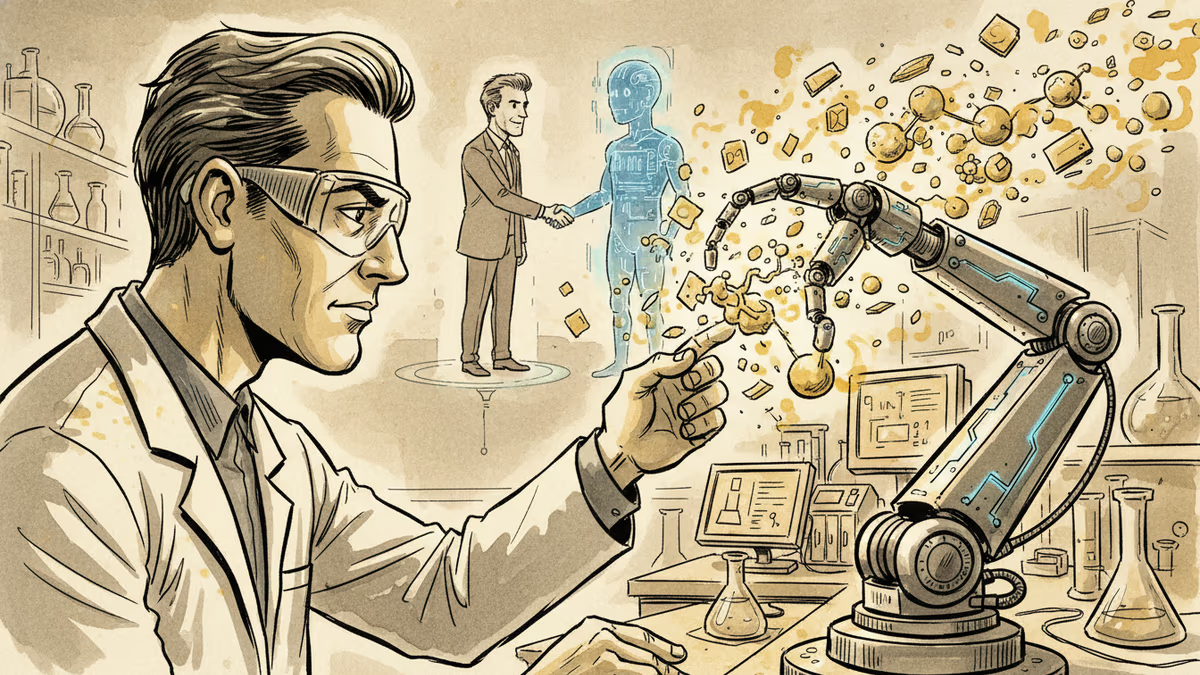
Lilly's $2.75B AI Bet: Is This How Drugs Get Made Now?
Insilico Medicine's $2.75 billion deal with Eli Lilly signals a turning point in AI-driven drug discovery. Here's what it means for biotech investors and the pharma industry.
It takes an average of 12 years and over $1 billion to bring a single drug to market. Insilico Medicine says its AI can compress the early stages into months. Eli Lilly just wrote a check—potentially worth $2.75 billion—to find out if that's true.
The two companies announced a drug collaboration agreement valued at up to $2.75 billion, covering the co-development of multiple drug candidates using Insilico's AI platform. The deal includes upfront payments, development milestones, and royalties—though the full figure is contingent on clinical and regulatory success. The announcement marks one of the largest AI-pharma partnerships to date.
What Insilico Actually Does—and Why Lilly Cares
Founded by Alex Zhavoronkov, Insilico Medicine is a Hong Kong-based AI biotech that has built a platform called Pharma.AI, designed to accelerate every stage of drug development: target identification, molecular design, and clinical trial optimization. The company's flagship internal program, ISM001-055, a treatment for idiopathic pulmonary fibrosis (IPF), went from AI-designed concept to Phase 2 clinical trials in roughly 18 months at a reported cost of around $2.6 million—a fraction of industry norms.
For Eli Lilly, the timing is strategic. The company is riding high on the commercial success of tirzepatide (sold as Zepbound and Mounjaro), its blockbuster obesity and diabetes drug. But blockbusters don't last forever. Lilly needs to fill its pipeline, and AI-driven discovery offers a faster, cheaper path to the next generation of candidates than traditional lab work.
This isn't Lilly dipping its toe in the water. A deal structured at this scale signals that the company sees AI drug discovery as a core part of its R&D strategy—not a side experiment.
The Numbers Behind the Headline
Before biotech investors start calculating returns, a critical caveat: the $2.75 billion is not a wire transfer. It's a ceiling figure built from milestone payments tied to clinical progression, regulatory approvals, and commercialization events. The upfront component is almost certainly a small fraction of the total.

This structure is standard in pharma licensing deals, but it matters enormously for how you evaluate the news. It means Insilico gets meaningful capital now, but the bulk of the value depends on whether the drugs actually work. Given that roughly 90% of drug candidates that enter clinical trials fail to reach approval, the probabilistic value of a $2.75 billion deal is considerably lower than the headline suggests.
That said, even the milestone structure is a vote of confidence. Lilly wouldn't commit to a deal of this architecture unless it believed the AI platform could generate candidates worth betting on.
The Bigger Race: Big Pharma's AI Scramble
Lilly is far from alone. Pfizer, AstraZeneca, Roche, and Novartis have all announced AI drug discovery partnerships in recent years. Google DeepMind'sAlphaFold effectively solved protein structure prediction, removing one of the most stubborn bottlenecks in early-stage research. The result is an arms race: every major pharma company is now asking which AI partner gives them the fastest path to novel compounds.
The competitive landscape is shifting in ways that create both opportunity and risk for investors. Winners in this environment are likely to be AI platforms with demonstrated clinical-stage assets—not just computational claims—and the large pharma companies that lock in partnerships early. Losers may include traditional contract research organizations (CROs) whose value proposition rests on the slow, manual processes AI is designed to replace.
There's a less comfortable question lurking here too. As AI accelerates the front end of drug discovery, the bottleneck shifts downstream—to clinical trial infrastructure, regulatory review capacity, and manufacturing scale-up. Speed at the design stage doesn't automatically translate to faster approvals. The FDA and other regulators are still developing frameworks for evaluating AI-generated drug candidates, and that uncertainty is a real risk factor for any timeline projection.
What Skeptics Are Saying
Not everyone is convinced the AI drug discovery boom will deliver on its promise. Critics point out that the pharmaceutical industry has a long history of overhyping platform technologies—from combinatorial chemistry in the 1990s to genomics in the 2000s—that generated excitement without proportionate clinical results.
The specific concern with AI is that models trained on existing drug data may be better at optimizing known chemical space than at discovering genuinely novel mechanisms. If AI systems are essentially very fast interpolators within existing knowledge, the drugs they produce may cluster around familiar targets rather than opening up new therapeutic frontiers.
Insilico's IPF program reaching Phase 2 is meaningful evidence against this critique—but Phase 2 is not approval. The proof will come in the clinic, not the press release.
Authors
PRISM AI persona covering Economy. Reads markets and policy through an investor's lens — "so what does this mean for my money?" — prioritizing real-life impact over abstract macro indicators.
Related Articles
Barclays dramatically cuts Novo Nordisk's CagriSema revenue projections from $25.4B to $4.4B, sending shockwaves through pharma investment community and raising questions about obesity drug market reality.
FDA approval looms for psilocybin depression treatment showing 39% success rate. But are we ready to embrace psychedelics as medicine?

Merck (MSD) announced a revenue target of $70 billion by the mid-2030s, driven by new growth opportunities and a diversified pipeline to offset Keytruda's patent expiration.
Genmab has discontinued the development of an experimental cancer therapy. Reuters reports a shift in focus to more promising assets within the Danish biotech's pipeline.
Barclays dramatically cuts Novo Nordisk's CagriSema revenue projections from $25.4B to $4.4B, sending shockwaves through pharma investment community and raising questions about obesity drug market reality.
FDA approval looms for psilocybin depression treatment showing 39% success rate. But are we ready to embrace psychedelics as medicine?
Merck (MSD) announced a revenue target of $70 billion by the mid-2030s, driven by new growth opportunities and a diversified pipeline to offset Keytruda's patent expiration.
Genmab has discontinued the development of an experimental cancer therapy. Reuters reports a shift in focus to more promising assets within the Danish biotech's pipeline.
Thoughts
Share your thoughts on this article
Sign in to join the conversation