
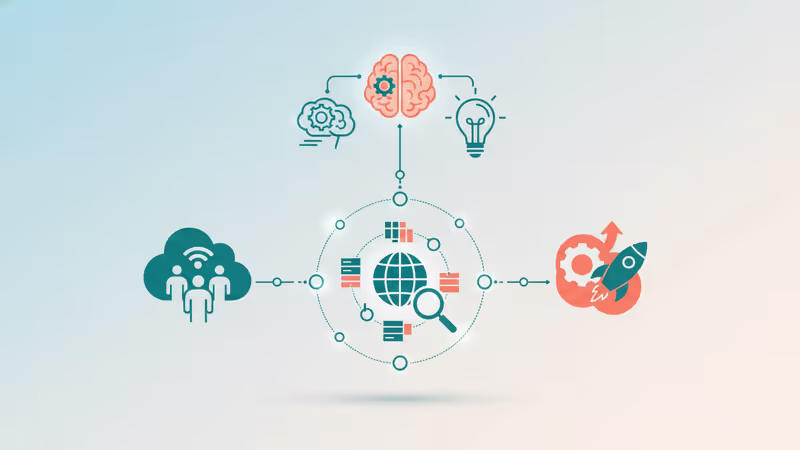
Why OpenAI Is Really Targeting Scientists Now
After revolutionizing everyday work, OpenAI launches dedicated science team. GPT-5 solves months-long research problems, but are scientists ready for AI collaboration?
92%. That's the score OpenAI's latest model, GPT-5.2, achieved on PhD-level biology, physics, and chemistry problems. It crushes the human expert baseline of around 70% and represents a massive leap from GPT-4's39% just a year ago.
Three years after ChatGPT upended daily life, OpenAI is making its most ambitious play yet: conquering science itself. In October, the company launched OpenAI for Science, a dedicated team focused on turning large language models into research collaborators.
But OpenAI isn't first to this party. Google DeepMind has run AI-for-science teams for years, creating breakthroughs like AlphaFold for protein structure prediction. So why is OpenAI jumping in now?
The Reasoning Revolution
Kevin Weil, who leads OpenAI for Science, has the credentials to answer. The former Twitter and Instagram product chief started as a particle physicist at Stanford before ditching academia for Silicon Valley. "With GPT-5, we saw that becoming possible," he says.
The game-changer is reasoning ability. Unlike earlier models that simply predicted the next word, GPT-5 breaks problems into steps and works through them methodically. This approach helped it achieve gold-medal performance in the International Math Olympiad, one of the world's toughest math competitions.
"These models are no longer just better than 90% of grad students," Weil explains. "They're really at the frontier of human abilities."
That's a bold claim, but the evidence is mounting. GPT-5 has "read substantially every paper written in the last 30 years," according to Weil, and can connect insights across completely unrelated fields—something even the most brilliant human collaborator struggles with.
Scientists Weigh In
The real test comes from researchers themselves. Robert Scherrer, a physics professor at Vanderbilt University, used GPT-5 Pro (at $200/month) to solve a problem that stumped him and his graduate student for months.
"GPT-5 still makes dumb mistakes," Scherrer admits. "Of course, I do too, but the mistakes GPT-5 makes are even dumber." Yet he's convinced: "If current trends continue, I suspect that all scientists will be using LLMs soon."

Derya Unutmaz from the Jackson Laboratory uses GPT-5 to brainstorm ideas and plan immune system experiments. "When you can complete analysis of data sets that used to take months, not using them is not an option anymore," he says.
But skepticism remains. Andy Cooper from the University of Liverpool says his team hasn't found LLMs "fundamentally changing the way that science is done," though they're proving useful in automated workflows.
The Hallucination Problem
For all the excitement, GPT-5 makes dangerous mistakes. In October, OpenAI executives boasted that their model had solved unsolved math problems, only to delete their posts when mathematicians pointed out it had simply found existing solutions in old German papers.
More troubling was a case where GPT-5's flawed idea made it into a peer-reviewed physics journal. Jonathan Oppenheim, a quantum mechanics researcher, called it out: "It's like asking for a COVID test, and the LLM cheerfully hands you a test for chickenpox."
Weil acknowledges the problem but offers a different perspective: "When I'm doing research, if I'm bouncing ideas off a colleague, I'm wrong 90% of the time and that's kind of the point. We're both spitballing ideas and trying to find something that works."
OpenAI is working on solutions—making GPT-5 express less confidence and using the model to fact-check itself. "You can kind of hook the model up as its own critic," Weil explains.
Market Reality Check
OpenAI faces stiff competition. Google DeepMind'sAlphaEvolve has already solved real-world problems using similar techniques. Anthropic'sClaude and other rivals offer comparable capabilities at competitive prices.
This raises a crucial question: Why should scientists choose GPT-5 over alternatives? The answer may lie less in technical superiority than in OpenAI's aggressive push to capture market share before competitors fully mobilize.
"I think 2026 will be for science what 2025 was for software engineering," Weil predicts. "At the beginning of 2025, if you were using AI to write most of your code, you were an early adopter. Twelve months later, if you're not using AI to write most of your code, you're probably falling behind."
Investment and Career Implications
For investors, OpenAI's science push signals a major market expansion beyond consumer and enterprise applications. The global R&D market represents hundreds of billions in annual spending, with pharmaceutical research alone worth over $200 billion yearly.
But the career implications for scientists are more complex. While AI tools promise to accelerate research, they also raise questions about attribution, creativity, and the future of scientific training. If GPT-5 can solve PhD-level problems, what does that mean for graduate education?
The regulatory landscape remains murky. Unlike consumer AI applications, scientific AI tools could influence drug approvals, environmental policies, and national security decisions. How will agencies like the FDA adapt to AI-generated research insights?
Authors
Related Articles

OpenAI has reorganized for the second time in a month, merging ChatGPT and Codex into a single agentic platform under president Greg Brockman's unified product leadership.
After two weeks of witnesses calling him a liar, OpenAI CEO Sam Altman testified in his own defense, claiming Elon Musk tried to kill the company twice.
Sam Nelson, 19, died after following ChatGPT's advice to mix Kratom and Xanax. His parents are suing OpenAI for wrongful death, raising urgent questions about AI trust, liability, and design.
OpenAI's new Daybreak initiative uses the Codex AI agent to find and patch security vulnerabilities before attackers do—putting it in direct competition with Anthropic's secretive Claude Mythos.
OpenAI has reorganized for the second time in a month, merging ChatGPT and Codex into a single agentic platform under president Greg Brockman's unified product leadership.
After two weeks of witnesses calling him a liar, OpenAI CEO Sam Altman testified in his own defense, claiming Elon Musk tried to kill the company twice.
Sam Nelson, 19, died after following ChatGPT's advice to mix Kratom and Xanax. His parents are suing OpenAI for wrongful death, raising urgent questions about AI trust, liability, and design.
OpenAI's new Daybreak initiative uses the Codex AI agent to find and patch security vulnerabilities before attackers do—putting it in direct competition with Anthropic's secretive Claude Mythos.
Thoughts
Share your thoughts on this article
Sign in to join the conversation