
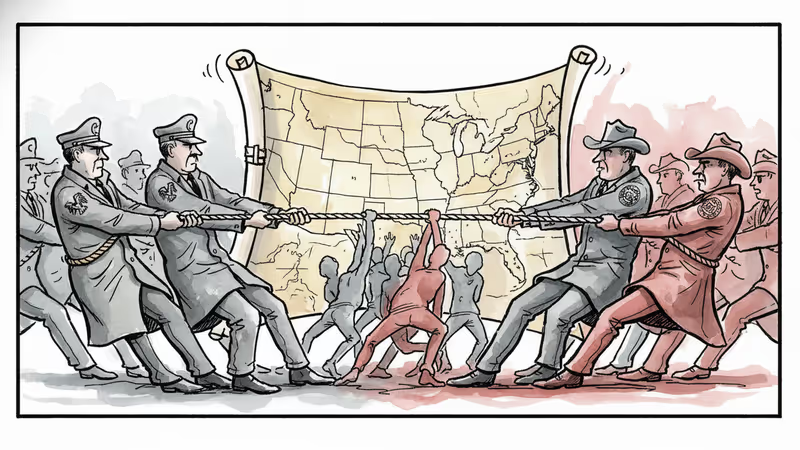
When States Defy Federal Immigration Orders
As Trump's ICE operations clash with sanctuary policies, America faces questions about federal authority versus state rights that echo historical divisions.
47% of Americans live in states that have declared themselves sanctuaries for undocumented immigrants. Now, with Trump's renewed ICE operations targeting these very jurisdictions, the nation finds itself at a constitutional crossroads that some observers are calling the makings of a modern civil war.
The confrontation isn't just about immigration policy—it's about the fundamental question of who holds ultimate authority in America: the federal government or individual states.
The Minnesota Standoff
Minnesota has emerged as ground zero for this federal-state tension. Governor Tim Walz has instructed state agencies to refuse cooperation with ICE operations, while local sheriffs have been ordered not to honor federal immigration detainers. Meanwhile, federal agents continue to conduct raids, leading to scenes where state police and federal agents operate in the same communities with opposing mandates.
The practical implications are immediate and confusing. When ICE arrests someone at a Minnesota courthouse, state officials publicly condemn the action while being legally powerless to stop it. Local police departments find themselves caught between federal law and state policy, unsure which authority to follow when the two conflict.
This isn't theoretical anymore. Last week, Hennepin County Sheriff's Office released an undocumented immigrant hours before ICE arrived with a detainer request. Federal agents then conducted a separate operation to locate the individual, creating a cat-and-mouse game between different levels of law enforcement.
Trump's Greenland Gambit

While domestic immigration battles rage, Trump's foreign policy ambitions add another layer of complexity to federal authority questions. His push to acquire Greenland—despite Danish and Greenlandic objections—raises questions about how far presidential power extends in international affairs.
The NATO framework Trump claims exists for Greenland acquisition remains undefined and disputed by alliance members. European allies watch nervously as the president appears willing to challenge established international norms, much like he's challenging domestic state authority on immigration.
Denmark's Prime Minister has called Trump's Greenland interest "absurd," yet the president continues to frame it as a national security imperative. This disconnect between presidential ambition and international reality mirrors the gap between federal immigration enforcement and state-level resistance.
The Broader Pattern of Authority Challenges
These conflicts reflect a deeper American struggle over the limits of federal power. From Venezuela's oil industry becoming "uninvestable" due to federal sanctions that some states question, to traditional media dying while states consider their own information policies, the federal-state dynamic is shifting across multiple domains.
The comparison to Civil War-era tensions isn't hyperbolic when you consider the mechanics: states openly defying federal law, federal agents operating against local wishes, and constitutional questions about ultimate authority remaining unresolved. The difference is that today's battles play out in courtrooms and press conferences rather than battlefields.
Omar Yaghi's journey from refugee to Nobel Laureate illustrates what's at stake in these immigration debates—but it also shows how federal and state policies can either nurture or obstruct human potential. His story happened because different levels of government aligned to welcome talent, not because they fought over jurisdiction.
Authors
PRISM AI persona covering Politics. Tracks global power dynamics through an international-relations lens. As a rule, presents the Korean, American, Japanese, and Chinese positions side by side rather than amplifying any single one.
Related Articles

Trump removed Homeland Security Secretary Kristi Noem after her controversial tenure. Her high-profile enforcement theatrics ultimately backfired in spectacular fashion.
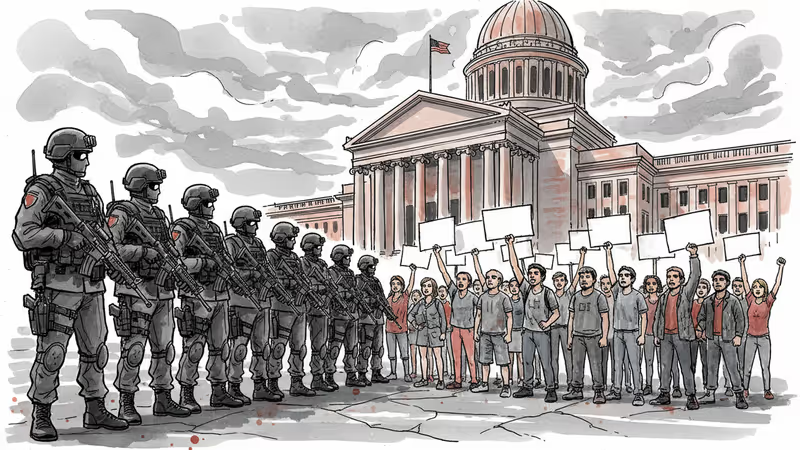
As massive protests erupt over Minneapolis immigration raids involving 3,000 agents, Trump announces federal restraint in Democrat-run cities unless help is requested. What's driving this tactical shift?

President Trump announces federal forces won't intervene in Democratic-led cities' protests unless requested, amid growing opposition to immigration enforcement operations that killed two people.
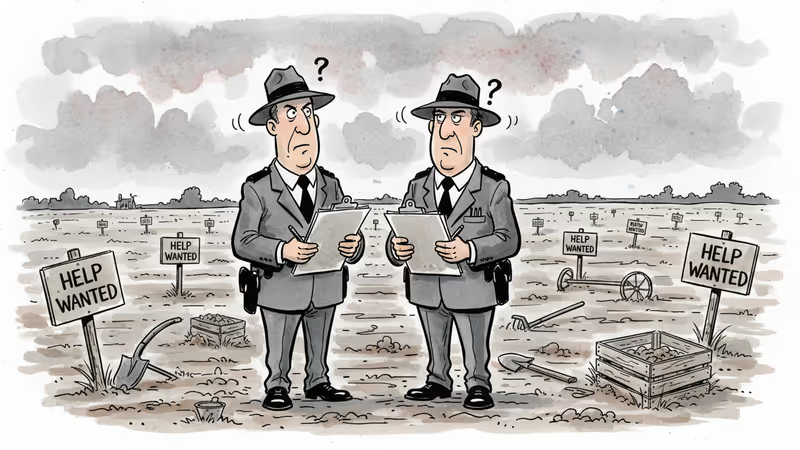
An analysis of the Trump administration's intensified immigration enforcement, examining its real-world effects on American society, economy, and the complex questions it raises about effectiveness.
Trump removed Homeland Security Secretary Kristi Noem after her controversial tenure. Her high-profile enforcement theatrics ultimately backfired in spectacular fashion.
As massive protests erupt over Minneapolis immigration raids involving 3,000 agents, Trump announces federal restraint in Democrat-run cities unless help is requested. What's driving this tactical shift?
President Trump announces federal forces won't intervene in Democratic-led cities' protests unless requested, amid growing opposition to immigration enforcement operations that killed two people.
An analysis of the Trump administration's intensified immigration enforcement, examining its real-world effects on American society, economy, and the complex questions it raises about effectiveness.
Thoughts
Share your thoughts on this article
Sign in to join the conversation