
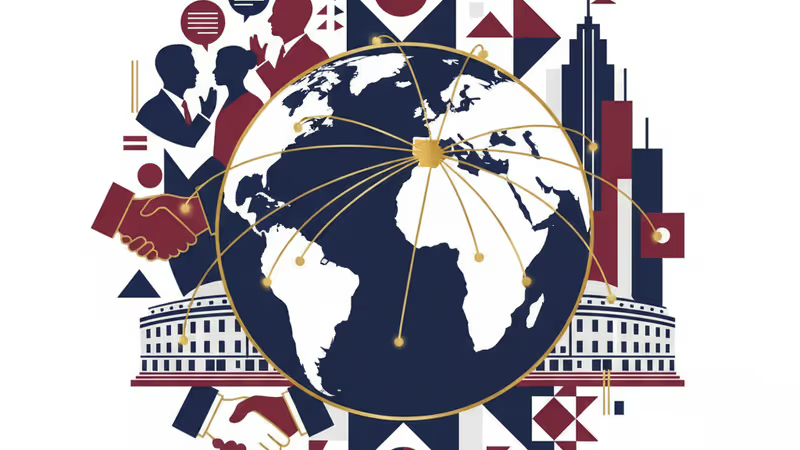
India's Nationalist Pivot: Decoding the Global Impact of Hindutva
An analysis of Hindu nationalism's rise in India under Modi and its global impact on geopolitics, technology, and investment. A PRISM deep dive.
The Lede: Why This Matters to You
India, the world's most populous nation and a critical node in global supply chains and technology, is undergoing a profound ideological transformation. The rise of Hindu nationalism, or Hindutva, is not merely a domestic political shift; it is a fundamental re-engineering of the country's identity. For global executives and investors, understanding this transition is non-negotiable. It impacts everything from market-entry strategies and regulatory risk to data governance and the geopolitical alignment of a rising superpower.
Why It Matters: The Ripple Effect
The consolidation of a Hindu nationalist identity has significant second-order effects beyond India's borders:
- Investment Climate: Proponents argue this creates a strong, decisive government capable of bold economic reforms. However, critics point to heightened social tensions and unpredictable policy shifts, creating a complex risk calculus for foreign capital. Navigating this new political economy is paramount.
- Geopolitical Realignment: A more muscular, self-assured India is changing its foreign policy. It engages differently with China, the United States (via the Quad), and its South Asian neighbors. This recalibrates regional power dynamics and security architectures.
- The Tech Stack: India's digital landscape is a key battleground. The government's push for data sovereignty and clashes with global tech giants over content moderation are direct consequences of this nationalist drive, signaling a potential splintering of the global internet.
The Analysis: From Fringe to Mainstream
A Tale of Two Indias
For decades following its independence in 1947, India was defined by the secular, pluralistic vision of its first Prime Minister, Jawaharlal Nehru. This model sought to manage the country's immense diversity by keeping religion separate from the state. Hindu nationalism, an ideology first articulated in the 1920s that posits India as a fundamentally Hindu nation (or 'Hindutva'), remained a marginal political force.
The ascent of Prime Minister Narendra Modi and the Bharatiya Janata Party (BJP) marked a historic reversal. They successfully mainstreamed Hindutva, framing it as a reclamation of authentic Indian identity and a rejection of a perceived elitist, Western-oriented past. This narrative of a culturally proud, empowered "New India" resonates with a significant portion of the electorate.
Ideology in Action
This ideological shift is not abstract; it has translated into concrete policy. Actions such as the revocation of Article 370's special status for Jammu and Kashmir, the passage of the Citizenship Amendment Act (CAA), and the construction of a grand temple on the disputed Ayodhya site are seen by supporters as correcting historical wrongs and strengthening the nation. Conversely, critics, both domestic and international, view these moves as undermining India's secular constitution and marginalizing its 200-million-strong Muslim minority, raising concerns about social cohesion and democratic backsliding.
PRISM Insight: The Rise of 'Digital Saffron'
The intersection of technology and Hindu nationalism is a critical, often overlooked, trend. The ideology has proven incredibly effective at leveraging social media for political mobilization and narrative control. This has led to direct confrontations between New Delhi and Silicon Valley over issues of free speech, data privacy, and accountability.
For tech investors and firms, this translates into a new operational reality. The push for "Aatmanirbhar Bharat" (Self-Reliant India) is spawning a generation of domestic tech champions, but it also creates pressure for data localization and compliance with stringent, politically-sensitive content takedown orders. The operating environment is no longer a simple extension of Western digital norms; it is uniquely Indian and increasingly assertive.
PRISM's Take: Navigating the New Geo-Cultural Reality
The rise of Hindu nationalism is not a fleeting political wave; it represents a deep, structural change in India's self-perception. The world is no longer dealing with the non-aligned, secular republic of the 20th century. It is engaging with a civilizational state that is confident, religiously and culturally defined, and unapologetic in its pursuit of national interest.
For global strategists, this requires a fundamental mindset shift. Engagement with India must now account for this potent ideological dimension. The challenge lies in partnering with India's undeniable economic and demographic power while navigating the complexities of its evolving national identity. Ignoring this internal transformation is to misread one of the most significant geopolitical stories of the 21st century.
Related Articles

Analysis of how economic warfare, from Russian asset freezes to the struggles of Gaza's tech sector, is shaping a new era of geopolitical conflict.
Analysis of the US fuel efficiency rollback reveals a strategic pivot that strands billions in auto investments and cedes EV leadership to global rivals like China.
Analysis of the new era of hybrid warfare, where economic sanctions, digital sieges, and political unrest are reshaping global conflict and business risk.
The EU's plan to use frozen Russian assets for a $105B Ukraine loan is a major escalation in economic warfare, setting a risky precedent for the global financial system.