

The New Arsenal: How Economic Warfare and Tech Blockades Are Redefining Global Conflict
Analysis of how economic warfare, from Russian asset freezes to the struggles of Gaza's tech sector, is shaping a new era of geopolitical conflict.
The Lede
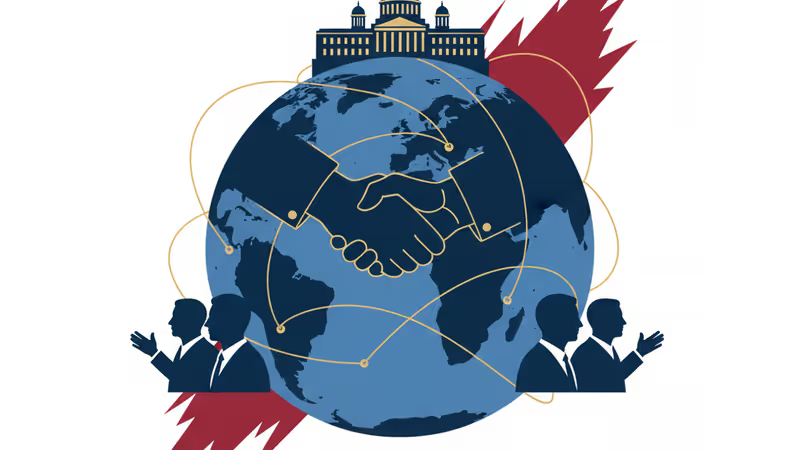
For the modern executive, the frontlines of geopolitical conflict are no longer just on a map; they run through the global financial system and digital infrastructure. While Russia’s conventional war in Ukraine grinds on, the real escalation is happening in boardrooms and data centers. The EU’s plan to leverage frozen Russian assets for a $105 billion Ukrainian defense loan and the crippling of Gaza's tech sector are not isolated events. They are flashpoints in a new era of hybrid containment, where economic leverage and technological disruption have become the primary weapons of statecraft. Understanding this shift is no longer optional—it's critical for navigating sovereign risk, supply chain stability, and future market dynamics.
Why It Matters
The second-order effects of this new battlefield are already reshaping the global landscape:
- Precedent & Financial Destabilization: The move to use profits from frozen Russian assets, which President Putin labels 'robbery', crosses a significant threshold. It shifts from freezing to effective seizure, a precedent that could cause non-Western nations (like China or Gulf states) to reconsider holding vast reserves in euros or dollars, potentially fragmenting the global financial system.
- Human Capital as a Target: The plight of Gaza’s tech workers, struggling with intermittent power and internet, illustrates a devastating new form of collateral damage. It's not just physical infrastructure at risk, but the digital and human capital essential for a 21st-century economy. This cripples a region's future long after the physical conflict subsides.
- Accelerating Tech Nationalism: These conflicts force nations to treat technology infrastructure as a core component of national security. This will accelerate the balkanization of the internet, the onshoring of critical tech manufacturing, and the rise of 'sovereign clouds' and national champions, creating a more complex regulatory and operational environment for multinational corporations.
The Analysis
We are witnessing the evolution from a Cold War of military alliances to a 'Code War' of economic and technological blocs. The EU’s massive financial package for Ukraine is a modern-day Marshall Plan, but funded through financial warfare and aimed at sustaining a defense economy. This represents a strategic pivot for Brussels, moving from a primarily economic union to a significant geopolitical actor capable of wielding immense financial power.
Simultaneously, the weaponization of finance has a clear counter-narrative. Putin’s framing of the EU as ‘robbers’ is designed to resonate with a global audience wary of Western financial dominance. It’s a calculated move to position Russia as a defender against a unilateral order, appealing to nations seeking alternatives to the dollar-centric system.
In the Middle East, the crisis in Gaza serves as a powerful microcosm of this new reality. The inability of a nascent, talented tech workforce to function is a direct consequence of a conflict that has made their digital lifeline a strategic vulnerability. It demonstrates that in modern geopolitics, controlling access to electricity and internet bandwidth can be as effective as a physical blockade in neutralizing an opponent's economic potential.
PRISM Insight
This new paradigm creates both immense risk and distinct opportunity. The investment thesis of the next decade will be built on resilience. We will see a surge in demand for 'conflict-resilient tech'—decentralized energy grids, low-earth orbit satellite internet (like Starlink), and offline-first software solutions that can function in degraded environments. For investors, sovereign risk analysis must now include a 'digital fragility score' that assesses a nation's dependence on foreign-controlled internet gateways, subsea cables, and cloud infrastructure. Nations that invest in digital and energy sovereignty will become the safer bets in an increasingly unstable world.
PRISM's Take
The unwritten rules of global finance and connectivity that have governed the post-Cold War era are being systematically dismantled. The West's use of its financial dominance against Russia, while strategically necessary from its perspective, is forcing a global realignment. The key takeaway for global leaders and strategists is that economic interdependence is no longer a guaranteed peace dividend; it is now a domain of active conflict. Building resilience—financial, technological, and logistical—is not merely a defensive posture but the defining strategic imperative for navigating a world where the flow of capital and data has become the new arsenal of power.
Related Articles
The Houthi detention of UN staff in Yemen is a strategic move, challenging global order and paralyzing humanitarian aid. An analysis of the new geopolitical reality.

Beyond a human rights crisis, allegations of abuse in Israeli prisons are a strategic liability, fueling radicalization and diplomatic isolation. An analysis.

Analysis of the DOJ's Epstein files release. This is a critical test case for digital transparency, government accountability, and the future of information warfare.

ISIS has lost its territory but not its influence. Discover how its decentralized, tech-savvy model poses a new kind of threat to global stability and business.