
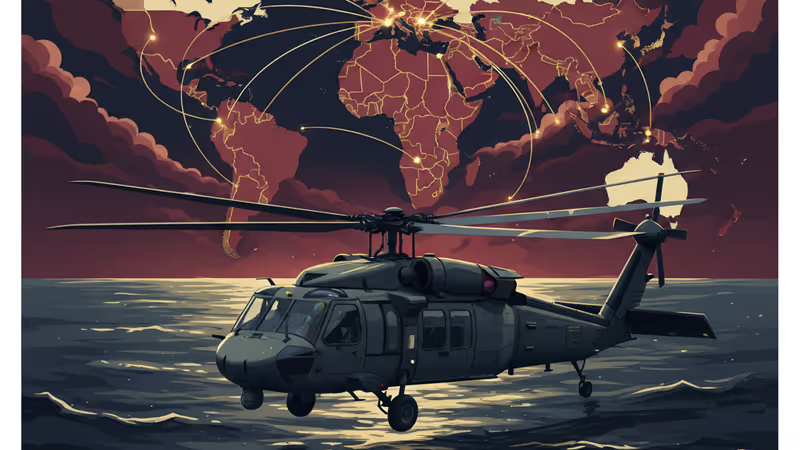
Indian Navy Deploys MH-60R 'Flying Frigates,' But Budget Cuts Hobble Drone Surveillance Plans
The Indian Navy is boosting its combat power with new MH-60R Romeo helicopters but is scaling back plans to acquire MQ-9B Sea Guardian drones due to budget issues.
The Indian Navy's combat aviation power is getting a major boost, but its ambitions for wide-area surveillance are being scaled back. While India recently commissioned a second squadron of advanced Sikorsky MH-60R Romeo helicopters, its plans to acquire a fleet of maritime surveillance drones from the U.S. have been sharply reduced due to budget constraints.
A 'Flying Frigate' Fills a Decades-Old Gap
Last week, the navy announced the commissioning of Indian Naval Air Squadron 335 (INAS 335), nicknamed the "Ospreys," at the INS Hansa naval air base in Goa. This is the second squadron to operate the MH-60R Romeo, following the first unit, INAS 334, based in Kochi. The induction is a major relief, addressing a critical operational shortfall caused by the attrition of its aging Seaking 42B/C fleet. Often called "flying frigates," the MH-60R is equipped for diverse missions, including anti-submarine warfare, anti-surface warfare, and search and rescue.
Eyes in the Sky Grounded by Budget Reality
In sharp contrast to the helicopter fleet's expansion, plans for maritime surveillance assets are facing headwinds. India's initial plan to acquire 22MQ-9B Sea Guardian unmanned aerial systems (UAS) from the U.S. in a deal worth an estimated $2 billion has reportedly been pared down to just 10 drones. The Sea Guardian, with an endurance of 24-36 hours, was expected to be a cornerstone of surveillance over the vast Indian Ocean Region (IOR).
The navy's long-range maritime reconnaissance fleet of Boeing P-8I Poseidon aircraft is facing similar cuts. A plan to expand the fleet from 12 to 28 aircraft has been revised, with the navy now expected to acquire only 8-10 more, capping the total fleet size at 20-22. This is seen as a direct consequence of a declining real capital budget for defense.
Alliance with the U.S. and Burden Sharing
These defense acquisitions are being pursued through the U.S. Department of Defense's Foreign Military Sales (FMS) program. Under FMS, the Pentagon acts as an agent for the buyer, negotiating terms with vendors and providing U.S. government guarantees on price and performance. This procurement model is part of a broader strategic alignment where India is increasingly sharing the cost and operational effort of maintaining maritime security in the IOR alongside partners like the Malabar countries and the AUKUS nations.
This content is AI-generated based on source articles. While we strive for accuracy, errors may occur. We recommend verifying with the original source.
Related Articles

Thailand and Cambodia have resumed border clashes, including drone and rocket attacks, even as the first peace talks begin. The conflict has killed over 40 and displaced a million.
After repeated delays, Taiwan's newly ordered F-16V fighter jets have begun ground tests in the US. This marks a crucial step in bolstering Taiwan's air defense amid rising tensions with China.
South Korea's DAPA has decided on a selective bidding process for its ₩7 trillion ($5B) next-gen destroyer project, aiming to end a stalemate caused by a legal feud between Hanwha Ocean and HD Hyundai.
China's state media has released footage of a PLA war game simulating a fight between its J-16 fighters and the French Rafale, a move seen as a strategic signal to rivals like India.
Thailand and Cambodia have resumed border clashes, including drone and rocket attacks, even as the first peace talks begin. The conflict has killed over 40 and displaced a million.
After repeated delays, Taiwan's newly ordered F-16V fighter jets have begun ground tests in the US. This marks a crucial step in bolstering Taiwan's air defense amid rising tensions with China.
South Korea's DAPA has decided on a selective bidding process for its ₩7 trillion ($5B) next-gen destroyer project, aiming to end a stalemate caused by a legal feud between Hanwha Ocean and HD Hyundai.
China's state media has released footage of a PLA war game simulating a fight between its J-16 fighters and the French Rafale, a move seen as a strategic signal to rivals like India.