

Why India Became ChatGPT's Second-Largest Market
India's 100 million weekly ChatGPT users reveal how AI companies are reshaping global expansion strategies through localized pricing and educational focus.
100 million people use ChatGPT weekly in India. That's more than the entire population of Germany, making India OpenAI's second-largest market after the United States.
CEO Sam Altman revealed this figure ahead of India's government-hosted AI summit, where he'll join executives from Anthropic, Google, and other AI giants. But the number itself isn't the story—it's how OpenAI cracked a market that many Western tech companies still struggle to understand.
The $5 Strategy That Changed Everything
OpenAI's India playbook started with price. The company launched ChatGPT Go, priced under $5, then made it free for a year for Indian users. Compare that to ChatGPT Plus at $20 monthly—a significant expense in a market where the average monthly income hovers around $200.
This wasn't just discounting; it was strategic market entry. While competitors focused on premium segments, OpenAI went wide, betting that volume would eventually drive value. The approach worked: India now represents 12.5% of ChatGPT's 800 million global weekly users.
Google followed suit, offering Indian students free one-year subscriptions to its AI Pro plan. The message was clear: whoever captures India's young, tech-savvy population first wins the long game.
Students Leading the Charge
India has become the world's largest source of student ChatGPT users, according to Altman. This isn't coincidental—it reflects deeper cultural and economic forces.
With 1.4 billion people and over 1 billion internet users, India offers scale. But it's the demographic composition that matters most: half the population is under 25, creating a massive cohort of digital natives hungry for educational tools.
Universities are overwhelmed, with millions competing for limited seats. AI tutors fill the gap, offering personalized learning at zero marginal cost. Students use ChatGPT for everything from exam prep to coding practice, creating usage patterns that would be expensive to replicate through traditional education.

The Monetization Challenge
But here's where the story gets complicated. High usage doesn't automatically translate to high revenue. India's price-sensitive market means even successful products struggle with monetization.
Altman acknowledged this challenge, noting that "translating widespread adoption into sustained economic impact" remains difficult. Free users are great for growth metrics, but investors eventually want returns.
The infrastructure constraints add another layer. While internet penetration is high, data costs and device limitations affect user experience. Many Indians access ChatGPT through mobile apps on budget smartphones, requiring different optimization strategies than Western markets.
Global Implications for AI Competition
India's emergence as an AI powerhouse has geopolitical implications. The country's IndiaAI Mission—a national program expanding computing capacity and supporting startups—signals ambitions beyond being just a user base.
For AI companies, India represents both opportunity and risk. Capture the market, and you gain influence over 1.4 billion people's relationship with AI. Lose it, and competitors gain a massive advantage in the global race.
China's AI companies are notably absent from this competition, blocked by geopolitical tensions. This creates an opening for American firms like OpenAI and Google, but also for European and other international players.
The Democratic AI Question
Altman framed India's role in broader terms: "Given India's size, it also risks forfeiting a vital opportunity to advance democratic AI in emerging markets around the world."
This hints at a larger concern. If AI adoption becomes concentrated in wealthy nations or among elite users within developing countries, the technology could exacerbate global inequality rather than democratize opportunity.
India's massive user base gives it leverage in shaping how AI develops globally. The features, languages, and use cases that work for Indian users influence product roadmaps for billions of others in similar markets.
Authors
Related Articles
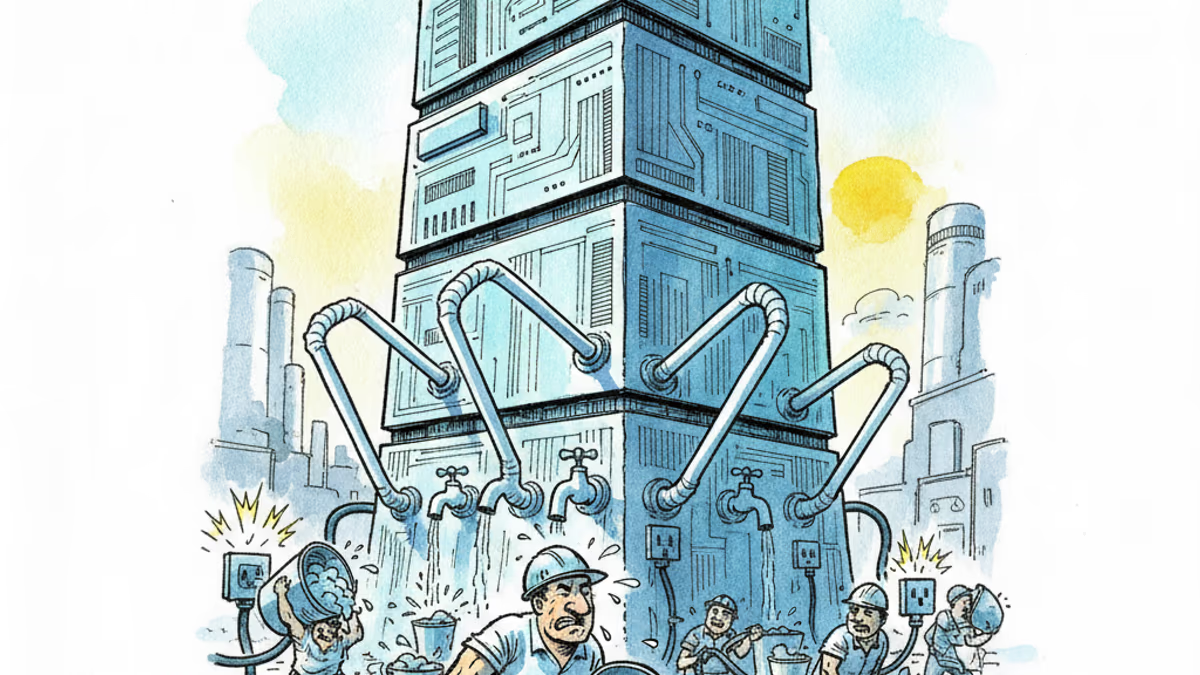
Samsung and SK unveiled a chip and AI investment package worth thousands of trillions of won on June 29. The headline number swings wildly by outlet, but the real contest isn't capital — it's water and power.

SolarSquare is raising $55-60M at a $450-500M valuation, more than doubling its worth in 18 months. Here's what's driving investor conviction in India's residential solar market.

Viral videos show 2026 graduates jeering executives who praise AI at commencement ceremonies. It's not just rudeness — it's a signal about who pays for technological optimism.

Filipino virtual assistants using AI to ghost-manage LinkedIn profiles for executives is now a structured industry. 30 comments a day, fake engagement rings, and a platform struggling to tell real from fabricated.
Samsung and SK unveiled a chip and AI investment package worth thousands of trillions of won on June 29. The headline number swings wildly by outlet, but the real contest isn't capital — it's water and power.
SolarSquare is raising $55-60M at a $450-500M valuation, more than doubling its worth in 18 months. Here's what's driving investor conviction in India's residential solar market.
Viral videos show 2026 graduates jeering executives who praise AI at commencement ceremonies. It's not just rudeness — it's a signal about who pays for technological optimism.
Filipino virtual assistants using AI to ghost-manage LinkedIn profiles for executives is now a structured industry. 30 comments a day, fake engagement rings, and a platform struggling to tell real from fabricated.
Thoughts
Share your thoughts on this article
Sign in to join the conversation