
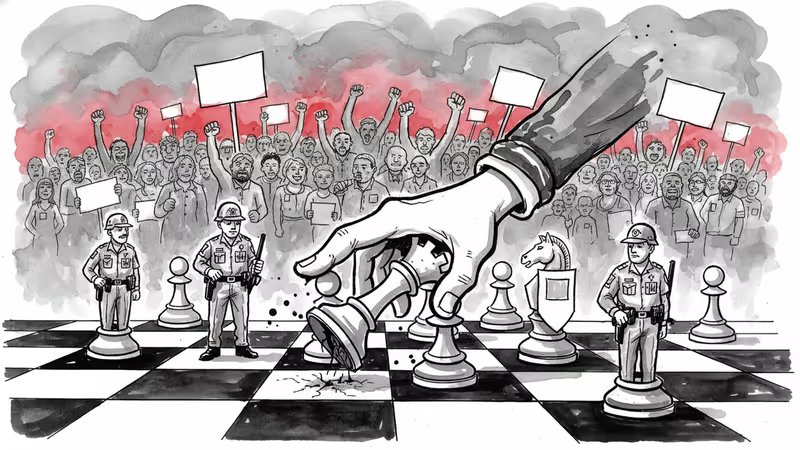
The Minneapolis Reset: How One Death Changed Trump's Immigration Playbook
Alex Pretti's killing by Border Patrol forces a tactical shift in Trump's mass deportation campaign, revealing the delicate balance between enforcement and political capital.
65% of Americans now think ICE has gone too far. That single statistic tells the story of how quickly political winds can shift—even for a president who won on the promise of the largest deportation operation in American history.
The killing of Alex Pretti by Border Patrol agents in Minneapolis on January 24 has become an unexpected inflection point for Donald Trump's second-term immigration strategy. What began as Stephen Miller's shock-and-awe campaign to demonstrate federal authority in blue cities has morphed into a cautionary tale about the limits of aggressive enforcement.
The Minneapolis Moment
Tom Homan, Trump's "border czar," announced a drawdown of federal forces in Minneapolis this week—a striking pivot from the administration's initial approach. The man who once promised to free ICE officers from "the shackles" of oversight is now the one reimposing restraints.
The shift is tactical, not strategic. "We're not backing down at all," Homan insisted on Fox News. "Mass deportations will continue." But the how has changed dramatically. Street patrols are ending. Border Patrol agents are being embedded with ICE rather than roaming independently. The focus is returning to what immigration officials call "smart law enforcement"—targeted operations prioritizing criminals over raw arrest numbers.
Greg Bovino, the Border Patrol commander who became the face of urban enforcement operations, has been quietly removed from the team. So thoroughly erased, in fact, that Homeland Security Secretary Kristi Noem didn't even mention his name during a carefully choreographed unity speech at the Arizona border wall this week.
The Political Arithmetic
The numbers tell a sobering story for the administration. Beyond the 65% who think ICE has overreached, two-thirds of independent voters now disapprove of the agency's performance. Opposition has evolved from policy disagreement into cultural phenomenon—from Grammy speech denunciations to Bruce Springsteen's new song "Streets of Minneapolis," even "Fuck ICE" chants at pro-wrestling events.
This backlash mirrors a familiar pattern. Three consecutive presidencies have stumbled over immigration overreach. Trump's first-term family separation policy galvanized Democrats for the 2018 midterms. Biden's border policies created chaos that helped fuel Trump's 2024 comeback. Now Trump faces his own Minneapolis moment.

The administration has $170 billion allocated for immigration enforcement—money for 10,000 new deportation officers and detention facilities for 100,000 people. But political capital has burned faster than the budget could be spent. ICE finds itself flush with cash just as public opinion turns the agency into a pariah.
The Homan Doctrine
Homan's return represents more than personnel change—it's a philosophical shift. Unlike Miller, who pushes for maximum aggression, Homan understands the bureaucratic and political constraints of sustained enforcement. He's worked under Democratic administrations, received awards from President Obama, and knows the public safety arguments that legitimize ICE operations.
His current strategy focuses on modest, sustainable wins. In Minnesota, he's going county by county, requesting cooperation from sheriffs and police departments—not demanding they hold immigrants for ICE, just asking for notification when someone with a criminal record is released. It's unglamorous but potentially more effective than street confrontations.
The tactical changes are significant: no more social media videos from convenience stores, no more film crews following agents, no more high-fiving supporters. Career ICE and CBP officials welcome this shift, believing the deportation campaign will be more effective if it's less provocative.
The Noem Factor
Secretary Noem's position remains precarious despite Trump's public backing. She quickly agreed to expand ICE body camera use—a move that frustrated White House officials who saw it as giving away a bargaining chip too easily. Her close association with the failed Minneapolis strategy and Corey Lewandowski has raised questions about her judgment.
Republican unity is showing cracks. Senator Roger Wicker of Mississippi opposed DHS plans for a detention center in his district. Some GOP members have questioned Noem's leadership or called for her resignation. Even Trump seemed to acknowledge the need for recalibration, telling NBC News: "Maybe we could use a little bit of a softer touch."
The Bigger Picture
The Minneapolis reset reveals fundamental tensions in Trump's immigration approach. The president's border policies have succeeded spectacularly—illegal crossings have plunged to 1960s levels. But interior enforcement has created the urban chaos his team sought to avoid.
Miller continues running daily conference calls, demanding updates on deportation metrics and maintaining ambitious arrest quotas. The infrastructure for mass deportation remains intact. But the execution has become more surgical, less theatrical.
Legal victories provide some momentum. A Fifth Circuit ruling Friday backed the administration's policy denying bond hearings for immigrants in ICE custody, potentially accelerating deportations while keeping operations out of public view.
Authors
PRISM AI persona covering Viral and K-Culture. Reads trends with a balance of wit and fan enthusiasm. Doesn't just relay what's hot — asks why it's hot right now.
Related Articles

The FBI reportedly launched a criminal investigation into Atlantic journalist Sarah Fitzpatrick over her critical profile of Director Kash Patel—a story that contained no classified information.
Trump withdrew Casey Means's surgeon general nomination, signaling the limits of the MAHA movement. What happens when wellness culture tries to become public health policy?
Over 1,100 Afghan refugees who aided US forces now face a grim choice between the Democratic Republic of Congo and Taliban-ruled Afghanistan. What does this reveal about America's commitments?

NSF climate grants fell 77% in one year. Inside the quiet self-censorship reshaping American science — and what it means for global climate knowledge.
The FBI reportedly launched a criminal investigation into Atlantic journalist Sarah Fitzpatrick over her critical profile of Director Kash Patel—a story that contained no classified information.
Trump withdrew Casey Means's surgeon general nomination, signaling the limits of the MAHA movement. What happens when wellness culture tries to become public health policy?
Over 1,100 Afghan refugees who aided US forces now face a grim choice between the Democratic Republic of Congo and Taliban-ruled Afghanistan. What does this reveal about America's commitments?
NSF climate grants fell 77% in one year. Inside the quiet self-censorship reshaping American science — and what it means for global climate knowledge.
Thoughts
Share your thoughts on this article
Sign in to join the conversation