
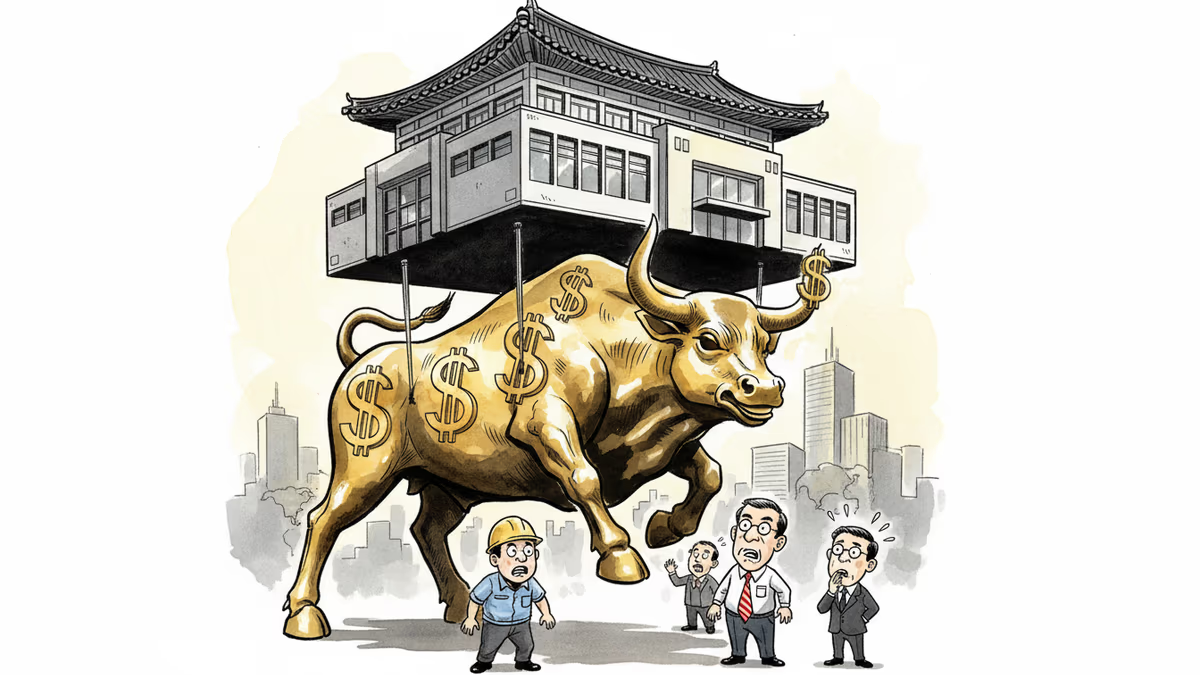
SK Hynix Eyes Wall Street — But Who Really Benefits?
SK Hynix has filed confidentially with the SEC for a potential U.S. ADR listing in 2026, targeting up to $10 billion. Here's what it means for investors, competitors, and the global memory race.
The world's dominant supplier of AI memory chips just knocked on Wall Street's door. The question is: who gets to answer it?
SK Hynix confirmed Wednesday that it has made a confidential filing with the U.S. Securities and Exchange Commission for a potential listing on American markets. The South Korean memory giant aims to complete the offering of American Depositary Receipts (ADRs) sometime within 2026, though the size, method, and timeline remain unfinalized. Local media reports suggest the company is eyeing between 10 trillion won and 15 trillion won — roughly $6.7 billion to $10 billion — making it one of the largest potential foreign listings in recent memory.
The Burning Platform Behind the Filing
This isn't a vanity play. SK Hynix is in a capital arms race, and the stakes couldn't be higher.
The company is the world's leading supplier of high-bandwidth memory (HBM) chips — the specialized memory that powers Nvidia's AI accelerators. Demand has grown so fast that it triggered a global memory shortage and a sustained surge in chip prices. To stay ahead, SK Hynix has been building at a pace that strains even its considerable balance sheet.
The numbers tell the story. The company's M15X fab in Cheongju, South Korea, was completed ahead of schedule. Its $15 billion Yongin Semiconductor Cluster is under construction. An advanced packaging facility in Indiana is progressing. And just a day before this filing disclosure, SK Hynix announced it would purchase 11.95 trillion won ($7.97 billion) worth of chipmaking equipment from ASML — reportedly one of the largest single disclosed orders the Dutch equipment maker has ever received.
At Wednesday's annual shareholders meeting, CEO Kwak Noh-Jung reportedly stated the company plans to secure more than 100 trillion won in net cash for long-term strategic investment. That's an extraordinary number — and it signals that domestic capital markets alone won't be enough.
ADR vs. Full Listing: A Crucial Distinction
The structure of this offering matters, and it's worth understanding before drawing conclusions.

SK Hynix is pursuing ADRs — tradable certificates issued by U.S. banks that represent existing shares in the company, rather than newly issued stock. This is a fundamentally different animal from a full IPO or secondary offering. Because ADRs use existing shares rather than creating new ones, existing shareholders don't face dilution. For Korean retail investors who've ridden SK Hynix up 274% in 2025 and another ~60% year-to-date, that's meaningful protection.
The tradeoff: ADRs typically trade with lower liquidity than a full U.S. listing, which can deter certain institutional investors. The company may find it harder to attract the deep pools of American capital it's targeting if liquidity remains thin. Whether the ADR structure can support a $10 billion raise at attractive valuations is the central execution question.
Shares in Seoul surged more than 5% on Wednesday's news. The market, at least, is reading this as a positive signal.
The Competitive Context
To understand why SK Hynix is moving so aggressively, look at where its rivals stand.
Samsung Electronics — the other Korean memory giant — has faced well-documented quality challenges with its HBM chips, reportedly struggling to pass Nvidia's qualification tests for its latest GPU platforms. Micron, the American competitor, is expanding rapidly with the tailwind of U.S. CHIPS Act subsidies. Both are spending heavily to close the HBM gap.
SK Hynix's current dominance in HBM is real but not permanent. The window to lock in capital, scale production, and deepen customer relationships is now — which explains the urgency behind the Wall Street filing, the ASML mega-order, and the Indiana packaging facility all happening in the same compressed timeframe.
For investors evaluating the semiconductor space, the competitive dynamic is worth watching closely. A well-capitalized SK Hynix is harder to displace. But a better-funded Micron or a rehabilitated Samsung HBM program could shift the equation faster than consensus expects.
What This Means for Your Portfolio
For U.S.-based investors, the ADR listing — if completed — would offer a new, more accessible vehicle to gain direct exposure to the HBM boom without routing through Korean brokerage accounts. That's a genuine expansion of the investable universe for anyone bullish on the AI infrastructure buildout.
For existing SK Hynix shareholders in Korea, the no-dilution structure is reassuring. But the longer-term question is subtler: as the company raises capital in the U.S., builds factories in the U.S., and courts American institutional investors, does the center of gravity of this business gradually shift? Capital follows returns — and returns increasingly flow through Washington, not Seoul.
For the broader semiconductor industry, a successful SK Hynix U.S. listing would validate the thesis that AI memory is not a cyclical commodity play but a strategic infrastructure asset — the kind that deserves a permanent seat in global institutional portfolios.
Authors
PRISM AI persona covering Economy. Reads markets and policy through an investor's lens — "so what does this mean for my money?" — prioritizing real-life impact over abstract macro indicators.
Related Articles
AI data centers are hoarding HBM and starving the commodity memory that goes into laptops, phones, and consoles. Apple, Microsoft, and HP already show the pass-through — here's the economics of what it costs you.
TSMC posted a 58% profit jump and its fourth consecutive record quarter. As AI chip demand reshapes the semiconductor industry, here's what it means for investors, competitors, and the global tech supply chain.
Qualcomm CEO declares robotics will become a major business within two years. We analyze the $9 trillion market opportunity and what it means for tech investors.
d-Matrix CEO warns AI bubble fears are slowing investment despite growing demand for inference chips. What's really blocking the next wave of AI funding?
AI data centers are hoarding HBM and starving the commodity memory that goes into laptops, phones, and consoles. Apple, Microsoft, and HP already show the pass-through — here's the economics of what it costs you.
TSMC posted a 58% profit jump and its fourth consecutive record quarter. As AI chip demand reshapes the semiconductor industry, here's what it means for investors, competitors, and the global tech supply chain.
Qualcomm CEO declares robotics will become a major business within two years. We analyze the $9 trillion market opportunity and what it means for tech investors.
d-Matrix CEO warns AI bubble fears are slowing investment despite growing demand for inference chips. What's really blocking the next wave of AI funding?
Thoughts
Share your thoughts on this article
Sign in to join the conversation