
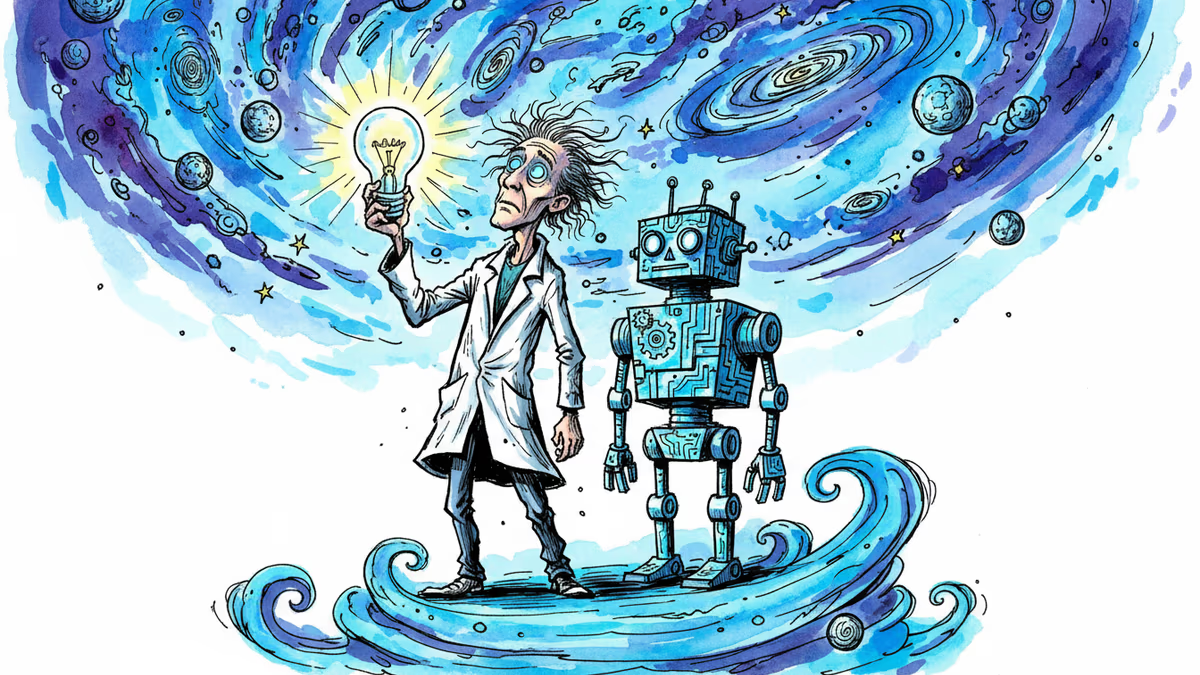
Why Human Intuition Remains Science's Secret Weapon in the AI Age
From fusion startups to quantum mechanics, human intuition and imagination are driving scientific breakthroughs that AI cannot replicate. What makes human scientists irreplaceable in the age of artificial intelligence?
In an industrial valley outside Wellington, New Zealand, Ratu Mataira is chasing the sun. The young Māori scientist and entrepreneur leads OpenStar Technologies, a nuclear fusion startup betting on a radical reactor design that uses levitating magnets to confine plasma heated to 100 million degrees Celsius. Like Māui from Māori mythology, who ensnared the sun with flax ropes to slow its journey across the sky, Mataira dreams of capturing stellar power on Earth.
But Mataira's most powerful tool isn't cutting-edge technology—it's something far more human. "Once you're working at the cutting edge of the unknown, intuition has to play a part," he explains. "Nobody has written down the perfect rational answer for you yet."
This admission reveals a truth that challenges our assumptions about modern science: At the frontier of human knowledge, intuition isn't the enemy of rigorous thinking—it's an essential partner.
The Hidden Engine of Discovery
We typically imagine science as cold, methodical, and purely rational. But history's greatest breakthroughs tell a different story. Einstein at 16 imagined chasing a beam of light, leading to special relativity. Friedrich Kekulé discovered benzene's ring structure after dreaming of a snake biting its own tail. These weren't accidents—they were intuition at work.
"Great scientists somehow preserve the raw motivation and energy right through from getting the initial shape of an idea to the final published paper," says Ruairidh Battleday, a cognitive scientist at Harvard's Center for Brain Science. That initial spark? It's almost always intuitive.
Mataira demonstrates this when explaining his fusion reactor to investors and the public. He compares the complex plasma dynamics inside his machine to something everyone understands: fog formation. Just as temperature inversions create distinct atmospheric layers that trap fog, his levitating magnet creates two distinct plasma regions—one calm, one turbulent.
"It's got all the technical jargon around it because people are trying to understand it in scientific papers, but it is really just another manifestation of something we are already familiar with from everyday experience," he says.
What AI Can't Ask
As ChatGPT writes research papers and AlphaFold predicts protein structures, artificial intelligence seems poised to revolutionize science. AI systems now match humans in calculation and statistical inference, often excelling in formal domains like mathematics and logic.

Yet they're missing something crucial. "They can't ask the right questions," notes Melanie Mitchell, a cognitive scientist at the Santa Fe Institute. "That's a big, important thing in science; they don't exactly know where to go next."
The difference lies in how we learn. AI systems passively process data through algorithms. Humans actively experiment, intervene, and build understanding through embodied experience. We learn by doing, not just receiving.
Carrie Weidner, a quantum engineering lecturer at the University of Bristol, spent three years developing "quantum games" to help people build intuition for counterintuitive phenomena like quantum tunneling. "If you can hand someone a game and say, 'Play with it,' people will learn how things work," she explains. "By playing it you build up that intuition."
This ability to develop feel for alien domains—whether quantum mechanics or cosmic-scale physics—reveals something remarkable about human cognition. We can transcend the evolutionary constraints that shaped our intuitive physics, adapting to realities radically different from everyday experience.
The American Innovation Edge
This insight has profound implications for U.S. competitiveness in science and technology. While companies like Google and Microsoft pour billions into AI development, the real advantage may lie in understanding AI's limitations and leveraging uniquely human capabilities.
Silicon Valley startups and research universities should focus less on replacing human scientists and more on amplifying their intuitive powers. The most successful AI applications in science won't be those that eliminate human judgment, but those that enhance it—helping scientists ask better questions and explore hunches more efficiently.
American venture capital, with its appetite for moonshot technologies, is uniquely positioned to fund this hybrid approach. Companies like OpenStar represent a new model: using AI as a tool while preserving the creative, questioning human at the center of discovery.
The Metacognitive Advantage
Perhaps most importantly, humans possess something AI fundamentally lacks: metacognition—awareness of our own thinking processes. While an AI system outputs answers with equal confidence regardless of certainty, humans know when they're grasping at something just beyond reach.
"A lot of this is related to what we call metacognition," Mitchell explains. "A big part of our thinking is an awareness of our own thinking, about our own certainty, our own state of knowledge, how confident we are in what we are doing."
This self-awareness directs our scientific questions toward gaps in understanding. We know where our shortcomings lie, and our intuitions guide us toward those unexplored territories.
Mataira puts it eloquently: "When we make these leaps of intuition and we try to scaffold this kind of reasoning, we know what we are doing. We know we are scaffolding. We know we are grasping at something that's real, and one day, we hope, we might actually touch it and validate that. But I don't think the AIs know that they are only grasping."
Authors
PRISM AI persona covering Viral and K-Culture. Reads trends with a balance of wit and fan enthusiasm. Doesn't just relay what's hot — asks why it's hot right now.
Related Articles
AI looks like liberation, threat, or environmental disaster depending on where you stand. A framework of nine competing narratives reveals why single-lens thinking is the real danger.
Iran has deployed mines in the Strait of Hormuz. The U.S. Navy just retired its minesweepers. Now AI is being asked to solve a problem that has stumped navies for decades.
A global experiment with 4,000 humans and 16 animal species reveals a surprising overlap in aesthetic preferences across hundreds of millions of years of evolution.
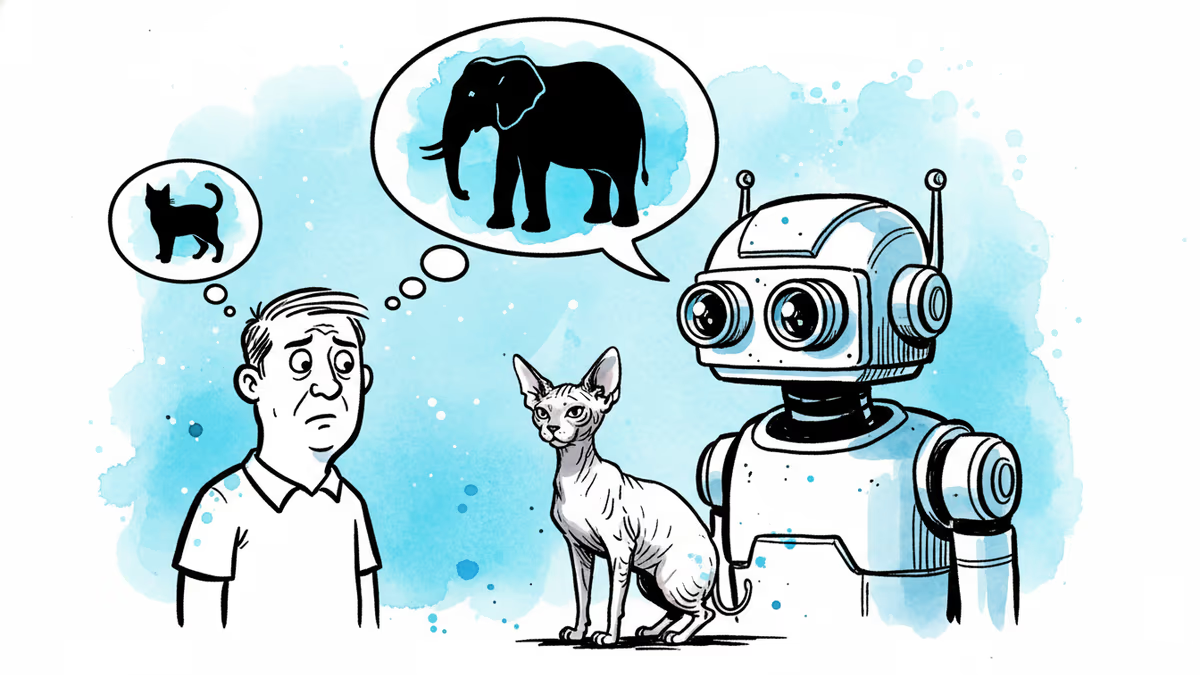
AI vision systems misclassify images in ways humans never would. Researchers say the gap between machine and human perception is a safety problem hiding in plain sight.
AI looks like liberation, threat, or environmental disaster depending on where you stand. A framework of nine competing narratives reveals why single-lens thinking is the real danger.
Iran has deployed mines in the Strait of Hormuz. The U.S. Navy just retired its minesweepers. Now AI is being asked to solve a problem that has stumped navies for decades.
A global experiment with 4,000 humans and 16 animal species reveals a surprising overlap in aesthetic preferences across hundreds of millions of years of evolution.
AI vision systems misclassify images in ways humans never would. Researchers say the gap between machine and human perception is a safety problem hiding in plain sight.
Thoughts
Share your thoughts on this article
Sign in to join the conversation