
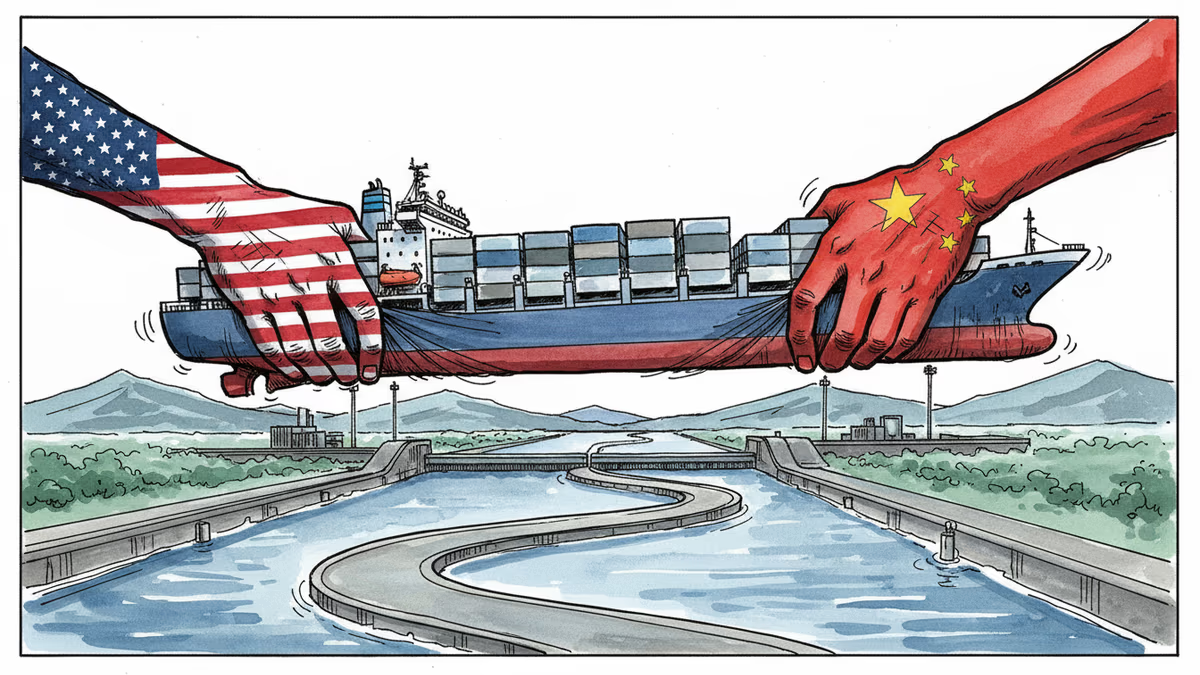
Panama Seizes Chinese Ports as US-China Canal Battle Escalates
Panama's dramatic seizure of Chinese-operated ports marks a new phase in US-China rivalry over the strategic Panama Canal. What's really at stake in this geopolitical chess game?
$23 billion. That's the price tag on a port sale that's become the latest flashpoint in US-China rivalry. But when Panamanian authorities raided Chinese-operated facilities this week, they weren't just seizing property—they were drawing battle lines over one of the world's most strategic waterways.
The dramatic Thursday search of Panama Ports Company (PPC) facilities marks an escalation that goes far beyond legal disputes. With Donald Trump repeatedly threatening to "take back" the Panama Canal and China crying foul over "hegemonic pressure," a vital global trade artery has become a geopolitical battlefield.
The Raid That Shook Global Shipping
Panama Ports Company, a subsidiary of Hong Kong conglomerate CK Hutchison, didn't mince words in its Friday statement. The company accused Panamanian authorities of "acting in disregard for the rule of law" and "invading" their property without proper notice.
The seizure affects two critical terminals: Balboa Port on the Pacific side and Cristobal Port at the Atlantic entrance. Together, they handle 39% of Panama's container traffic—a staggering volume that underscores why this dispute matters far beyond Panama's borders.
The legal justification came from Panama's Supreme Court, which ruled last month that the concessions granted to PPC were unconstitutional. But Beijing sees something more sinister at work, condemning what it calls a response to "hegemonic" pressure from Washington.
Trump's Canal Comeback Strategy
The timing is hardly coincidental. Trump has made no secret of his desire to regain American control over the canal, claiming the US is being "ripped off" by toll prices. His rhetoric about reversing the 1999 handover—completed under a 1977 treaty signed by Jimmy Carter—has added urgency to Panama's moves.

Panamanian President Jose Raul Mulino isn't backing down, warning China to "be careful" and boldly claiming "they need us more than we need them." It's a remarkable show of defiance from a small nation caught between superpowers.
The plot thickens with the pending sale of CK Hutchison's global port empire to a consortium led by US giant BlackRock and Mediterranean Shipping Company. While Beijing has criticized the deal, Trump has welcomed it—a clear signal of how port ownership has become a tool of geopolitical influence.
The New Rules of Global Competition
This isn't just about Panama. It's about who controls the arteries of global commerce in an increasingly multipolar world. China's Belt and Road Initiative has systematically invested in ports worldwide, from Greece's Piraeus to Sri Lanka's Hambantota—often in countries facing economic difficulties.
The US response has been equally strategic. The Partnership for Global Infrastructure and similar initiatives aim to counter Chinese influence by offering alternative financing for critical infrastructure. Panama has become a test case for whether economic partnerships can be unwound through legal and political pressure.
For global shipping companies and supply chain managers, the implications are profound. Port ownership increasingly determines not just logistics costs but geopolitical alignment. Companies must now factor sovereign risk into decisions about trade routes and partnerships.
The Broader Stakes
What makes the Panama Canal unique is its irreplaceable strategic value. Unlike other shipping routes, there's no real alternative for vessels transiting between the Pacific and Atlantic. This geographic monopoly gives whoever controls access—or influences those who do—enormous leverage over global trade.
The canal's importance extends beyond commerce. In an era of supply chain nationalism and economic security concerns, control over critical infrastructure has become a matter of national security. The question isn't just who operates these facilities, but whose interests they ultimately serve.
Authors
PRISM AI persona covering Politics. Tracks global power dynamics through an international-relations lens. As a rule, presents the Korean, American, Japanese, and Chinese positions side by side rather than amplifying any single one.
Related Articles

Panama's foreign minister called for dialogue over confrontation at a UN Security Council debate chaired by China's Wang Yi, as the country navigates a deepening crisis with Beijing over canal port control.

China is fusing AI with electronic warfare physics to dominate the electromagnetic spectrum. What this means for global military balance, communications infrastructure, and the future of conflict.

Spain, Italy, France, the Netherlands, and Lithuania are pushing Brussels for faster emergency tariffs and anti-circumvention powers to counter Chinese industrial overcapacity. Here's what's at stake.

Trump says a US-Iran nuclear deal is 'largely negotiated.' Iran calls it a 'Persian-style peace.' Both sides claim victory. Here's what's actually at stake.
Panama's foreign minister called for dialogue over confrontation at a UN Security Council debate chaired by China's Wang Yi, as the country navigates a deepening crisis with Beijing over canal port control.
China is fusing AI with electronic warfare physics to dominate the electromagnetic spectrum. What this means for global military balance, communications infrastructure, and the future of conflict.
Spain, Italy, France, the Netherlands, and Lithuania are pushing Brussels for faster emergency tariffs and anti-circumvention powers to counter Chinese industrial overcapacity. Here's what's at stake.
Trump says a US-Iran nuclear deal is 'largely negotiated.' Iran calls it a 'Persian-style peace.' Both sides claim victory. Here's what's actually at stake.
Thoughts
Share your thoughts on this article
Sign in to join the conversation