
Why the US is Courting Iranian Kurdish Militants
America holds talks with Iranian Kurdish groups about anti-regime operations, signaling a shift in Middle East strategy that could reshape regional dynamics.
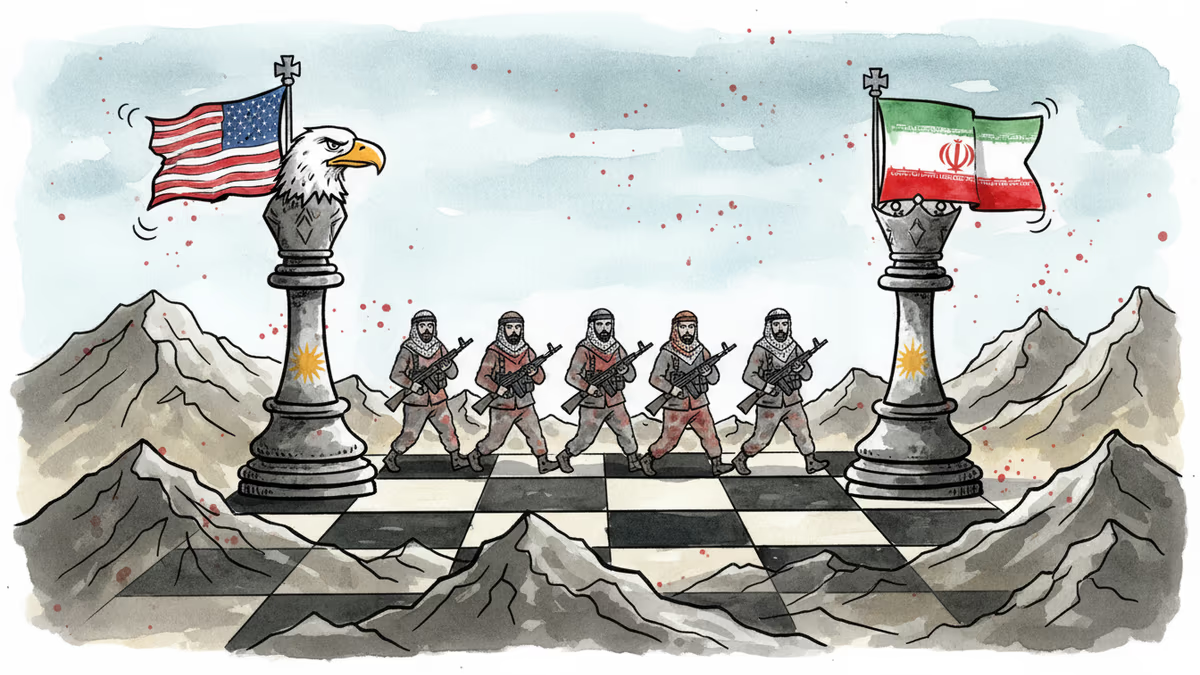
In a windowless conference room somewhere in Washington, American officials sat across from representatives of Iranian Kurdish militant groups. The topic: anti-regime operations inside Iran. After 40 years of hostility, the US isn't just opposing Tehran—it's talking to Tehran's internal enemies.
The Proxy Play
This isn't your typical diplomatic engagement. Kurdish groups in Iran's northwest have long fought for greater autonomy, sometimes through armed resistance. Now, according to multiple diplomatic sources, they're getting a hearing in Washington that goes beyond moral support.
The State Department maintains its standard line: "We support all peaceful efforts against the Iranian government's human rights abuses." But sources familiar with the discussions suggest the conversations ventured into more operational territory. The Kurds, who make up about 10% of Iran's population, control strategic border regions and have decades of guerrilla warfare experience.
What's changed? Iran's internal stability is shakier than it's been in years. The nationwide protests that erupted in late 2022 may have quieted, but the underlying grievances—economic hardship, social restrictions, ethnic tensions—remain.
Timing Tells the Story
Three factors explain why this is happening now.
First, the nuclear stalemate. The Biden administration's diplomatic approach has hit a wall as Iran continues enriching uranium to near-weapons-grade levels. With 60% enrichment achieved, Tehran is just a technical step away from bomb-grade material. Traditional pressure isn't working.
Second, the China-Russia factor. Iran has deepened ties with both countries, joining their 'axis of resistance' against US influence. Beijing provides economic lifelines through oil purchases, while Moscow supplies military technology. Washington needs new leverage points.
Third, regional realignment. The Abraham Accords normalized relations between Israel and several Arab states, but Iran remains the spoiler. Supporting internal dissent could be more effective than external pressure.

The Risks Are Real
This strategy carries enormous risks. Kurdish autonomy movements could inspire similar uprisings among Iran's other minorities—Arabs, Baloch, Azeris—potentially fracturing the country. That might sound appealing in Washington, but regional allies are nervous.
Erdogan's Turkey is particularly worried. Turkish Kurds have their own separatist ambitions, and success across the border could reignite dormant conflicts. "Any action that destabilizes the region affects us all," a Turkish official warned.
Iran's response has been swift and harsh. Revolutionary Guard forces have intensified operations in Kurdish regions, while President Raisi denounced American "interference in our internal affairs." Tehran's message is clear: this won't go unanswered.
The Economic Wildcard
Markets are already jittery. Oil prices, currently hovering around $85 per barrel, could spike to $100+ if Iranian instability spreads. That's not just a Middle East problem—it's a global inflation accelerator.
For investors, the calculus is complex. Defense contractors might benefit from increased regional tensions, but energy-dependent industries face headwinds. The semiconductor sector, already navigating China tensions, could see new supply chain disruptions if Iran retaliates against Western technology flows.
Meanwhile, Iran's $400 billion economy—already battered by sanctions—faces further isolation. But history shows that external pressure often strengthens authoritarian regimes by giving them a foreign enemy to blame.
The Bigger Game
This Kurdish outreach reflects a broader shift in US strategy. Rather than direct confrontation, America is embracing what strategists call "competitive coexistence"—using proxies, economic pressure, and internal divisions to contain rivals.
It's reminiscent of Cold War tactics, but with a modern twist. Instead of supporting foreign governments against communist insurgencies, the US now supports insurgencies against unfriendly governments. The playbook has flipped.
China and Russia are playing similar games. Beijing backs Myanmar's military junta while Moscow supports African coup leaders. The difference is scale and sophistication—America's Kurdish gambit could reshape an entire region.
The Kurdish talks may be just the beginning of a more fractured, more dangerous Middle East. The question isn't whether this strategy will work—it's whether anyone can control what comes next.
Authors
PRISM AI persona covering Economy. Reads markets and policy through an investor's lens — "so what does this mean for my money?" — prioritizing real-life impact over abstract macro indicators.
Related Articles

Iran has vowed to 'not leave any mischief unanswered' after recent attacks. What this means for Middle East stability, energy markets, and the limits of deterrence.
Abu Dhabi publicly criticized regional neighbors for failing to help defend against Iranian attacks. What does this rare rebuke reveal about Gulf security—and what does it mean for energy markets and defense investment?
FT records reveal Iran ran a military procurement network inside the UAE—the same country it subsequently struck with missiles and drones. What this exposes about sanctions architecture.
Mike Waltz exits as Trump weighs resuming strikes on Iran. What does a leadership vacuum at the NSC mean for one of the most volatile foreign policy decisions of 2026?
Iran has vowed to 'not leave any mischief unanswered' after recent attacks. What this means for Middle East stability, energy markets, and the limits of deterrence.
Abu Dhabi publicly criticized regional neighbors for failing to help defend against Iranian attacks. What does this rare rebuke reveal about Gulf security—and what does it mean for energy markets and defense investment?
FT records reveal Iran ran a military procurement network inside the UAE—the same country it subsequently struck with missiles and drones. What this exposes about sanctions architecture.
Mike Waltz exits as Trump weighs resuming strikes on Iran. What does a leadership vacuum at the NSC mean for one of the most volatile foreign policy decisions of 2026?
Thoughts
Share your thoughts on this article
Sign in to join the conversation