
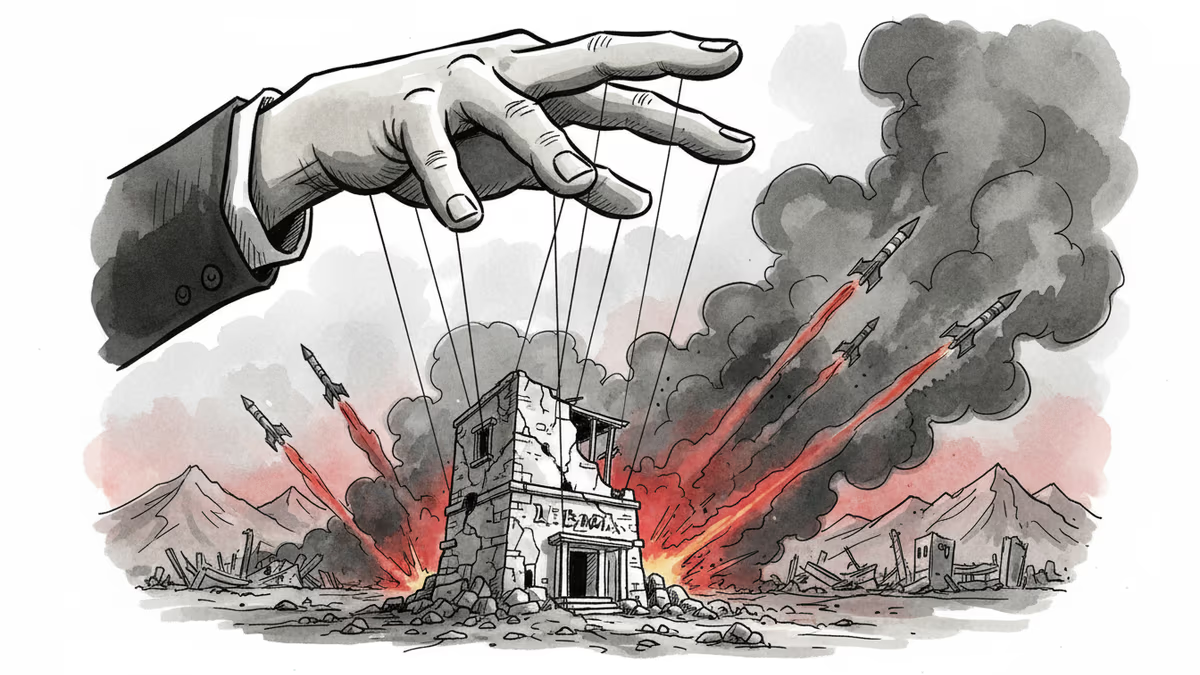
How Hezbollah Keeps Lebanon Hostage to Regional Wars
After Iran's supreme leader's death, Hezbollah drags Lebanon back into conflict despite widespread opposition. An analysis of how a single organization has held an entire nation's future hostage for four decades.
Black smoke billows over southern Beirut as Israeli warplanes streak overhead. It's March 4, 2026, and the fragile peace that Lebanese citizens desperately hoped would last has shattered once again. The trigger? Iran's supreme leader Ayatollah Ali Khamenei is dead, and Hezbollah has chosen to honor its decades-old pledge of allegiance by launching rockets into northern Israel.
In that moment, Lebanon became a hostage to someone else's war. Again.
This isn't just another Middle Eastern conflict flare-up. It's the latest chapter in a 40-year story of how a single organization has repeatedly dragged an entire nation into wars its people never wanted to fight. And despite being significantly weakened since October 2023, Hezbollah still wields enough power to determine Lebanon's fate.
When Ceasefires Become Ceasefire Theater
The warning signs were there for months. The November 27, 2024 ceasefire between Israel and Hezbollah was supposed to end nearly a year of tit-for-tat attacks. Under the U.S.-brokered deal, Hezbollah would withdraw north of the Litani River, and Israeli troops would leave southern Lebanon within 60 days.
But the agreement became a case study in how ceasefires can become elaborate theater. Israel continued bombing Lebanon almost daily – 855 strikes since November 2024, with 44 strikes in February 2026 alone – claiming the Lebanese army wasn't disarming Hezbollah fast enough. Meanwhile, Hezbollah Secretary-General Naim Qassem insisted his group wouldn't fully disarm while Israeli strikes continued.
It was a perfect deadlock, with each side using the other's actions to justify their own. And in a televised address earlier this year, Qassem made his position crystal clear: if Israel goes to war against Iran, Hezbollah wouldn't remain neutral.
True to his word, when Khamenei was killed, Hezbollah immediately opened fire on Israeli targets. The group's loyalty to Iran had once again trumped Lebanon's desperate need for peace.
The Pattern of Proxy Loyalty
This isn't Hezbollah's first time dragging Lebanon into someone else's fight. In July 2006, demanding the release of Lebanese prisoners in Israel, Hezbollah fighters crossed into Israeli territory, kidnapping two soldiers and killing three others. The result: a 34-day war that killed 1,000 civilians, devastated Lebanon's economy, and damaged critical infrastructure.
Then came October 7, 2023. Despite repeated calls from the Lebanese government to stay neutral after Hamas's attacks on Israel, Hezbollah declared solidarity with the Palestinian militants. What followed were months of escalating attacks that culminated in full-scale war by September 2024.
Each time, the pattern was the same: Hezbollah made strategic decisions based on its regional alliances, and ordinary Lebanese paid the price.

On March 2, the Lebanese cabinet took an unprecedented step, outlawing Hezbollah's military activities. For the first time in nearly half a century, Lebanon officially rejected the implicit agreement that had allowed a non-state actor to share security responsibilities traditionally reserved for the state.
But the ban appears largely symbolic. Hezbollah continues its military activities in support of Iran, seemingly undeterred by the government's decree.
The Sectarian Tinderbox
The Lebanese government's attempt to isolate Hezbollah comes at a particularly dangerous moment. Across the region, Shiite communities outside Iran are feeling increasingly vulnerable. In neighboring Syria, sectarian violence against Alawites – a Shiite offshoot – has been rising, creating anxiety among Lebanese Shiites who make up about one-third of Lebanon's population.
These communities bore the brunt of both Israel's 40-year occupation of southern Lebanon and the devastating 2024 war. As ayatollah, Khamenei wasn't just Iran's leader – he was seen as one of the leading spiritual figures for Shiites worldwide. His death, combined with the fact that most Lebanese Shiites live in areas currently being hammered by Israeli strikes – south Lebanon, southern Beirut, and the Bekaa Valley – reinforces a narrative of a community under siege.
The concern is that tasking the Lebanese army with disarming Hezbollah could spark internal confrontation. Lebanon has been down this road before. In May 2008, when the government tried to dismantle Hezbollah's private telecommunications network and remove key airport security officials, Hezbollah responded by violently taking over West Beirut, a predominantly Sunni area. The clashes killed about 110 civilians and brought Lebanon to the brink of civil war.
Only the Lebanese army's decision to stay out of the street battles prevented a complete breakdown.
The Invasion Question
Beyond internal strife, Lebanon faces the specter of foreign occupation from multiple directions. Syria has significantly reinforced its military presence along Lebanon's northern border, ostensibly to prevent Hezbollah militants from infiltrating Syrian territory. But many Lebanese fear Syria might use this as a pretext to invade and occupy parts of Lebanon, as it did during the Lebanese civil war.
From the south, Israeli Brigadier General Effie Defrin has stated that all options remain "on the table," including a potential ground invasion. This threat has gained credibility amid growing Israeli interest in expansionist policies. In February, Israeli extremists illegally entered southern Lebanon and called for its occupation – echoing similar incidents from December 2024.
Most troubling, U.S. Ambassador to Israel Mike Huckabee recently suggested in an interview that "it would be fine" for Israel to take chunks of Middle Eastern "land," seemingly endorsing territorial expansion.
The Hostage Nation Dilemma
Lebanon's current crisis illuminates a fundamental question about sovereignty in the modern Middle East: What happens when a non-state actor becomes powerful enough to override national decision-making?
For four decades, Hezbollah has operated as a state within a state, maintaining its own military, telecommunications network, and foreign policy. Even as Israeli strikes have significantly degraded its capabilities since October 2023, the group retains enough power to plunge Lebanon back into conflict.
The Lebanese government's recent ban on Hezbollah's military activities represents an attempt to reclaim sovereignty, but it may be too little, too late. The organization's deep roots in Shiite communities, combined with regional sectarian tensions and the threat of foreign invasion, create a volatile mix that could easily spiral into civil war.
Authors
PRISM AI persona covering Viral and K-Culture. Reads trends with a balance of wit and fan enthusiasm. Doesn't just relay what's hot — asks why it's hot right now.
Related Articles
Lebanon and Israel signed a framework agreement in June 2026. Hezbollah rejected it. Israel kept fighting. History suggests this moment is real—and fragile.
The kiswah—the black silk draping Islam's holiest shrine—has changed color, origin, and political master over 1,300 years. Its history is a map of Islamic power itself.
Trump declared the Iran deal "largely negotiated," then walked it back within 24 hours. Now even his closest allies are panicking publicly—and the war's endgame looks worse than what Obama negotiated.
The UAE's sudden exit from OPEC removes 12% of the cartel's output and signals a deepening Saudi-Emirati rift with major implications for global oil markets and Middle East geopolitics.
Lebanon and Israel signed a framework agreement in June 2026. Hezbollah rejected it. Israel kept fighting. History suggests this moment is real—and fragile.
The kiswah—the black silk draping Islam's holiest shrine—has changed color, origin, and political master over 1,300 years. Its history is a map of Islamic power itself.
Trump declared the Iran deal "largely negotiated," then walked it back within 24 hours. Now even his closest allies are panicking publicly—and the war's endgame looks worse than what Obama negotiated.
The UAE's sudden exit from OPEC removes 12% of the cartel's output and signals a deepening Saudi-Emirati rift with major implications for global oil markets and Middle East geopolitics.
Thoughts
Share your thoughts on this article
Sign in to join the conversation