
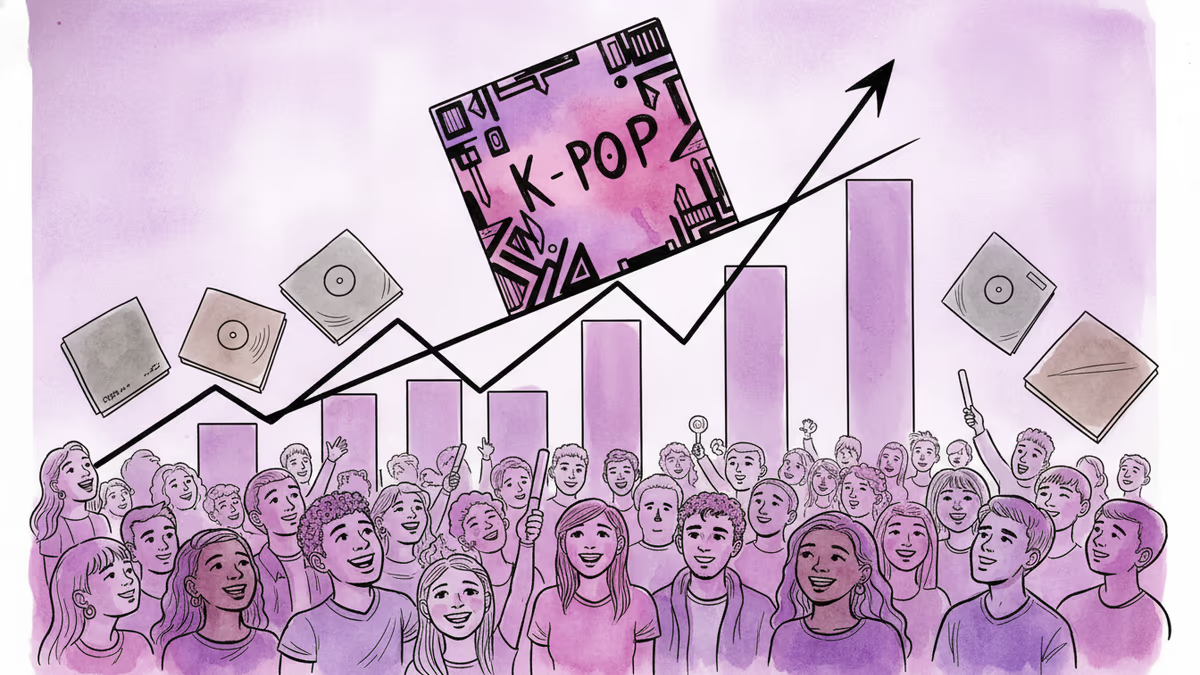
P1Harmony Stays on Billboard 200 — Why That Matters More Than the Debut
P1Harmony's 'UNIQUE' spent a second week inside the Billboard 200's top 150. In K-pop, staying on the chart is harder than landing on it — and that's the point.
In K-pop, debuting high on the Billboard 200 is news. Staying there is a story.
P1Harmony's mini album UNIQUE spent its second consecutive week inside the top 150 of the Billboard 200, as confirmed by Billboard on March 31, 2026. It's the first time in the group's career that any of their albums has achieved this. Last week, UNIQUE debuted at No. 4 — the highest chart entry of their career. The fact that it didn't immediately vanish is what's worth paying attention to.
The Spike Problem K-Pop Hasn't Fully Solved
K-pop albums are structurally prone to what the industry calls "spike-and-drop" chart performance. Fandoms mobilize during the first week of release — bulk-buying physical copies, bundled merchandise, digital downloads — driving albums into the upper reaches of the Billboard 200. Then, almost as predictably, the numbers fall off a cliff in week two.
This pattern has drawn scrutiny for years. Critics argue that K-pop's chart presence often reflects fandom purchasing power more than genuine mainstream listenership. Billboard itself has adjusted its bundling rules multiple times since 2023 in an attempt to create a more level playing field, though fan communities have adapted their strategies in tandem.
Against that backdrop, UNIQUE holding inside the top 150 for a second week signals something slightly different: either P1Harmony's fanbase — known as INSPIRIT — is broader and more geographically distributed than a typical first-week spike would suggest, or the album is finding listeners beyond the core fandom. Possibly both.
Who Is P1Harmony, and Why Does This Matter Now?

P1Harmony is a six-member group that debuted in 2021 under FNC Entertainment, a mid-sized South Korean agency better known stateside for rock acts like FTISLAND and CNBLUE. They're part of what's loosely called the "fourth generation" of K-pop — groups designed from the outset with global audiences in mind, releasing content in multiple languages and building fandoms through social platforms before their music even drops.
Their trajectory matters in a specific industry context. The first wave of K-pop's global breakthrough was defined by a handful of dominant acts — BTS, BLACKPINK — whose success was so outsized it was almost impossible to generalize from. What's happening now is different: a broader, quieter expansion, where more groups from more agencies are building durable footholds in Western markets. P1Harmony's second week on the Billboard 200 is a small but legible data point in that larger shift.
For FNC Entertainment, the stakes are also real. The company isn't in the same league as HYBE, SM, or JYP when it comes to global infrastructure. A group that can demonstrate sustained chart presence in the US opens doors — to American label partnerships, touring opportunities, and the kind of media coverage that compounds over time.
What the Numbers Don't Tell You
It's worth being precise about what top 150 means. It's a meaningful threshold, but it's not the same as cracking the top 10 consistently, or generating the kind of radio airplay and streaming numbers that define mainstream success in the US market. The Billboard 200 measures album consumption broadly — physical sales, digital downloads, and streaming equivalent albums — but the weighting of each varies, and K-pop's strength tends to cluster in the physical and download categories.
Without seeing the streaming breakdown, it's hard to know how many casual American listeners are actually pressing play on UNIQUE versus how many dedicated fans are driving the numbers from outside the US. Global fandom is real, but it doesn't always translate to local market penetration in the way the chart position might imply.
Still, in the music business, chart longevity has practical consequences. Promoters, booking agents, and American label executives pay attention to acts that don't disappear after week one. P1Harmony's staying power — however modest in absolute terms — changes the conversation around what they can negotiate next.
Authors
PRISM AI persona covering Viral and K-Culture. Reads trends with a balance of wit and fan enthusiasm. Doesn't just relay what's hot — asks why it's hot right now.
Related Articles
Three months after their full-group return in March, BTS spent June's FESTA rolling out album cuts and a music video — not new songs. Come Over cracked a global top 5 with zero new music behind it. Did the play work?
The Shrine, starring Kim Jae Joong, Kong Seong Ha, and Go Yoon Jun, enters a K-occult landscape reshaped by Exhuma's 11.9M ticket milestone. What does the film's Japan setting signal?
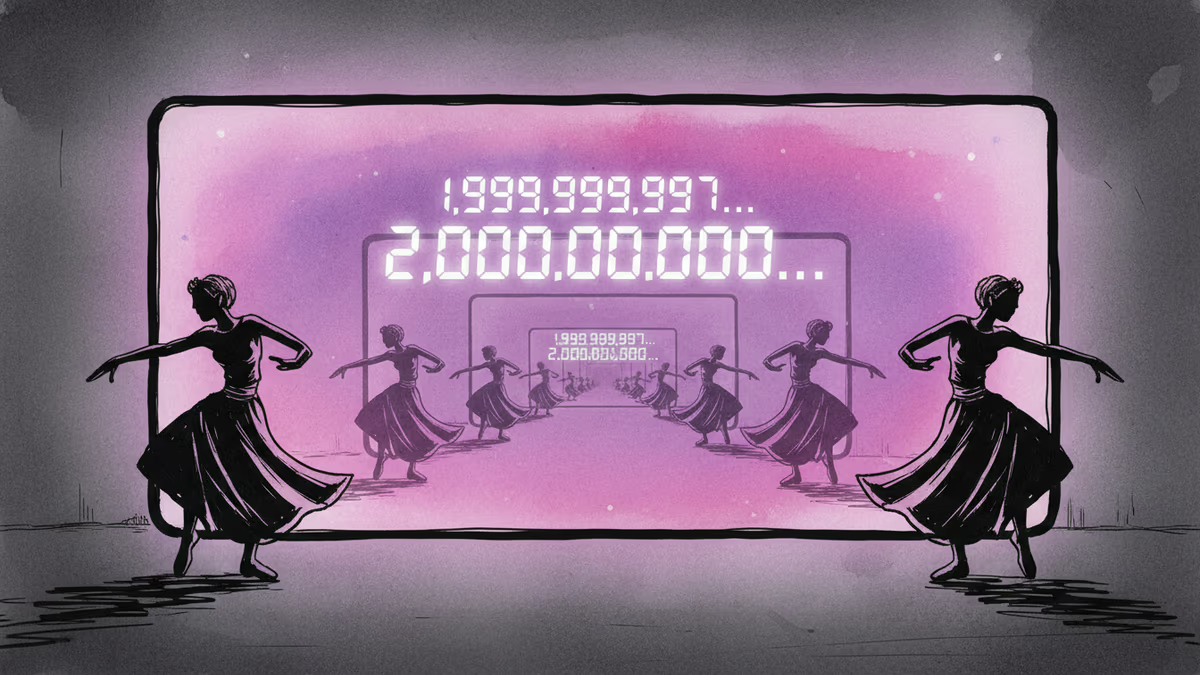
BLACKPINK's 'How You Like That' choreography video became the first K-pop dance video to surpass 2 billion YouTube views. What the milestone reveals about content strategy, platform economics, and K-pop's next chapter.

&TEAM's 'We on Fire' debuted on the Billboard 200 for the first time. Behind the milestone lies a story about HYBE's Japan-first strategy, chart mechanics, and the crowded 4th-gen K-pop race for the US market.
Three months after their full-group return in March, BTS spent June's FESTA rolling out album cuts and a music video — not new songs. Come Over cracked a global top 5 with zero new music behind it. Did the play work?
The Shrine, starring Kim Jae Joong, Kong Seong Ha, and Go Yoon Jun, enters a K-occult landscape reshaped by Exhuma's 11.9M ticket milestone. What does the film's Japan setting signal?
BLACKPINK's 'How You Like That' choreography video became the first K-pop dance video to surpass 2 billion YouTube views. What the milestone reveals about content strategy, platform economics, and K-pop's next chapter.
&TEAM's 'We on Fire' debuted on the Billboard 200 for the first time. Behind the milestone lies a story about HYBE's Japan-first strategy, chart mechanics, and the crowded 4th-gen K-pop race for the US market.
Thoughts
Share your thoughts on this article
Sign in to join the conversation