
Chinese Battery Factory Global Expansion 2026: The Rise of Reverse Tech Transfer
Explore the global expansion of Chinese battery giants in 2026, from local pushback in Hungary to the strategic pivot toward Energy Storage Systems (ESS) and the new era of reverse tech transfer.
The era of "Made in China" being synonymous with cheap labor is over. Today, it stands for high-tech dominance in the global energy transition. Major players like CATL, BYD, and Gotion are building factories on nearly every continent. A recent study identified 68 facilities that have been built or announced by Chinese firms outside their home turf over the past decade, signaling a new phase of manufacturing prowess.
Chinese Battery Factory Global Expansion 2026: Challenges in Hungary
Hungary has emerged as the primary gateway for Chinese firms into the European market. The country hosts at least four plants currently under construction, including an $8.5 billion mega-factory. However, this expansion hasn't been without friction. Local communities are raising alarms over environmental footprints and labor practices. For instance, when CATL laid off more than 100 employees last summer, it sparked investigations into whether they fulfilled promises to prioritize local hiring.
Environmental concerns are equally heated. Protests regarding groundwater pollution—a legacy issue from earlier Japanese and Korean investments—have intensified. In October, a Hungarian court even ordered a Samsung plant to suspend production. As Chinese firms announce plants in drought-prone regions, they find themselves at the center of a national debate over natural resources.

Pivot to Energy Storage Amid Sluggish EV Demand
Not every deal has crossed the finish line. At least five investments have been paused or canceled as EV adoption in Western markets proves slower than in China. Geopolitical shifts, such as policy changes under the Inflation Reduction Act (IRA), have forced companies to recalibrate. The new backup plan? Energy Storage Systems (ESS). Ford and Envision AESC are both shifting focus toward grid-level battery storage, which remains less politicized and highly in demand across both Democratic and Republican states.
The Irony of Reverse Technology Transfer
For decades, Western automakers traded tech secrets for access to China's market. Now, the tables have turned. Ford CEO Jim Farley recently noted that competing globally now requires access to Chinese IP. This sentiment was echoed by French President Emmanuel Macron, who welcomed Chinese investment provided it includes technology transfer. The world is no longer just buying Chinese batteries; it's desperate to learn how to make them.
Authors
Related Articles
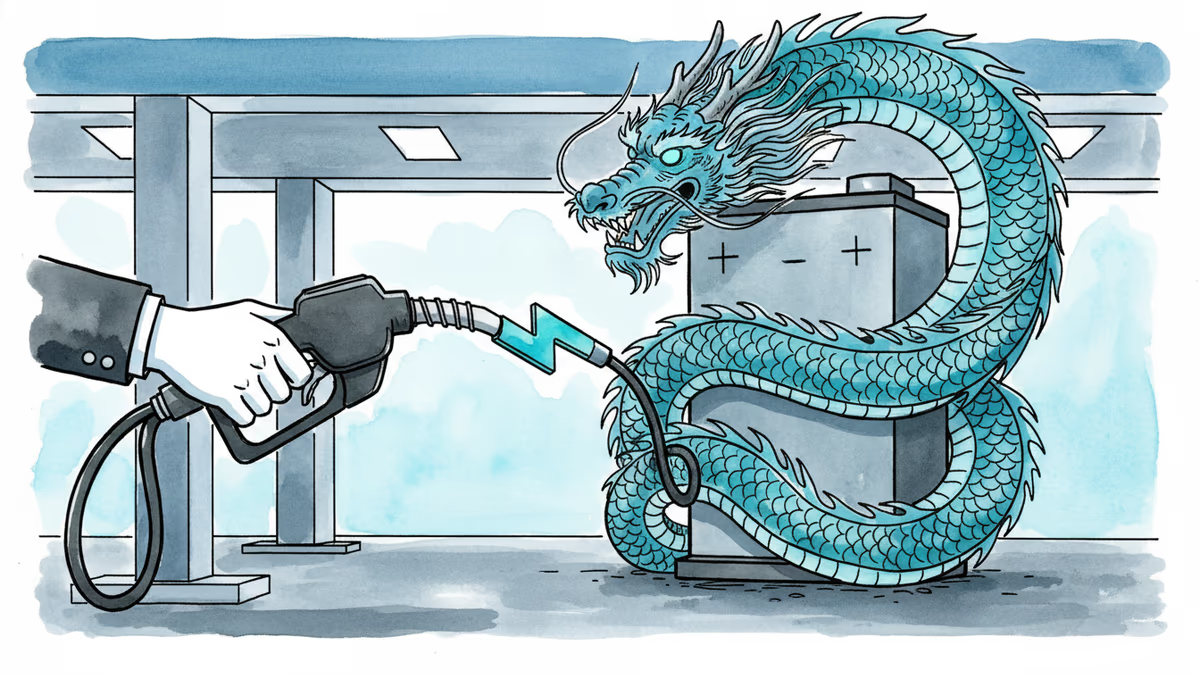
CATL's third-gen Shenxing LFP battery claims charging speeds nearly 5x faster than Hyundai or Porsche's best 800V systems. Here's what that really means.
BYD has officially surpassed Tesla as the world's leading EV seller. Explore the growth of the Chinese brand and what it means for the future of the EV market.
China's new-car sales hit a record 34.4 million in 2025. Discover how BYD, Xiaomi, and Leapmotor are reshaping the global EV landscape as imports hit 16-year lows.
LG Energy Solution CEO Kim Dong-myung announces a bold AI transformation 2030 plan to boost productivity by 30% and secure a competitive edge in the EV and ESS markets.
CATL's third-gen Shenxing LFP battery claims charging speeds nearly 5x faster than Hyundai or Porsche's best 800V systems. Here's what that really means.
BYD has officially surpassed Tesla as the world's leading EV seller. Explore the growth of the Chinese brand and what it means for the future of the EV market.
China's new-car sales hit a record 34.4 million in 2025. Discover how BYD, Xiaomi, and Leapmotor are reshaping the global EV landscape as imports hit 16-year lows.
LG Energy Solution CEO Kim Dong-myung announces a bold AI transformation 2030 plan to boost productivity by 30% and secure a competitive edge in the EV and ESS markets.
Thoughts
Share your thoughts on this article
Sign in to join the conversation