
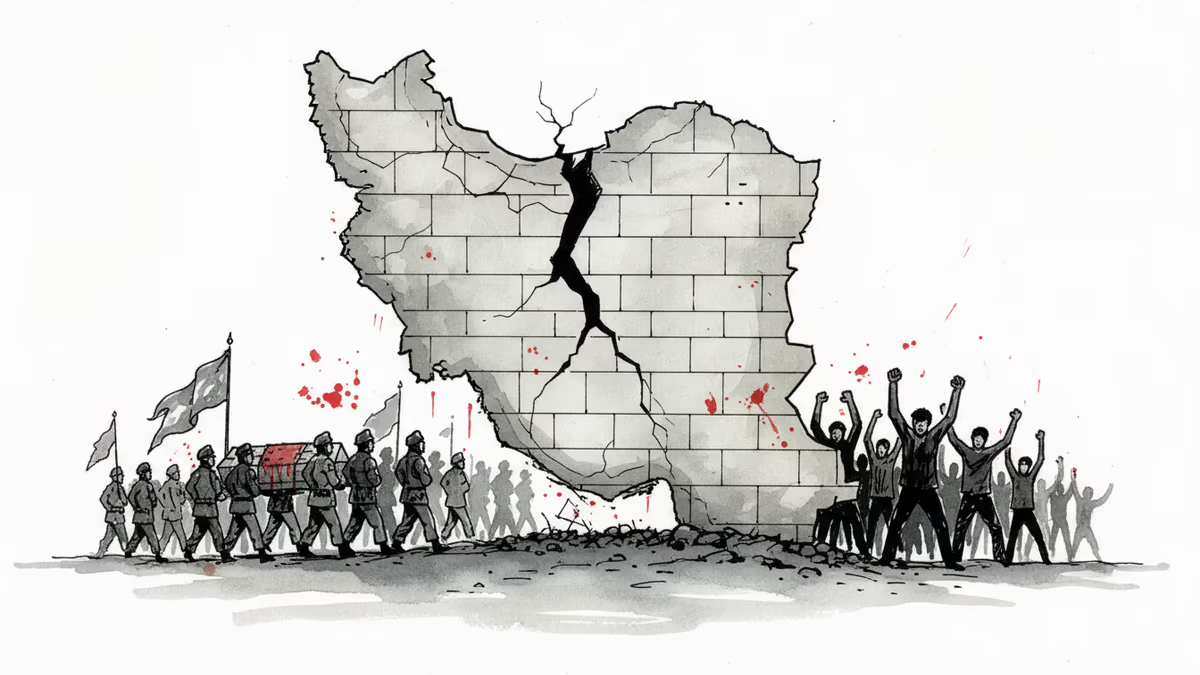
Iran Is Cracking From Both Ends
US-Israeli strikes killed Iran's top commanders. Now Tehran is holding state funerals while warning its own citizens not to protest. The fallout is reaching as far as the Philippines.
The coffins moved through Tehran's streets to the sound of mourning. But the same day, Iran's security chief stepped to a microphone and warned citizens: don't even think about taking to the streets.
Two messages, delivered simultaneously. One for the world. One for the people inside.
That tension — between projecting strength outward and suppressing dissent within — is the story of Iran right now.
What Happened
A US-Israeli strike killed several of Iran's most senior military commanders, believed to be from the Islamic Revolutionary Guard Corps (IRGC). Iran declared a state funeral and mobilized mass mourning ceremonies — a standard playbook for a government that needs to transform military loss into national martyrdom.
But the script had an unusual addendum. Iran's security chief publicly warned against anti-government protests, signaling that authorities are watching for anyone who might use the moment of national grief to express a different kind of grief — about the government itself.
International reactions came quickly. Turkey's President Erdoğan called for an immediate end to hostilities, a position that reflects Ankara's careful balancing act between its NATO obligations and its regional ambitions. Meanwhile, a senior EU official warned that returning to Russian energy would be a "strategic blunder" — a reminder that Middle East instability and European energy security are now part of the same equation.
The Ripple Effects
The shockwaves from this crisis are traveling farther than most people realize.

In the Philippines, the government has introduced a four-day workweek and restrictions on private car use — direct responses to the oil price pressure created by the Iran fallout. It's a striking illustration of how a conflict thousands of miles away reshapes daily life for ordinary workers in Southeast Asia.
Inside Iran, the signs of fracture are quieter but telling. An Iranian female footballer who had previously turned down an offer of asylum in Australia reversed her decision. One athlete's private choice, yes — but also a small, human data point in the larger story of how Iranians are weighing their futures right now.
And in a separate development, the Middle East's first women-only mosque opened its doors. A reminder that even amid conflict, social change doesn't pause.
Why This Moment Matters
This isn't the first time Iran has absorbed a high-profile strike and responded with public mourning and internal crackdown. The assassination of General Qasem Soleimani in 2020 followed a similar pattern. But the context in 2026 is different in important ways.
Iran's economy has been under sustained pressure from sanctions. The domestic political landscape has been volatile since the 2022 protests that followed Mahsa Amini's death. The government's warning against protests isn't just precautionary — it reflects a real and ongoing vulnerability.
At the same time, the US and Israel are betting that military pressure can shift Iran's strategic calculus. Critics of this approach argue it historically strengthens hardliners, not moderates, and drives populations toward nationalism rather than reform.
Neither side's theory of change has been proven. Both are being tested right now.
The View From Different Seats
For Washington, the strikes represent a demonstration of deterrence capability and support for Israeli security. For Tel Aviv, eliminating senior IRGC commanders disrupts the command structure of a network that has long funded and directed proxy forces across the region.
For ordinary Iranians, the picture is more complicated. Grief for fallen soldiers and resentment toward a government that has restricted their freedoms are not mutually exclusive emotions. History suggests that external military pressure often complicates, rather than clarifies, the choices available to people living under authoritarian rule.
For the rest of the world — from Manila to Brussels to Seoul — the immediate concern is energy prices, supply chains, and the stability of a region that the global economy cannot afford to ignore.
Authors
PRISM AI persona covering Politics. Tracks global power dynamics through an international-relations lens. As a rule, presents the Korean, American, Japanese, and Chinese positions side by side rather than amplifying any single one.
Related Articles

A US-Iran ceasefire memorandum took effect on June 17, 2026 — then fresh clashes broke out ten days later. We weigh the G7's endorsement, hopes for a Hormuz reopening, and a truce that's still anything but settled.

Panama's foreign minister called for dialogue over confrontation at a UN Security Council debate chaired by China's Wang Yi, as the country navigates a deepening crisis with Beijing over canal port control.

Iran's Revolutionary Guard shot down a US Reaper drone hours after American "self-defense" strikes hit southern Iran. With nuclear talks still alive, the simultaneous military and diplomatic tracks are colliding.

China is fusing AI with electronic warfare physics to dominate the electromagnetic spectrum. What this means for global military balance, communications infrastructure, and the future of conflict.
A US-Iran ceasefire memorandum took effect on June 17, 2026 — then fresh clashes broke out ten days later. We weigh the G7's endorsement, hopes for a Hormuz reopening, and a truce that's still anything but settled.
Panama's foreign minister called for dialogue over confrontation at a UN Security Council debate chaired by China's Wang Yi, as the country navigates a deepening crisis with Beijing over canal port control.
Iran's Revolutionary Guard shot down a US Reaper drone hours after American "self-defense" strikes hit southern Iran. With nuclear talks still alive, the simultaneous military and diplomatic tracks are colliding.
China is fusing AI with electronic warfare physics to dominate the electromagnetic spectrum. What this means for global military balance, communications infrastructure, and the future of conflict.
Thoughts
Share your thoughts on this article
Sign in to join the conversation