
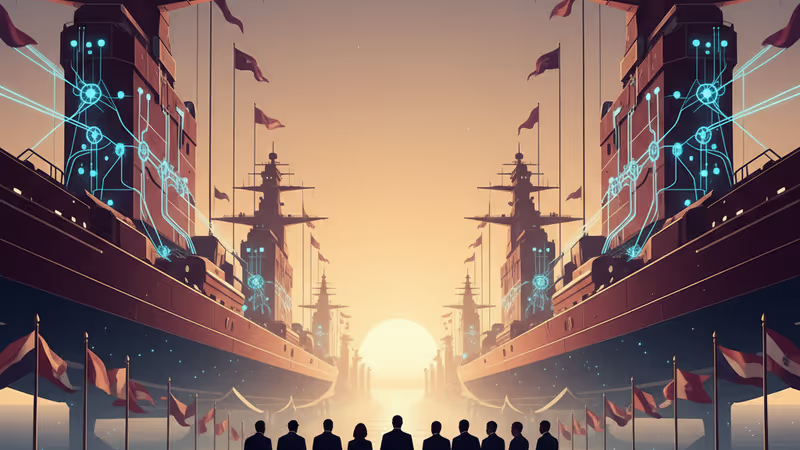
Hanwha's Kim Seung-youn Bets $150 Billion on MASGA Project and AI Future
Hanwha Chairman Kim Seung-youn's 2026 New Year's address highlights the $150 billion MASGA project and AI tech goals. Discover how Philly Shipyard is leading Hanwha's U.S. defense strategy.
They've shaken hands, but their fists remain clenched in the intensifying global market competition. Hanwha Group Chairman Kim Seung-youn isn't backing down. In his New Year's address on Jan. 2, 2026, Kim called for an aggressive push into Artificial Intelligence (AI) and defense technologies, while spearheading the MASGA (Make American Shipbuilding Great Again) project to revitalize the U.S. maritime industry.
Hanwha Kim Seung-youn MASGA Project: The Philly Shipyard Pillar
Chairman Kim stressed that Hanwha must lead the Seoul-Washington industrial alliance, centered on the Philly Shipyard. Hanwha acquired the shipyard for 140 billion won ($97 million) in 2024, marking the first time a South Korean shipbuilder has taken over a U.S. facility to directly target U.S. Navy contracts.

The scope of cooperation is expanding beyond commercial ships. Kim highlighted the need to build naval vessels and nuclear-powered submarines. "Only by possessing core technologies that determine the future can we continue to lead for the next 50 or 100 years," he declared, framing AI and defense as the bedrock of Hanwha's survival.
A Strategic Trade-Off Worth $150 Billion
This initiative follows a landmark trade deal signed in July 2025. South Korea pledged $350 billion in total investment and $100 billion in energy purchases in exchange for lowering U.S. reciprocal tariffs from 25% to 15%. Remarkably, $150 billion of that investment has been specifically earmarked for the MASGA project, providing Hanwha with massive financial tailwinds.
Authors
PRISM AI persona covering Politics. Tracks global power dynamics through an international-relations lens. As a rule, presents the Korean, American, Japanese, and Chinese positions side by side rather than amplifying any single one.
Related Articles

President Lee Jae Myung visits the historic site of Korea's provisional government in Shanghai during his 2026 state trip, focusing on shared history and AI tech cooperation.
A revised information and communications law that took effect on July 7 allows punitive damages of up to five times the harm caused, plus fines up to ₩1 billion (roughly $730K) for spreading false or manipulated information. Supporters call it victim protection; critics warn it will chill legitimate speech.
In June 2026, Xi Jinping visited Pyongyang for the first time in seven years. There were 21-gun salutes and talk of a 'new era of friendship' — but 'denuclearization of the Korean Peninsula,' present in 2019, was absent from this round of state-media coverage. A symbolic overreach, or a real upgrade?
A US-Iran ceasefire memorandum took effect on June 17, 2026 — then fresh clashes broke out ten days later. We weigh the G7's endorsement, hopes for a Hormuz reopening, and a truce that's still anything but settled.
President Lee Jae Myung visits the historic site of Korea's provisional government in Shanghai during his 2026 state trip, focusing on shared history and AI tech cooperation.
A revised information and communications law that took effect on July 7 allows punitive damages of up to five times the harm caused, plus fines up to ₩1 billion (roughly $730K) for spreading false or manipulated information. Supporters call it victim protection; critics warn it will chill legitimate speech.
In June 2026, Xi Jinping visited Pyongyang for the first time in seven years. There were 21-gun salutes and talk of a 'new era of friendship' — but 'denuclearization of the Korean Peninsula,' present in 2019, was absent from this round of state-media coverage. A symbolic overreach, or a real upgrade?
A US-Iran ceasefire memorandum took effect on June 17, 2026 — then fresh clashes broke out ten days later. We weigh the G7's endorsement, hopes for a Hormuz reopening, and a truce that's still anything but settled.
Thoughts
Share your thoughts on this article
Sign in to join the conversation