
GPS Took 10 Extra Years. The Bill Doubled. It's Still Not Done.
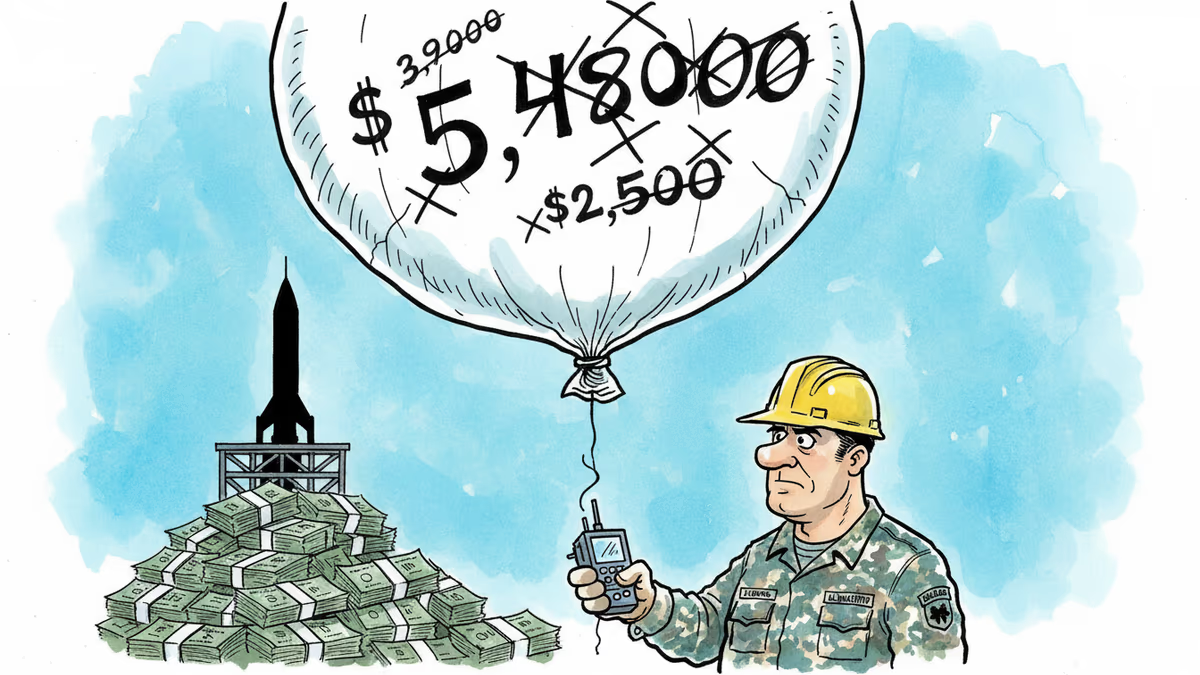
The US GPS ground control system OCX cost $8 billion—more than double its original budget—and arrived a decade late. What does that tell us about how defense software gets built?
$3.7 billion. Done by 2016. Simple enough promise.
Fifteen years later, the US military's GPS ground control system has cost $8 billion, arrived a decade late, and still isn't fully finished. Last July 4th weekend—perhaps hoping no one was paying close attention—the US Space Force quietly accepted ownership of the long-delayed GPS Next-Generation Operational Control System, known as OCX.
This is either a story about one troubled program finally crossing the finish line. Or it's a story about a system that never really had a finish line to begin with.
What OCX Actually Is—And Why It Matters
GPS isn't just for getting directions. It underpins global aviation, financial transactions, shipping logistics, autonomous vehicles, and military precision targeting. The constellation of 30+ GPS satellites orbiting Earth needs a sophisticated ground-based command-and-control system to keep it running. That's OCX.
Specifically, OCX was designed to support the newest generation of GPS satellites—GPS III—which began launching in 2018. These satellites carry upgraded capabilities: new civilian and military signals, and critically, stronger resistance to jamming. Without a matching ground system, those capabilities sit dormant in orbit, essentially unused.
RTX Corporation (formerly Raytheon) won the Pentagon contract in 2010 to build it. The original price tag: $3.7 billion. The original deadline: 2016. Today's official tally: $7.6 billion for the core system, with an additional OCX augmentation package exceeding $400 million to support the next batch of satellites—GPS IIIF—set to begin launching in 2027. Total program cost: north of $8 billion.
For context, that's roughly the annual GDP of a small nation, spent on software and ground stations that most people will never see.
The Three Reasons This Keeps Happening

Cost overruns in defense software aren't news. The Government Accountability Office (GAO) flags dozens of programs exceeding their original budgets by 25% or more every single year. What's worth examining is why the pattern persists with such reliability.
First, there's what procurement experts call the winner's curse. Defense contracts are competitive bids. Companies that win tend to be the ones that submitted the most optimistic timelines and the lowest initial costs—not necessarily the most realistic ones. Once the contract is signed, the real negotiation begins.
Second, requirements instability. Cybersecurity standards for OCX were continuously elevated throughout development—reasonably so, given that a compromised GPS control system would be a catastrophic national security event. But every new requirement costs time and money, and the original contract price didn't account for threats that didn't yet exist in 2010.
Third, lock-in. Once RTX was embedded as the primary contractor on a program this complex, replacing them mid-development would have cost more than continuing. The Pentagon was effectively negotiating from a position of dependency.
The Stakeholders See Very Different Things
For taxpayers, this is straightforward: a program that cost twice what was promised and took twice as long. The opportunity cost—what else $4+ billion in overruns could have funded—is a legitimate grievance.
For defense contractors, the picture is more nuanced. RTX would argue that the program's complexity genuinely expanded, that cybersecurity requirements weren't knowable in 2010, and that delivering a functioning system—however late and expensive—is ultimately what was required. They're not entirely wrong.
For the Space Force and Pentagon, OCX's completion is genuinely important. GPS III satellites have been orbiting for seven years with their full capabilities partially inaccessible because the ground system wasn't ready. That gap has real operational consequences.
For allied militaries and civilian industries that depend on GPS—including aviation authorities, shipping companies, and financial institutions worldwide—the quiet acceptance of OCX is a stabilizing signal, even if the journey to get there was anything but.
The Uncomfortable Pattern
The GPS IIIF augmentation contract—that additional $400 million—is worth watching closely. It follows the same structural logic as the original OCX program: a new generation of satellites, a new round of ground system development, a new contract with RTX. The question isn't whether this augmentation will face its own delays and cost pressures. History suggests it will. The question is whether the contracting framework has changed enough to produce a different outcome.
Some reformers argue for modular, iterative software development—the approach used in commercial tech, where systems are built in smaller increments with frequent delivery checkpoints rather than massive multi-year monolithic contracts. The Air Force and Space Force have experimented with this model in other programs. Whether it can be applied to something as security-sensitive as GPS command-and-control remains an open question.
Authors
Related Articles

The US Space Force has transferred yet another GPS satellite launch from ULA to SpaceX — the fourth such move in just over a year. What this pattern reveals about the future of military space launches.

Japan's Air Self-Defense Force is adopting VR flight simulators from Kanematsu as part of a national defense spending increase, signaling a shift to next-gen pilot training technology.

Rocket Lab's launch for the Space Force signals a shift beyond CubeSats. Our analysis explores how new 'DiskSat' designs could reshape the space economy.
The US Space Force and NASA just launched DiskSats, a radical new flat satellite design. PRISM analyzes how this could upend launch economics and the space industry.
The US Space Force has transferred yet another GPS satellite launch from ULA to SpaceX — the fourth such move in just over a year. What this pattern reveals about the future of military space launches.
Japan's Air Self-Defense Force is adopting VR flight simulators from Kanematsu as part of a national defense spending increase, signaling a shift to next-gen pilot training technology.
Rocket Lab's launch for the Space Force signals a shift beyond CubeSats. Our analysis explores how new 'DiskSat' designs could reshape the space economy.
The US Space Force and NASA just launched DiskSats, a radical new flat satellite design. PRISM analyzes how this could upend launch economics and the space industry.
Thoughts
Share your thoughts on this article
Sign in to join the conversation