
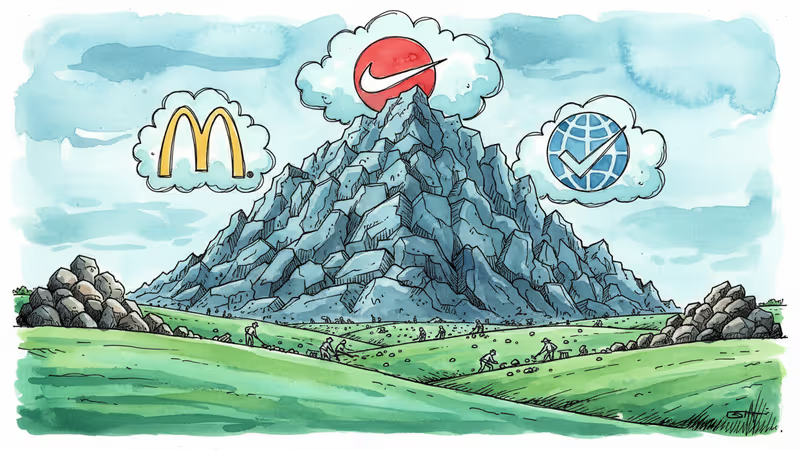
Google and Microsoft-Backed Terradot Swallows Carbon Rival
Terradot acquires competitor Eion as big investors demand scale in carbon removal. The consolidation reveals what really matters in climate tech: size, not just innovation.
"We were simply too small." That's how Eion CEO Anastasia Pavlovic Hans explained why her carbon removal startup is being acquired by Terradot, a competitor backed by Google and Microsoft. The deal, announced today, reveals a harsh reality in the climate tech world: innovation isn't enough if you can't deliver at scale.
Both companies use the same approach—spreading pulverized rocks on farm fields to absorb carbon dioxide from the atmosphere. It's called enhanced rock weathering (EWR), and it essentially speeds up a natural geological process that normally takes millennia. The technology has promise as a low-cost carbon removal method, but there's a catch: it requires massive, distributed operations across thousands of acres.
The Scale Problem
The numbers tell the story. California-based Terradot operates primarily in Brazil, working with basalt rock, while Eion focused on the U.S. market using olivine. Despite their different geographies and mineral choices, both companies faced the same fundamental challenge: the gap between what they wanted to charge and what buyers were willing to pay remained stubbornly wide, according to a survey by CDR.fyi.
This pricing gap isn't just about technology—it's about economics of scale. Large buyers, particularly sovereign wealth funds, want to purchase carbon credits in billion-dollar chunks. They don't want to manage relationships with dozens of small suppliers; they want one-stop shopping with companies that can guarantee consistent, large-scale delivery.
Terradot's investor roster reads like a who's who of major players: Gigascale Capital, Google, Kleiner Perkins, and Microsoft. Eion's backers—AgFunder, Mercator Partners, and Overture—while respectable, simply don't have the same firepower to fuel rapid scaling.
What This Means for Carbon Markets

This acquisition signals a broader shift in the carbon removal industry. The early days of scrappy startups competing on pure innovation are giving way to a more mature market where operational scale and financial backing matter as much as technological prowess.
For buyers, this consolidation could be good news. Larger, better-funded companies can offer more predictable pricing and delivery schedules. They can also invest in the infrastructure needed to monitor and verify carbon removal at scale—a crucial factor for corporate buyers who need to defend their climate commitments to stakeholders.
But there's a flip side. As the industry consolidates around a few well-funded players, will we lose the diversity of approaches that drives innovation? Terradot and Eion used different minerals in different regions, potentially learning valuable lessons about local conditions and optimal rock types. Will that experimentation continue under one roof?
The Bigger Picture
This deal reflects a broader trend in climate tech: the gap between venture-scale funding and the massive capital requirements of climate solutions. Unlike software startups that can scale with relatively modest investment, climate tech often requires billions in infrastructure before generating meaningful revenue.
The enhanced rock weathering market exemplifies this challenge. While the science is promising, success requires coordinating with thousands of farmers, managing complex supply chains for different rock types, and building monitoring systems across vast geographic areas. It's more like building a railroad than launching an app.
Authors
Related Articles
A Canadian startup claims it can prevent wildfires by stopping lightning strikes before they happen. But should we be playing god with nature's electrical storms?
Sony and Microsoft are pulling back from multi-platform strategies, signaling a return to console exclusives. What this means for gamers and the industry.
Microsoft's Project Silica stores data in glass at 1MB per cubic millimeter, potentially lasting centuries. What does this mean for our digital future?
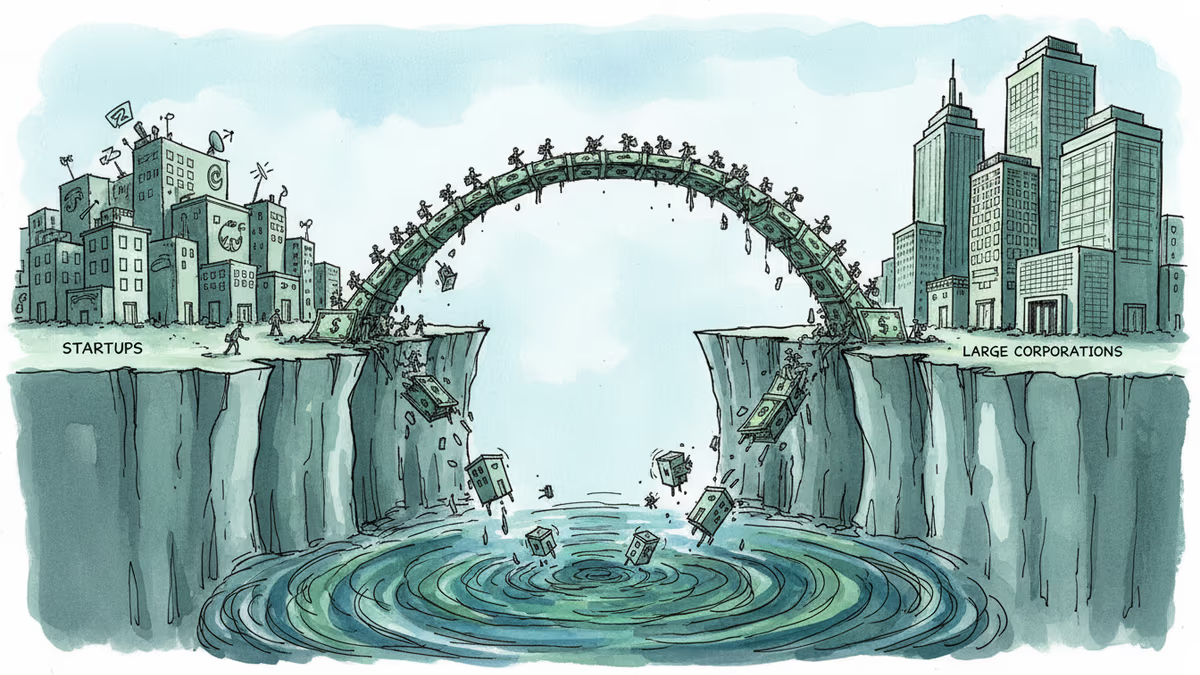
A new investment model aims to solve the chicken-and-egg problem killing climate tech materials startups by connecting guaranteed customers with scaling funding.
A Canadian startup claims it can prevent wildfires by stopping lightning strikes before they happen. But should we be playing god with nature's electrical storms?
Sony and Microsoft are pulling back from multi-platform strategies, signaling a return to console exclusives. What this means for gamers and the industry.
Microsoft's Project Silica stores data in glass at 1MB per cubic millimeter, potentially lasting centuries. What does this mean for our digital future?
A new investment model aims to solve the chicken-and-egg problem killing climate tech materials startups by connecting guaranteed customers with scaling funding.
Thoughts
Share your thoughts on this article
Sign in to join the conversation