
Google Home Finally Gets Button Support After Years of User Requests
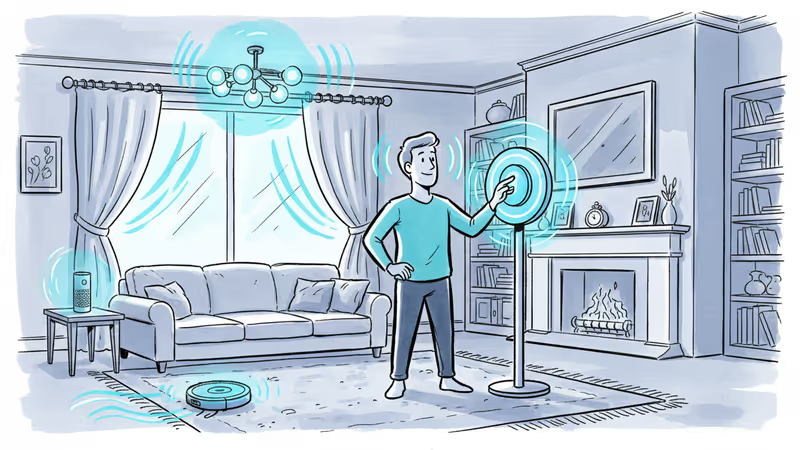
Google Home now supports physical buttons for smart home automation, allowing users to control multiple devices without voice commands. The long-awaited feature puts Google on par with Amazon Alexa and Samsung SmartThings.
How many times have you wanted to control your smart home but couldn't be bothered to say "Hey Google"? Google Home has finally answered that call with button support, ending what many users considered a glaring omission in the platform's capabilities.
The Power of Physical Control
The February 2nd update introduces "Switch or button pressed" as a new automation trigger, allowing users to control multiple smart devices with a single press. Whether it's an Ikea Bilresa remote or any compatible smart button, users can now trigger complex scenes—turning off lights, closing shades, starting the robot vacuum, or running a "Good Night" routine—without uttering a word.
This isn't just about convenience; it's about accessibility and context. Voice control fails in noisy environments, during phone calls, when you're sick, or when you simply don't want to wake sleeping family members. Physical buttons provide a reliable alternative that works regardless of ambient conditions or personal circumstances.
Better Late Than Never
Amazon Alexa and Samsung SmartThings have supported smart buttons for years, making Google's delay particularly noticeable to smart home enthusiasts. The company's reluctance to embrace physical controls seemed at odds with user feedback and market demand. This update suggests Google is finally listening to its community rather than pushing a voice-only agenda.

For developers and device manufacturers, this opens new possibilities. Smart button makers like Flic, Switchmate, and furniture companies like Ikea can now fully integrate their products into Google's ecosystem, potentially driving innovation in smart home interfaces.
The Broader Smart Home Evolution
This development reflects a maturing understanding of how people actually live with smart home technology. The initial promise was that voice control would replace all physical interfaces, but reality proved more nuanced. Different situations call for different interaction methods—voice for hands-free moments, apps for detailed control, and now buttons for quick, silent actions.
The timing is also significant. As smart homes become mainstream, accessibility and ease of use matter more than technological sophistication. Elderly users, guests unfamiliar with voice commands, and households with diverse tech comfort levels all benefit from intuitive physical controls.
Market Implications
For Google, this move helps level the playing field with competitors while potentially expanding their user base. Smart button manufacturers now have another major platform to target, which could drive down prices and increase innovation. The real winners, however, are consumers who gain more flexibility in how they interact with their connected homes.
The update also signals Google's recognition that the smart home isn't a monolithic experience. Different users have different needs, preferences, and living situations. A one-size-fits-all approach—even one as elegant as voice control—simply doesn't work for everyone.
Authors
Related Articles

The Heatbit Maxi Pro heats your room, filters your air, and mines bitcoin simultaneously. At $1,499, it's an ingenious idea with a brutal payback math. Here's the full breakdown.
Nosh One is an AI kitchen appliance that cooks autonomously—load ingredients, pick a recipe, walk away. But does automating the kitchen solve a problem, or create new ones?

Bose releases official API documentation for SoundTouch speakers ahead of their February 2026 EoL. This move allows open-source developers to keep the hardware functional.

Ugreen debuts the SynCare smart home security line at CES 2026, featuring 4K indoor and outdoor cameras with multimodal AI. Launching 2H 2026.
The Heatbit Maxi Pro heats your room, filters your air, and mines bitcoin simultaneously. At $1,499, it's an ingenious idea with a brutal payback math. Here's the full breakdown.
Nosh One is an AI kitchen appliance that cooks autonomously—load ingredients, pick a recipe, walk away. But does automating the kitchen solve a problem, or create new ones?
Bose releases official API documentation for SoundTouch speakers ahead of their February 2026 EoL. This move allows open-source developers to keep the hardware functional.
Ugreen debuts the SynCare smart home security line at CES 2026, featuring 4K indoor and outdoor cameras with multimodal AI. Launching 2H 2026.
Thoughts
Share your thoughts on this article
Sign in to join the conversation