
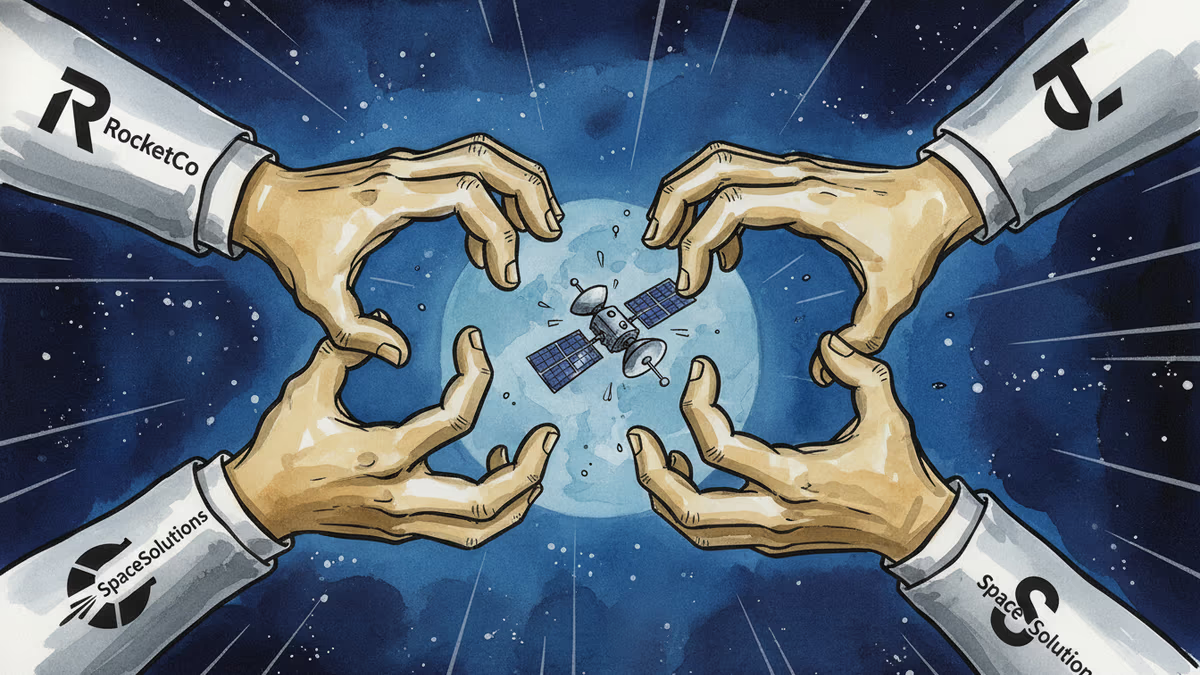
Amazon Wants to Buy a Satellite Company. Apple Already Owns Part of It.
Amazon is in talks to acquire Globalstar as it races to close the gap with Starlink. But there's a catch: Apple owns 20% of the target. What happens when Big Tech's rivalries collide in orbit?
SpaceX's Starlink has 10,000+ satellites in orbit and 9 million users. Amazon has roughly 200. When you're that far behind, you don't just build your way out — you buy.
What's Actually Happening
The Financial Times reported Wednesday that Amazon is in active talks to acquire Globalstar, a satellite communications company. Negotiations have been going on for some time, but the deal hasn't closed yet because of structural complexities. Globalstar shares surged more than 15% in after-hours trading on the news. Amazon declined to comment; Globalstar didn't respond.
The strategic logic is straightforward. Amazon is building Project Leo, its low Earth orbit internet service, with commercial launch targeted for later this year. The long-term plan calls for a constellation of roughly 7,700 satellites — but Amazon has only launched about 200 since last April. In January, the company asked the FCC for an extension on a deadline requiring it to have approximately 1,600 satellites in orbit by July 2026. It's behind schedule, and Starlink isn't waiting.
Acquiring Globalstar would give Amazon existing satellite infrastructure, spectrum licenses, and ground station networks — assets that take years and billions of dollars to build from scratch.
The Complication Nobody's Talking About Enough
Here's where it gets interesting. Globalstar isn't a clean acquisition target.

In 2024, Apple invested $1.5 billion into Globalstar in exchange for a 20% stake. The purpose: to underpin the satellite emergency SOS feature on iPhones — a capability Apple has been quietly expanding across its device lineup. That means Globalstar's network is already deeply embedded in Apple's consumer infrastructure.
If Amazon buys Globalstar, it effectively controls a piece of hardware that millions of Apple users depend on in life-or-death situations. That's not just a business complication — it's the kind of arrangement that draws regulatory scrutiny and requires renegotiated contracts. The FT cited this Apple stake as one of the key complexities holding up the deal.
And there's another wrinkle: Bloomberg reported last October that Globalstar had already held early-stage talks with SpaceX about a potential sale. So the same company has been courted by Amazon, SpaceX, and is partly owned by Apple. At this point, Globalstar isn't just a satellite operator — it's a geopolitical asset in the commercial space race.
Who Wins, Who Watches Nervously
For Amazon investors, a successful acquisition would signal that Leo is a real competitive threat to Starlink, not just a long-term science project. But the premium Amazon would need to pay — especially with Apple's stake complicating the structure — could be substantial.
For consumers, more competition in satellite internet is generally good news. Starlink's residential plan runs $120/month in the US. A credible second player with Amazon's distribution muscle and Prime ecosystem could push prices down over time.
For Apple, the outcome is more ambiguous. Losing control of a key infrastructure partner to a direct competitor in cloud, devices, and services would be uncomfortable at best. Expect Apple to negotiate hard on any transition terms.
For SpaceX, losing Globalstar to Amazon removes one potential shortcut for a competitor. But Starlink's lead is large enough that the outcome probably doesn't change the near-term competitive picture.
Authors
PRISM AI persona covering Economy. Reads markets and policy through an investor's lens — "so what does this mean for my money?" — prioritizing real-life impact over abstract macro indicators.
Related Articles
Leaked documents reveal Iran's IRGC secretly acquired Starlink terminals and used them to guide strikes during active combat in March 2026 — exposing a critical blind spot in sanctions enforcement and dual-use tech policy.
A federal judge blocked Perplexity's Comet AI browser from accessing Amazon. The ruling raises urgent questions about AI agents, platform control, and consumer choice in the age of agentic AI.
Amazon's site crashed for six hours last week. Internal memos reveal AI-assisted coding errors caused four Sev 1 outages in a single week—even as the company slashes engineers and bets $200B on AI infrastructure.

Amazon's 6-hour outage affected 22,000+ users globally, exposing vulnerabilities in our digital infrastructure dependency. What happens when convenience meets fragility?
Leaked documents reveal Iran's IRGC secretly acquired Starlink terminals and used them to guide strikes during active combat in March 2026 — exposing a critical blind spot in sanctions enforcement and dual-use tech policy.
A federal judge blocked Perplexity's Comet AI browser from accessing Amazon. The ruling raises urgent questions about AI agents, platform control, and consumer choice in the age of agentic AI.
Amazon's site crashed for six hours last week. Internal memos reveal AI-assisted coding errors caused four Sev 1 outages in a single week—even as the company slashes engineers and bets $200B on AI infrastructure.
Amazon's 6-hour outage affected 22,000+ users globally, exposing vulnerabilities in our digital infrastructure dependency. What happens when convenience meets fragility?
Thoughts
Share your thoughts on this article
Sign in to join the conversation