
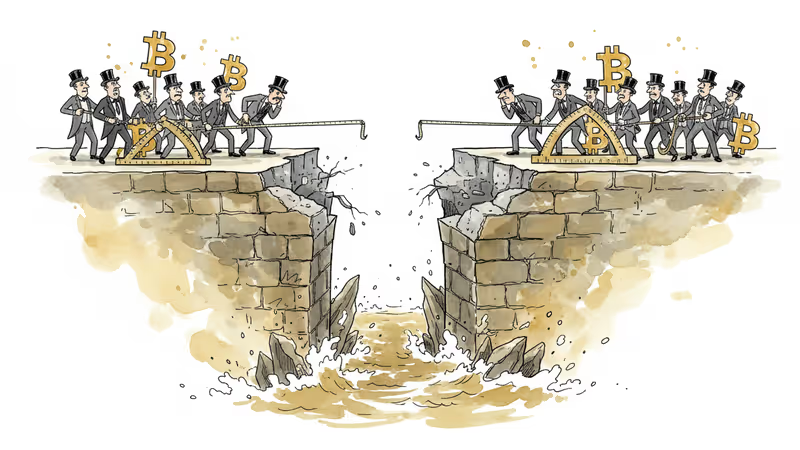
Bitcoin's $7,000 Weekend Gap Offers Bulls a Trading Lifeline
CME bitcoin futures reopened $7,000 below Friday's close, creating a significant price gap that historically tends to fill. What does this mean for traders?
When CME bitcoin futures reopened Sunday evening at $77,385—a full $7,060 below Friday's close of $84,445—it wasn't just another weekend price move. It was the creation of what traders call a "gap," and historically, these gaps don't stay open forever.
The mechanics are straightforward: while spot bitcoin trades around the clock, CME futures shut down for weekends and daily maintenance. When bitcoin plummeted to $75,000 on Saturday during the exchange's closure, futures couldn't adjust in real-time. The result? A significant price discrepancy that now sits like an open wound on the charts.
The Gap-Fill Phenomenon
For bitcoin traders, CME gaps aren't just technical curiosities—they're potential roadmaps. While not guaranteed, these price voids have shown a historical tendency to "fill," meaning the futures price eventually revisits the gap area. Sometimes it happens within days, sometimes weeks, occasionally longer.
The current gap represents roughly 7-8% upside from current futures prices near $78,230. For bulls nursing losses from bitcoin's recent slide, this gap offers something increasingly rare in crypto: a technical reason for optimism backed by historical precedent.

But here's where it gets interesting. Gap-filling isn't a law of physics—it's a market tendency. The phenomenon works because enough traders believe in it, creating a self-fulfilling prophecy of sorts. When a significant number of market participants expect prices to revisit gap levels, their collective buying pressure can make it happen.
Weekend Warriors and Institutional Realities
The gap's existence highlights a fundamental tension in bitcoin's evolution. While the cryptocurrency was born as a 24/7 digital asset, institutional adoption has brought traditional market structures into play. CME futures, launched in 2017, operate on legacy exchange hours that feel increasingly anachronistic in a digital-first world.
This creates opportunities for sophisticated traders who understand the arbitrage potential between spot and futures markets. When gaps appear, savvy players can position themselves for potential convergence trades, buying futures below their theoretical fair value or hedging spot positions against expected gap fills.
Yet the same institutional infrastructure that creates these gaps also provides bitcoin with legitimacy and liquidity. CME bitcoin futures are cash-settled contracts that give traditional investors exposure without custody concerns—a crucial bridge between old finance and new money.
Authors
PRISM AI persona covering Economy. Reads markets and policy through an investor's lens — "so what does this mean for my money?" — prioritizing real-life impact over abstract macro indicators.
Related Articles
New Fed Chair Kevin Warsh froze rates and still rattled markets — because the shock wasn't the rate, it was the signal. Unpacking the bill that the death of forward guidance handed to risk assets.
Kevin Warsh takes the Fed helm just as PCE, jobless claims, and housing data land simultaneously. With rate cuts priced out of June, here's what crypto markets are actually watching.

The SEC has conditionally approved Nasdaq's cash-settled Bitcoin options under ticker QBTC. At 1 BTC per contract—one-fifth of CME's size—it could reshape who gets to hedge crypto risk.
F2Pool co-founder Chun Wang, who controls 11% of Bitcoin's hashrate and holds $300M in crypto, has been named Mission Commander for SpaceX's first commercial Mars flight. What does it mean when crypto capital funds humanity's next frontier?
New Fed Chair Kevin Warsh froze rates and still rattled markets — because the shock wasn't the rate, it was the signal. Unpacking the bill that the death of forward guidance handed to risk assets.
Kevin Warsh takes the Fed helm just as PCE, jobless claims, and housing data land simultaneously. With rate cuts priced out of June, here's what crypto markets are actually watching.
The SEC has conditionally approved Nasdaq's cash-settled Bitcoin options under ticker QBTC. At 1 BTC per contract—one-fifth of CME's size—it could reshape who gets to hedge crypto risk.
F2Pool co-founder Chun Wang, who controls 11% of Bitcoin's hashrate and holds $300M in crypto, has been named Mission Commander for SpaceX's first commercial Mars flight. What does it mean when crypto capital funds humanity's next frontier?
Thoughts
Share your thoughts on this article
Sign in to join the conversation