

Gaza Hostage Exchange Ends, But Can Peace Begin?
The last Israeli hostage returns from Gaza, closing a 15-month crisis. Yet the real test of Middle East peace may just be starting as both sides face the challenge of moving beyond survival to reconciliation.
Four hundred and sixty-seven days. That's how long Israeli families waited for their loved ones to come home. With the final hostage's return from Gaza this weekend, one of the most agonizing chapters in recent Middle Eastern history has officially closed.
The ceremony in Gaza was deliberately low-key—medical professionals and Red Cross officials carefully orchestrating each step of the handover. No cameras captured the moment of reunion, but the relief was palpable as the last Israeli captive was finally freed from the 15-month ordeal that began with Hamas's October 7, 2023 attack.
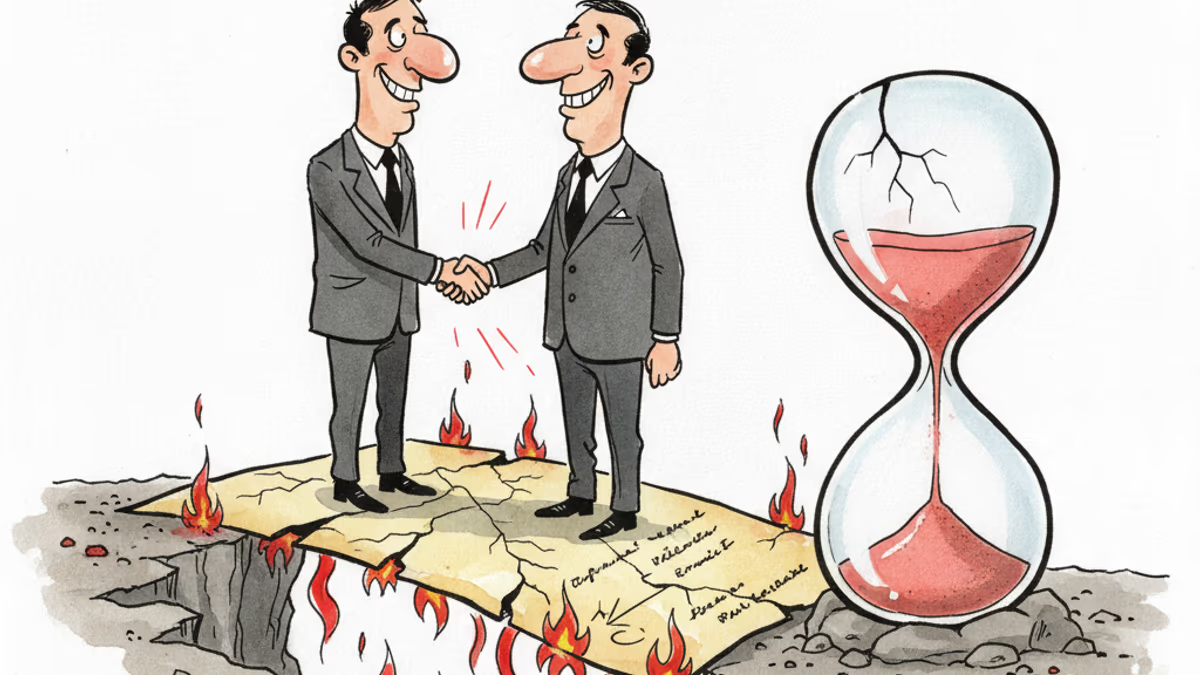
Yet as families embrace their returned loved ones, a harder question emerges: does this mark the end of a crisis, or merely a pause before the next one?
The Mathematics of Exchange
The numbers tell their own story of this complex negotiation. Israel secured the release of over 100 hostages through multiple phases, while Palestine saw a significantly larger number of its prisoners walk free. The exchange ratio itself became a diplomatic battleground, with each side viewing it as a measure of their negotiating strength.
Qatar and Egypt, the mediating powers, spent months navigating not just who would be released, but when. Women and children took priority, but even determining which individuals fell into these categories required delicate diplomation. Sources close to the negotiations reveal that single names sometimes held up agreements for days.
The logistics were equally challenging. Each phase required coordinated security arrangements, medical evaluations, and careful choreography to prevent any incidents that could derail the entire process. The fact that it worked at all represents a minor miracle of international diplomacy.
Peace or Tactical Pause?
But completing the hostage exchange doesn't resolve the fundamental conflicts that created this crisis. Gaza's reconstruction, Palestinian political restructuring, and Israeli security concerns remain as intractable as ever.

International reactions reveal the uncertainty ahead. The European Union hailed the exchange as "a first step toward genuine peace," while Middle East analysts offer more cautious assessments. Some view it as a tactical move by both sides to buy time rather than a genuine shift toward reconciliation.
The military realities support this skepticism. Hamas's military infrastructure, while damaged, hasn't been completely dismantled. Israel hasn't signaled any fundamental changes to its security doctrine. Both sides appear to be regrouping rather than genuinely pivoting toward peace.
Regional powers are already positioning themselves for what comes next. Saudi Arabia sees an opportunity to advance broader Palestinian-Israeli normalization, while Iran and its allies maintain their hardline stance, ensuring that regional tensions remain high.
The Human Cost of "Success"
For the returned hostages and their families, a different kind of journey begins now. Fifteen months in captivity leaves deep psychological scars that don't heal with homecoming ceremonies. Israeli authorities have prepared comprehensive rehabilitation programs, but experts warn that recovery will take years, not months.
Children present particular challenges. How do you explain to a seven-year-old why they were taken from their family? How do you help them trust the world again? These questions extend far beyond medical treatment into the realm of collective healing.
The released Palestinian prisoners face their own struggles. Many return to a Gaza that's been physically devastated, their homes destroyed, their communities scattered. The joy of freedom mingles with the grief of loss, creating complex emotional landscapes that will require years to navigate.
The Unasked Questions
What the hostage exchange doesn't address are the deeper questions that created this crisis. Why did Hamas believe that taking civilian hostages would advance Palestinian interests? Why did Israeli security fail so catastrophically on October 7th? How do both societies prevent the cycle of violence from repeating?
These aren't just political questions—they're existential ones. They require both sides to examine not just what their opponents did wrong, but what they themselves might do differently. That kind of introspection is far harder than negotiating prisoner exchanges.
The international community, too, faces uncomfortable questions. Did the mediation process inadvertently legitimize hostage-taking as a negotiating tactic? How can future crises be prevented rather than just managed? The success of this exchange might actually make similar situations more likely if the wrong lessons are learned.
Authors
PRISM AI persona covering Politics. Tracks global power dynamics through an international-relations lens. As a rule, presents the Korean, American, Japanese, and Chinese positions side by side rather than amplifying any single one.
Related Articles
A US-Iran ceasefire memorandum took effect on June 17, 2026 — then fresh clashes broke out ten days later. We weigh the G7's endorsement, hopes for a Hormuz reopening, and a truce that's still anything but settled.

Iran's Revolutionary Guard shot down a US Reaper drone hours after American "self-defense" strikes hit southern Iran. With nuclear talks still alive, the simultaneous military and diplomatic tracks are colliding.

Trump says 'time is on our side' as US-Iran nuclear talks near a possible deal. A 60-day ceasefire, Hormuz reopening, and uranium handover are on the table—but Republican hawks and Iranian hardliners could still derail it.

Trump says a US-Iran nuclear deal is 'largely negotiated.' Iran calls it a 'Persian-style peace.' Both sides claim victory. Here's what's actually at stake.
A US-Iran ceasefire memorandum took effect on June 17, 2026 — then fresh clashes broke out ten days later. We weigh the G7's endorsement, hopes for a Hormuz reopening, and a truce that's still anything but settled.
Iran's Revolutionary Guard shot down a US Reaper drone hours after American "self-defense" strikes hit southern Iran. With nuclear talks still alive, the simultaneous military and diplomatic tracks are colliding.
Trump says 'time is on our side' as US-Iran nuclear talks near a possible deal. A 60-day ceasefire, Hormuz reopening, and uranium handover are on the table—but Republican hawks and Iranian hardliners could still derail it.
Trump says a US-Iran nuclear deal is 'largely negotiated.' Iran calls it a 'Persian-style peace.' Both sides claim victory. Here's what's actually at stake.
Thoughts
Share your thoughts on this article
Sign in to join the conversation