
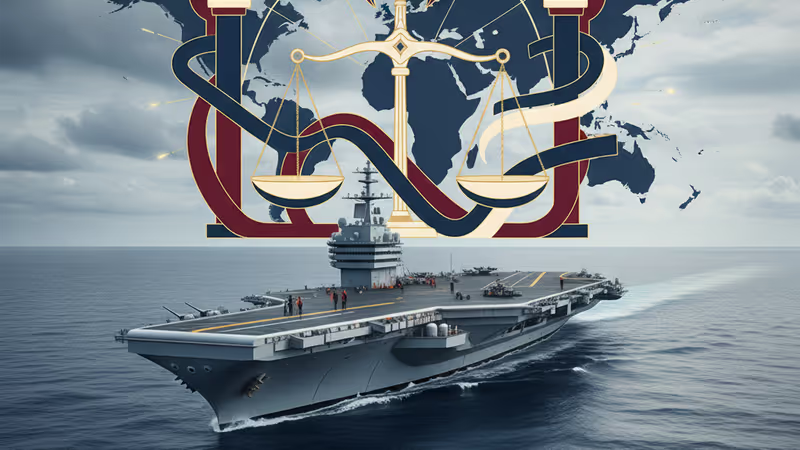
France to Build New Nuclear-Powered Aircraft Carrier in Major Defense Overhaul
France announces the construction of a new nuclear-powered aircraft carrier, set for 2038, as part of a major defense spending boost. An analysis of Macron's strategy to project French power and secure its role as a leading military force in Europe.
In Brief
French President Emmanuel Macron has announced plans to build a new-generation nuclear-powered aircraft carrier, slated for completion in 2038. The decision is the centerpiece of a significant increase in defense spending aimed at cementing France's strategic autonomy and power projection capabilities on the world stage.
France will build a new aircraft carrier, President Emmanuel Macron announced on Sunday, calling it a demonstration of the nation's strength in an increasingly perilous world. Speaking to French troops stationed in Abu Dhabi, Macron framed the decision as essential for projecting French influence.
“In an age of predators, we must be strong in order to be feared, and especially strong at sea. This is why... I have decided to equip France with a new aircraft carrier.” – Emmanuel Macron, President of France
The new vessel is scheduled to enter service in 2038, replacing the aging Charles de Gaulle, which has been in operation since 2001. According to the French defense ministry, the carrier will enable France to conduct heavily armed, long-range deployments at short notice for extended periods.
A Generational Leap in Naval Power
- Displacement: Approx. 78,000 tons (vs. 42,000 for the Charles de Gaulle)
- Length: 310 meters / 1,017 feet (vs. 261 meters / 856 feet)
- Power Plant: Nuclear
- Capacity: 30 fighter jets and 2,000 sailors
While still smaller than American supercarriers like the USS Gerald Ford (over 100,000 tons), the new warship represents a massive upgrade in French naval capability. Like its predecessor, it will be powered by nuclear reactors and equipped with French Rafale M fighter jets.
Doubling Down on Defense Spending
The aircraft carrier project is the flagship of a wider push to modernize the French military. The cost was estimated in 2023 at around €10 billion ($11.7 billion) by then-Defense Minister Sébastien Lecornu, who is now Prime Minister.
This investment is part of a much larger financial commitment. Macron has announced an additional €6.5 billion ($7.6 billion) in military spending over the next two years alone. His administration's goal is to reach a defense budget of €64 billion by 2027, the final year of his second term. This would be double the €32 billion budget when he first took office in 2017.
France currently maintains the second-largest military in the European Union, just behind Poland, with around 200,000 active personnel and over 40,000 reservists. Paris aims to increase its number of reservists to 80,000 by 2030.
PRISM Insight: More Than Just a Ship
France's decision to invest in a new nuclear carrier is a geopolitical statement. As the U.S. continues its strategic pivot and security dynamics in Europe shift, Paris is signaling a firm commitment to 'strategic autonomy'—the ability to act independently on the global stage. This vessel isn't just for NATO missions; it's a tool to project French influence from the Mediterranean to the Indo-Pacific, securing France’s long-term status as Europe's preeminent military power.
Related Articles

The French president's chief silverware keeper and two others are set to stand trial for stealing thousands of euros worth of national heritage tableware from the Elysee Palace, raising fresh concerns over security at France's state institutions.

As US-led peace talks intensify, a potential Trump-brokered deal to end the Russia-Ukraine war could redefine European security and global markets. An analysis.
The Japanese government is finalizing a record defense budget of over ¥9 trillion for FY2026, raising concerns about its ability to simultaneously address domestic pressures like inflation, healthcare, and disaster response.

At Turning Point's AmericaFest, a fierce internal feud between figures like Ben Shapiro and Steve Bannon gave way to calls for unity from VP JD Vance. An analysis of the ideological schism shaping the future of the Republican party.