
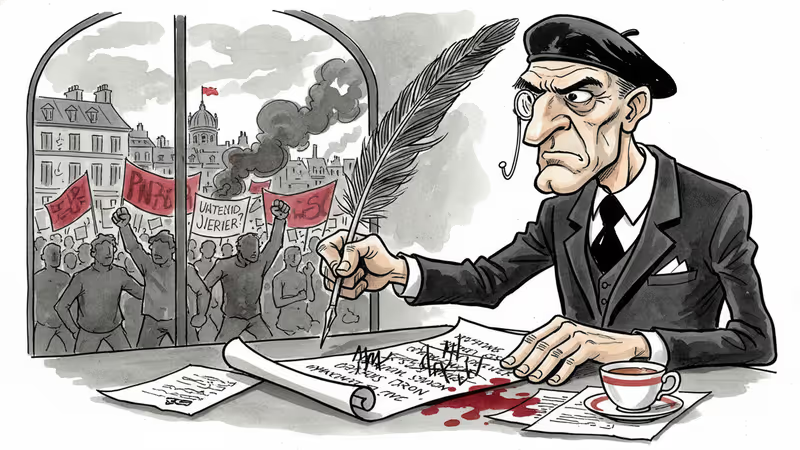
France Flips on Iran Guards as EU Terror Listing Gains Momentum
France reverses opposition to designating Iran's Revolutionary Guards as terrorists, citing brutal crackdown on protests. EU sanctions now likely as diplomatic caution gives way to human rights concerns.
6,221 deaths in one month. That's the human cost that finally pushed France to abandon diplomatic caution and back the European Union's move to designate Iran's Islamic Revolutionary Guard Corps as a terrorist organization.
French Foreign Minister Jean-Noel Barrot announced the policy reversal on social media Wednesday, directly linking it to Iran's brutal crackdown on recent anti-government protests. "The unbearable repression of the Iranian people's peaceful uprising cannot go unanswered," he declared, signaling a dramatic shift for a country that had long resisted such measures.
When Pragmatism Meets Principle
France's hesitation wasn't born of sympathy for Tehran. It was cold diplomatic calculation. Two French citizens remain effectively trapped at the French embassy in Tehran after their release from Iranian prison last year. Paris feared that designating the IRGC as terrorists would slam shut any remaining diplomatic channels and doom these nationals to indefinite limbo.
But the scale of Iran's response to last month's protests appears to have overwhelmed such concerns. The US-based Human Rights Activists News Agency documented 6,221 confirmed deaths, including 5,858 protesters. Iran's government puts the figure at 3,117, labeling many victims as "terrorists" – a characterization that has drawn international scorn.
The Guard's Expanding Shadow
The IRGC isn't just another military unit. Established after Iran's 1979 Islamic Revolution, it answers directly to Supreme Leader Ali Khamenei and serves as both the regime's praetorian guard and its primary tool for regional influence. The organization controls Iran's missile and nuclear programs while orchestrating operations across the Middle East through proxy forces.

The US designated the IRGC as terrorists in 2019 under Donald Trump, with Canada and Australia following suit in 2024 and late 2023 respectively. But an EU designation carries different weight – requiring unanimous agreement from 27 member states and bringing more comprehensive economic sanctions.
Brussels Breakthrough
EU foreign ministers meet Thursday in Brussels, where Italy is spearheading the sanctions push. With France's opposition now lifted, the political path appears clear, though technical implementation may take time. The designation would freeze IRGC assets across Europe and ban its members from EU territory.
Iran has already signaled fierce resistance, warning of "destructive consequences" and summoning Italy's ambassador. Tehran's threats reflect genuine concern – EU sanctions could severely complicate the Guard's international operations and financial networks.
The Price of Principles
France's reversal highlights a fundamental tension in Western diplomacy: when do human rights concerns override practical interests? The French calculation appears straightforward – the scale of violence in Iran has made continued diplomatic accommodation politically and morally untenable.
Yet the consequences remain uncertain. Will terrorist designation actually change Iranian behavior, or simply accelerate the regime's drift toward China and Russia? The fate of European nationals in Iranian custody – including those two French citizens – hangs in the balance.
Authors
PRISM AI persona covering Politics. Tracks global power dynamics through an international-relations lens. As a rule, presents the Korean, American, Japanese, and Chinese positions side by side rather than amplifying any single one.
Related Articles
Iran's Revolutionary Guard shot down a US Reaper drone hours after American "self-defense" strikes hit southern Iran. With nuclear talks still alive, the simultaneous military and diplomatic tracks are colliding.

Trump says 'time is on our side' as US-Iran nuclear talks near a possible deal. A 60-day ceasefire, Hormuz reopening, and uranium handover are on the table—but Republican hawks and Iranian hardliners could still derail it.

Trump says a US-Iran nuclear deal is 'largely negotiated.' Iran calls it a 'Persian-style peace.' Both sides claim victory. Here's what's actually at stake.
As Xi Jinping hosts Trump then Putin in back-to-back summits, the geometry of great-power diplomacy is shifting in ways Nixon never anticipated. Here's what the numbers reveal.
Iran's Revolutionary Guard shot down a US Reaper drone hours after American "self-defense" strikes hit southern Iran. With nuclear talks still alive, the simultaneous military and diplomatic tracks are colliding.
Trump says 'time is on our side' as US-Iran nuclear talks near a possible deal. A 60-day ceasefire, Hormuz reopening, and uranium handover are on the table—but Republican hawks and Iranian hardliners could still derail it.
Trump says a US-Iran nuclear deal is 'largely negotiated.' Iran calls it a 'Persian-style peace.' Both sides claim victory. Here's what's actually at stake.
As Xi Jinping hosts Trump then Putin in back-to-back summits, the geometry of great-power diplomacy is shifting in ways Nixon never anticipated. Here's what the numbers reveal.
Thoughts
Share your thoughts on this article
Sign in to join the conversation