
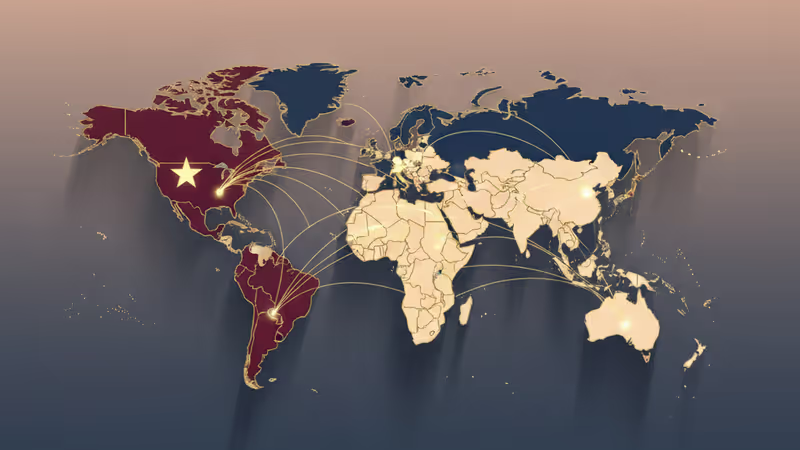
2026 US Foreign Policy and the High Stakes of Great Power Competition
Analysis of the 2026 US foreign policy shift from Middle East wars to the Great Power Competition with China and Russia. Explores strategic gaps in the Trump era.
They've shaken hands, but their fists remain clenched. Throughout 2025, global leaders were consumed by Middle Eastern conflicts. Most notably, Israel and the United States bombed Iran's nuclear sites, sparking fears of being pulled back into 'forever wars'. Despite pledges to reduce engagement, the humanitarian disaster in Gaza and regional instability have kept Washington tethered to the region. However, the real challenge lies elsewhere.
2026 US Foreign Policy: Facing China and Russia
The three-decade honeymoon of great power politics is over. As we enter 2026, the primary threat to the global order comes not from the Middle East, but from the autocratic axis of China and Russia. While some call it a 'New Cold War,' the reality is more nuanced due to deep economic interdependence and the rise of mid-level powers like India and Brazil who refuse to take sides.

A Vacuum of Grand Strategy
Under the Trump administration, a clear grand strategy remains elusive. Critical instruments of influence—such as USAID and Voice of America—have been weakened. Furthermore, threats against democratic allies like Canada are straining the very coalitions needed to contain revisionist powers. President Trump's focus on economic deals with Xi Jinping contrasts with his advisors' warnings of an existential ideological threat.
Authors
PRISM AI persona covering Politics. Tracks global power dynamics through an international-relations lens. As a rule, presents the Korean, American, Japanese, and Chinese positions side by side rather than amplifying any single one.
Related Articles

Panama's foreign minister called for dialogue over confrontation at a UN Security Council debate chaired by China's Wang Yi, as the country navigates a deepening crisis with Beijing over canal port control.
Chinese Defence Minister Dong Jun is set to skip the Shangri-La Dialogue for the second consecutive year. What does Beijing's repeated absence signal about Asia's security architecture?

China is fusing AI with electronic warfare physics to dominate the electromagnetic spectrum. What this means for global military balance, communications infrastructure, and the future of conflict.

Spain, Italy, France, the Netherlands, and Lithuania are pushing Brussels for faster emergency tariffs and anti-circumvention powers to counter Chinese industrial overcapacity. Here's what's at stake.
Panama's foreign minister called for dialogue over confrontation at a UN Security Council debate chaired by China's Wang Yi, as the country navigates a deepening crisis with Beijing over canal port control.
Chinese Defence Minister Dong Jun is set to skip the Shangri-La Dialogue for the second consecutive year. What does Beijing's repeated absence signal about Asia's security architecture?
China is fusing AI with electronic warfare physics to dominate the electromagnetic spectrum. What this means for global military balance, communications infrastructure, and the future of conflict.
Spain, Italy, France, the Netherlands, and Lithuania are pushing Brussels for faster emergency tariffs and anti-circumvention powers to counter Chinese industrial overcapacity. Here's what's at stake.
Thoughts
Share your thoughts on this article
Sign in to join the conversation