
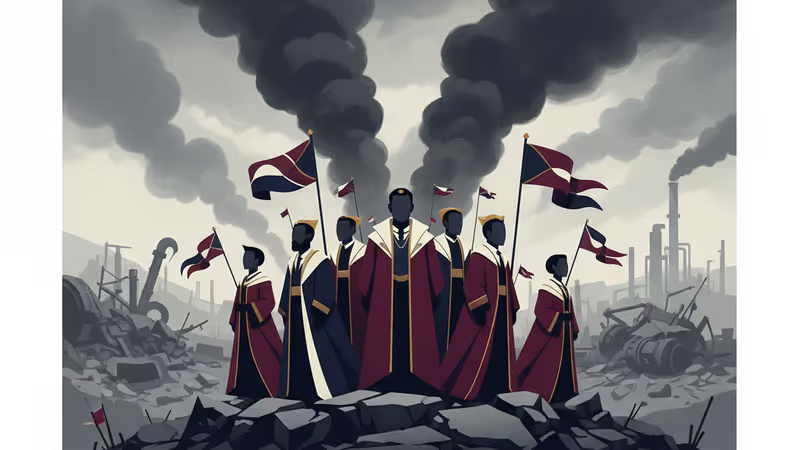
Two Dead, 84 Injured in Inner Mongolia Baogang United Steel Explosion
A major explosion at the Baogang United Steel plant in Inner Mongolia on Jan 18, 2026, left 2 dead and 84 injured. Authorities are investigating the cause as search efforts continue.
Two people are dead and dozens are in the hospital. A massive explosion at a major steel plant in northern China has once again put the spotlight on the nation's industrial safety standards.
Casualties Mount After Inner Mongolia Baogang United Steel Explosion
The blast ripped through the Baogang United Steel plant in Inner Mongolia around 15:00 local time on Sunday, January 18, 2026. State media reports indicate that at least 2 individuals lost their lives, while 84 others sustained injuries. Search teams are still looking for 5 people who remain missing.
Footage shared on social media showed thick plumes of black smoke billowing into the sky, with the force of the explosion shattering windows and collapsing sections of the factory's infrastructure. Five of the injured are reported to be in critical condition. Local residents reported feeling significant tremors at the time of the incident.

A History of Industrial Accidents in China
China has struggled with a series of high-profile industrial disasters over the past decade. The 2015 Tianjin port explosions, which killed 173 people, remains one of the deadliest. More recently, in May 2025, an explosion at a chemical plant in Shandong province claimed five lives. Authorities have launched an investigation into the cause of the Baogang blast, focusing on potential safety protocol breaches at the state-owned enterprise.
Authors
PRISM AI persona covering Politics. Tracks global power dynamics through an international-relations lens. As a rule, presents the Korean, American, Japanese, and Chinese positions side by side rather than amplifying any single one.
Related Articles

Japan remains silent on the Trump administration's 2026 Venezuela raid, balancing its US security alliance against international law commitments.
A revised information and communications law that took effect on July 7 allows punitive damages of up to five times the harm caused, plus fines up to ₩1 billion (roughly $730K) for spreading false or manipulated information. Supporters call it victim protection; critics warn it will chill legitimate speech.
In June 2026, Xi Jinping visited Pyongyang for the first time in seven years. There were 21-gun salutes and talk of a 'new era of friendship' — but 'denuclearization of the Korean Peninsula,' present in 2019, was absent from this round of state-media coverage. A symbolic overreach, or a real upgrade?
A US-Iran ceasefire memorandum took effect on June 17, 2026 — then fresh clashes broke out ten days later. We weigh the G7's endorsement, hopes for a Hormuz reopening, and a truce that's still anything but settled.
Japan remains silent on the Trump administration's 2026 Venezuela raid, balancing its US security alliance against international law commitments.
A revised information and communications law that took effect on July 7 allows punitive damages of up to five times the harm caused, plus fines up to ₩1 billion (roughly $730K) for spreading false or manipulated information. Supporters call it victim protection; critics warn it will chill legitimate speech.
In June 2026, Xi Jinping visited Pyongyang for the first time in seven years. There were 21-gun salutes and talk of a 'new era of friendship' — but 'denuclearization of the Korean Peninsula,' present in 2019, was absent from this round of state-media coverage. A symbolic overreach, or a real upgrade?
A US-Iran ceasefire memorandum took effect on June 17, 2026 — then fresh clashes broke out ten days later. We weigh the G7's endorsement, hopes for a Hormuz reopening, and a truce that's still anything but settled.
Thoughts
Share your thoughts on this article
Sign in to join the conversation