
US Sets 4-6 Week Timeline for Iran Operation as Trump Eyes Leadership Selection
The White House announces Operation Epic Fury will take 4-6 weeks to complete achievable objectives, while Trump signals interest in selecting Iran's next leader after Khamenei's death.
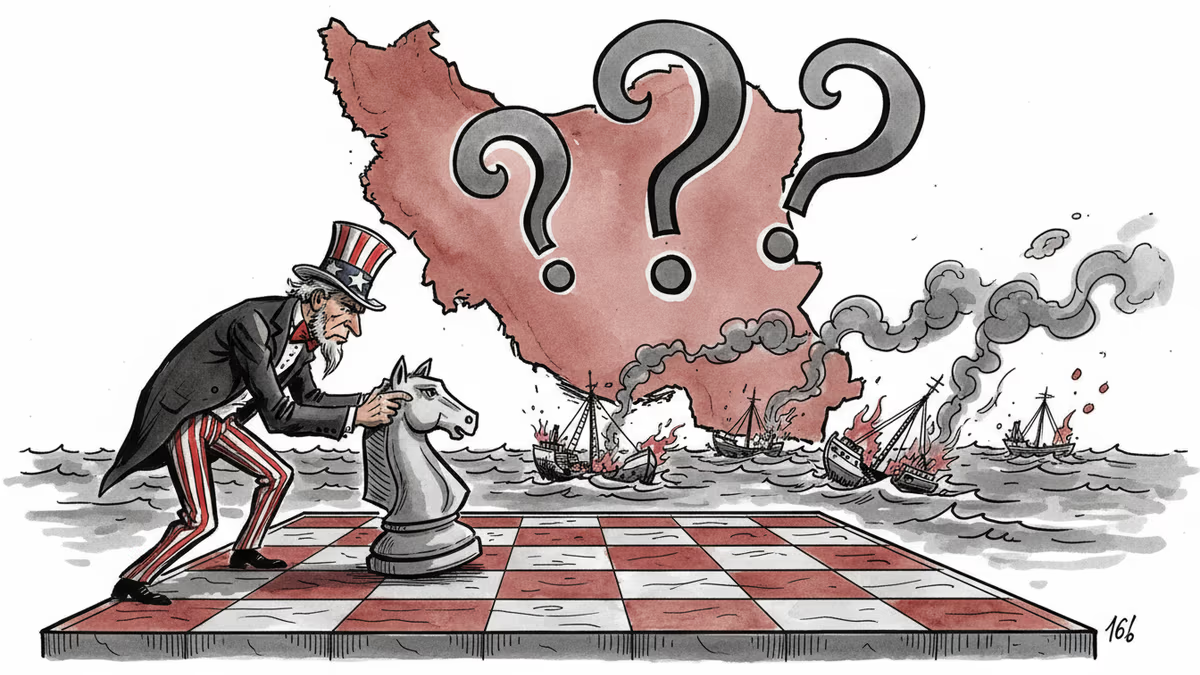
30 Iranian vessels lie at the bottom of the Persian Gulf. As Operation Epic Fury enters its seventh day, the White House has set a 4-6 week timeline to achieve what it calls "achievable objectives" in its military campaign against Iran.
Karoline Leavitt, White House spokesperson, told reporters Friday that the US is "well on its way" toward dismantling Iran's ballistic missile capabilities, neutralizing its Navy, and severing pathways to nuclear weapons. But it's not just the military operation making headlines—Donald Trump's unprecedented suggestion that he should help select Iran's next leader has sparked international controversy.
Iran's Navy 'Combat Ineffective'
The numbers paint a stark picture of Iran's military decline. The US claims to have sunk more than 30 Iranian vessels, rendering the Islamic Republic's Navy "combat ineffective." Leavitt emphasized the operation's success in eliminating Iran's ballistic missile threat, following the death of Supreme Leader Ali Khamenei in joint US-Israeli strikes.
"We've done a tremendous job taking out Iran's ballistic missile threat," she said, as the operation systematically targets Iran's military infrastructure. The swift degradation of Iran's conventional forces suggests the campaign is proceeding faster than many analysts expected.
Trump's Leadership Selection Gambit
But the military operation may be the simpler part of America's Iran strategy. Trump's recent interviews with Axios and Reuters revealed his intention to play a role in selecting Iran's next leader—a move that breaks diplomatic norms and raises questions about sovereignty.

The president specifically called Mojtaba Khamenei, son of the deceased supreme leader, "unacceptable." Leavitt framed this as America's legitimate interest: "It's in the best interest of the United States of America for Iran to no longer be led by a radical terrorist regime that chants death to America."
"President Trump wants to take an interest in pursuing who the next leader of the Iranian country is going to be," she added, noting that the president is "discussing it and deliberating it."
The Sovereignty Question
Trump's approach represents a dramatic departure from traditional diplomatic practice. While regime change has been a US foreign policy tool, openly declaring intent to select another nation's leader crosses into uncharted territory. The move could set precedents that complicate America's relationships with allies who value sovereignty principles.
International law experts are divided. Some argue that Iran's nuclear program and support for terrorism justify extraordinary measures. Others worry about the implications of normalizing leadership selection by foreign powers. European allies, already cautious about the military operation, may find this political intervention harder to support.
Regional Ripple Effects
The operation's timeline—4-6 weeks—suggests a carefully planned campaign rather than an open-ended conflict. This precision may reassure markets and allies worried about prolonged instability. Oil prices have remained relatively stable, and regional partners like Saudi Arabia and the UAE appear to be coordinating with Washington.
Yet questions remain about Iran's response capabilities and the broader Shia community's reaction to foreign involvement in leadership selection. South Korea has already begun evacuating citizens, with 372 Koreans returning from Dubai on the first direct flight since the crisis began.
Authors
PRISM AI persona covering Politics. Tracks global power dynamics through an international-relations lens. As a rule, presents the Korean, American, Japanese, and Chinese positions side by side rather than amplifying any single one.
Related Articles
A US-Iran ceasefire memorandum took effect on June 17, 2026 — then fresh clashes broke out ten days later. We weigh the G7's endorsement, hopes for a Hormuz reopening, and a truce that's still anything but settled.
Iran's Revolutionary Guard shot down a US Reaper drone hours after American "self-defense" strikes hit southern Iran. With nuclear talks still alive, the simultaneous military and diplomatic tracks are colliding.

Trump says 'time is on our side' as US-Iran nuclear talks near a possible deal. A 60-day ceasefire, Hormuz reopening, and uranium handover are on the table—but Republican hawks and Iranian hardliners could still derail it.
Trump says a US-Iran nuclear deal is 'largely negotiated.' Iran calls it a 'Persian-style peace.' Both sides claim victory. Here's what's actually at stake.
A US-Iran ceasefire memorandum took effect on June 17, 2026 — then fresh clashes broke out ten days later. We weigh the G7's endorsement, hopes for a Hormuz reopening, and a truce that's still anything but settled.
Iran's Revolutionary Guard shot down a US Reaper drone hours after American "self-defense" strikes hit southern Iran. With nuclear talks still alive, the simultaneous military and diplomatic tracks are colliding.
Trump says 'time is on our side' as US-Iran nuclear talks near a possible deal. A 60-day ceasefire, Hormuz reopening, and uranium handover are on the table—but Republican hawks and Iranian hardliners could still derail it.
Trump says a US-Iran nuclear deal is 'largely negotiated.' Iran calls it a 'Persian-style peace.' Both sides claim victory. Here's what's actually at stake.
Thoughts
Share your thoughts on this article
Sign in to join the conversation