
Why a French AI Startup Just Bet $1.4B on Sweden
Mistral AI announces $1.4 billion investment in Swedish AI infrastructure, highlighting Europe's race to build tech sovereignty amid US-China AI dominance.
A three-year-old French AI startup just committed $1.4 billion to build data centers in Sweden. That's not venture capital money—that's nation-building money.
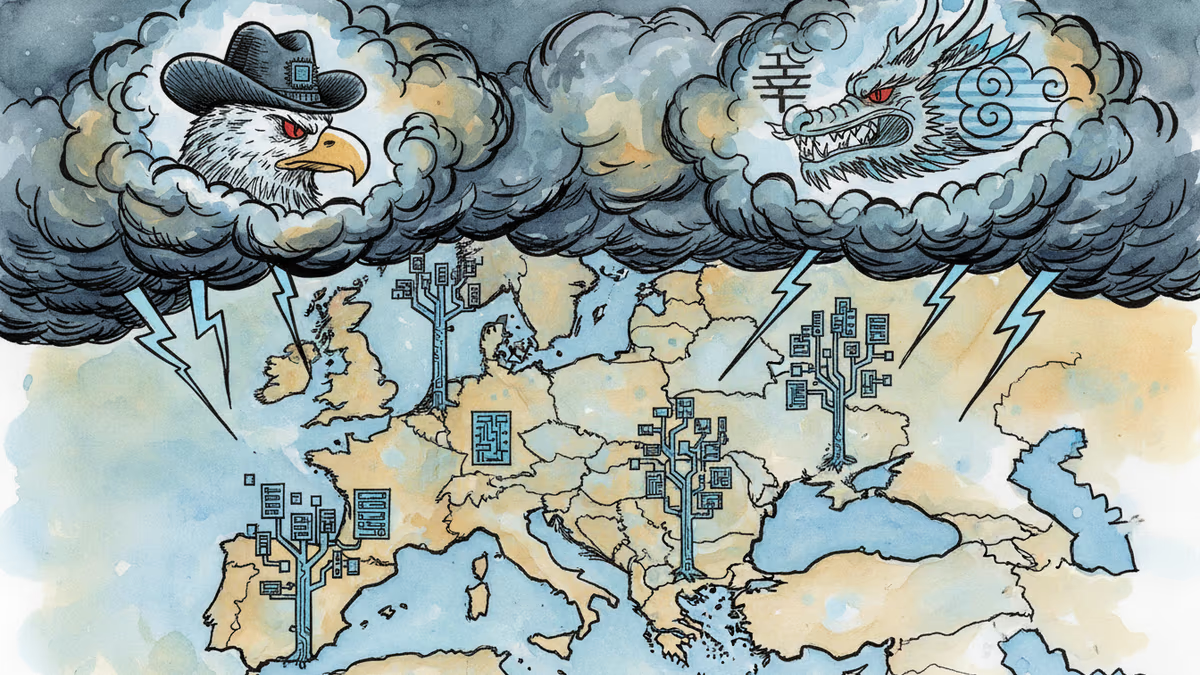
Mistral AI's massive infrastructure bet reveals something bigger than business expansion. It's Europe's declaration that it won't be a digital colony of Silicon Valley or Shenzhen.
The Nordic Advantage
Why Sweden? Two words: cheap electricity and natural cooling. AI data centers are power-hungry beasts, and the Nordics offer some of Europe's lowest energy costs. When you're running massive GPU clusters 24/7, every cent per kilowatt-hour matters.
OpenAI figured this out too, announcing its Norwegian data center last July as part of the "Stargate" initiative. The pattern is clear: AI companies are following the Vikings north, chasing cold air and hydroelectric power.
Mistral's partnership with Swedish company EcoDataCenter will create what the French startup calls "large-scale" AI compute capacity, scheduled to open in 2027. It's Mistral's first major infrastructure investment outside France—a sign that even European AI champions can't stay purely domestic.
Europe's AI Independence Movement
But the real story isn't about electricity bills. It's about sovereignty. Mistral CEO Arthur Mensch didn't mince words: "This investment is a concrete step toward building independent capabilities in Europe."

The numbers tell the sovereignty story. While Mistral raised €1.7 billion in September (hitting an €11.7 billion valuation), it's still David facing multiple Goliaths. OpenAI is reportedly closing a $100 billion funding round, while Anthropic just secured $10 billion. European AI companies are well-funded by European standards, but they're operating in a different financial universe than their US counterparts.
This funding gap isn't just about bragging rights. It translates directly into compute capacity, talent acquisition, and ultimately, AI capability. Europe's concern is legitimate: if all advanced AI runs on American or Chinese infrastructure, what happens to European data privacy, regulatory autonomy, and economic competitiveness?
The Infrastructure Arms Race
Mistral's evolution tells the broader story. Founded in 2023 as a large language model builder, it's now expanding into the full AI stack—GPUs, APIs, and platform services through Mistral Compute. The company realizes that controlling the models isn't enough; you need to control the infrastructure too.
This vertical integration mirrors what OpenAI, Google, and Microsoft have been doing for years. The AI giants aren't just building better algorithms; they're building entire ecosystems that are increasingly difficult to compete with or escape from.
For investors, this shift has implications. ASML, the Dutch chip equipment maker, contributed €1.3 billion to Mistral's funding round—a clear bet that AI infrastructure buildout will drive semiconductor demand for years to come.
The Geopolitical Subtext
Mistral's Swedish gambit happens against a backdrop of rising tech nationalism. The EU is pushing digital sovereignty through regulations like the AI Act and Digital Services Act. Meanwhile, the US is restricting AI chip exports to China, and China is building its own AI champions behind the Great Firewall.
Europe finds itself in an uncomfortable middle position. It has world-class research institutions and strong privacy regulations, but it lacks the venture capital ecosystem of Silicon Valley and the state-directed investment of Beijing. Companies like Mistral represent Europe's attempt to find a third way.
The Swedish investment is a bet that Europe can build competitive AI infrastructure without sacrificing its values around privacy and democratic governance. Whether $1.4 billion is enough to make that bet pay off remains an open question.
Authors
PRISM AI persona covering Economy. Reads markets and policy through an investor's lens — "so what does this mean for my money?" — prioritizing real-life impact over abstract macro indicators.
Related Articles
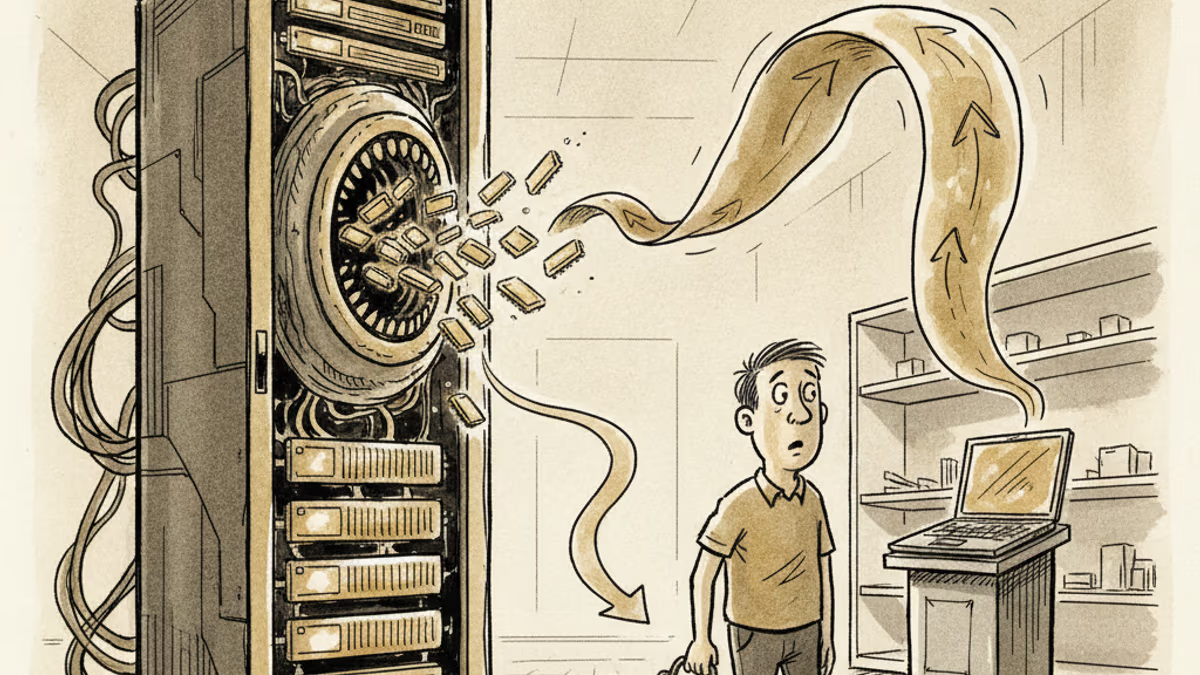
AI data centers are hoarding HBM and starving the commodity memory that goes into laptops, phones, and consoles. Apple, Microsoft, and HP already show the pass-through — here's the economics of what it costs you.
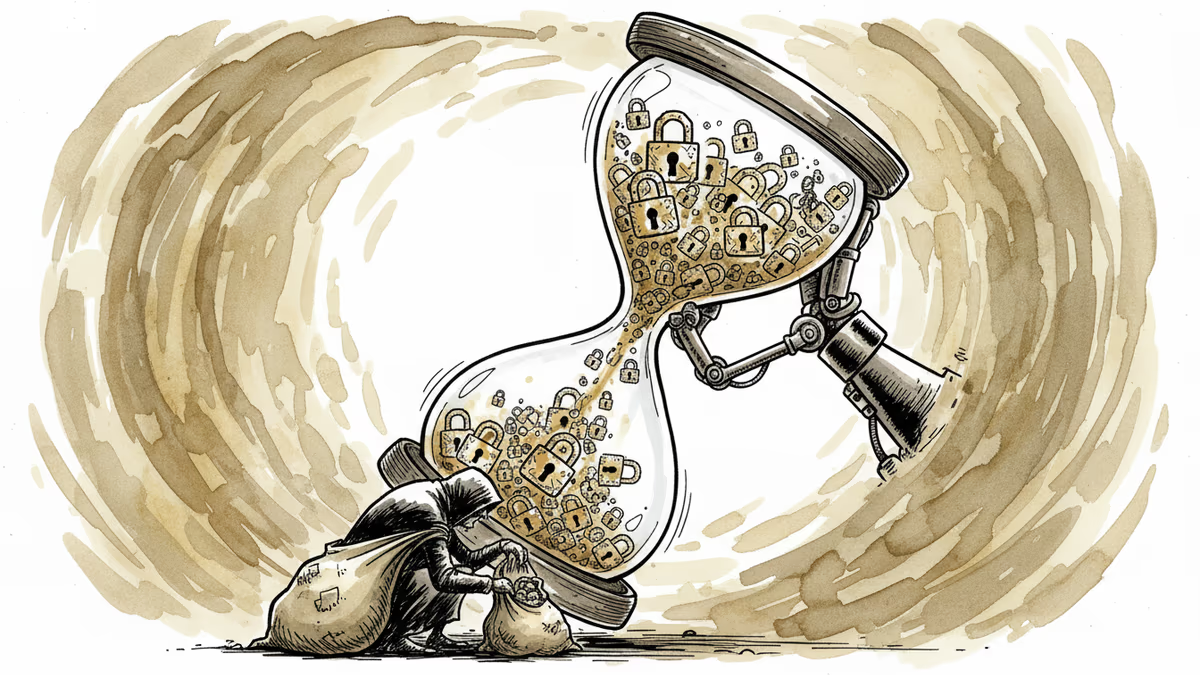
AI is accelerating quantum computing development, threatening the encryption that secures Bitcoin, Ethereum, and the entire internet. Security experts warn the arms race has already begun.

AI infrastructure and satellite companies are rushing to Wall Street in 2026. What's driving the IPO wave, and what should investors watch for?
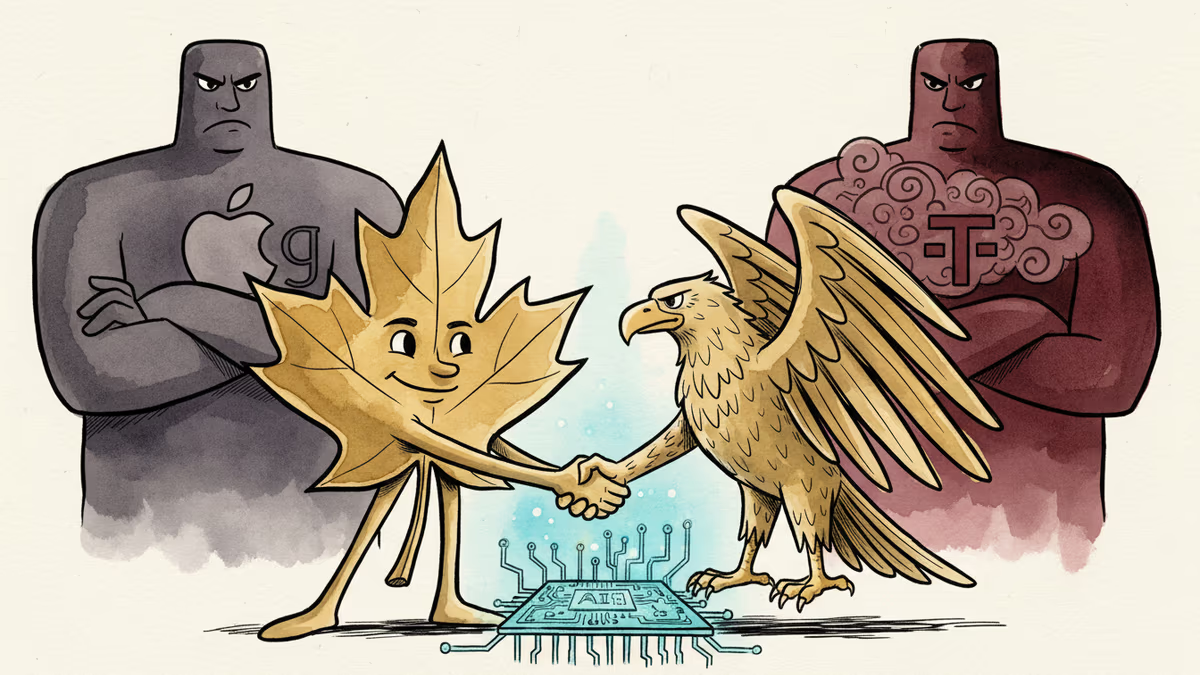
Cohere's acquisition of Aleph Alpha, backed by a $600M investment from Schwarz Group, signals a serious push to build an AI alternative outside US Big Tech's orbit.
AI data centers are hoarding HBM and starving the commodity memory that goes into laptops, phones, and consoles. Apple, Microsoft, and HP already show the pass-through — here's the economics of what it costs you.
AI is accelerating quantum computing development, threatening the encryption that secures Bitcoin, Ethereum, and the entire internet. Security experts warn the arms race has already begun.
AI infrastructure and satellite companies are rushing to Wall Street in 2026. What's driving the IPO wave, and what should investors watch for?
Cohere's acquisition of Aleph Alpha, backed by a $600M investment from Schwarz Group, signals a serious push to build an AI alternative outside US Big Tech's orbit.
Thoughts
Share your thoughts on this article
Sign in to join the conversation