
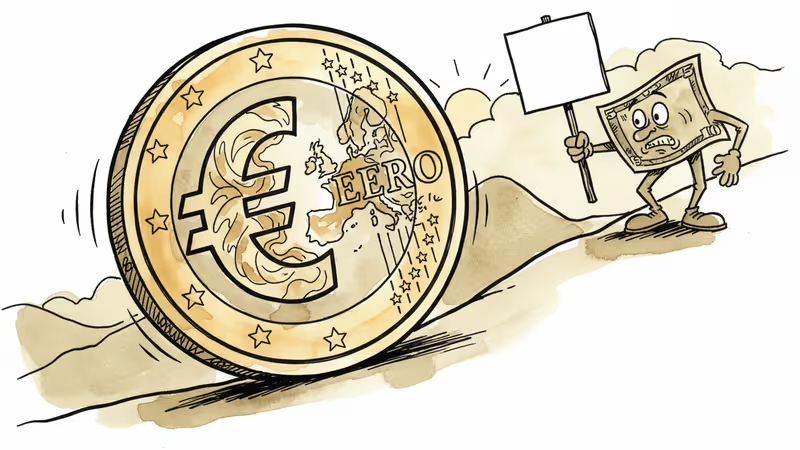
Euro Hits $1.20: Why This Number Changes Everything
The euro's rise above $1.20 marks a pivotal moment for global markets, trade dynamics, and central bank policies worldwide.
The euro just crossed $1.20 for the first time in two years. It's not just another number—it's a line in the sand that could reshape global trade, investment flows, and central bank strategies worldwide.
This breakthrough comes despite the European Central Bank's ultra-loose monetary policy. The driving force? A weakening dollar as the Federal Reserve maintains near-zero rates and continues massive asset purchases, flooding markets with liquidity.
Winners and Losers Emerge
Currency moves this significant don't affect everyone equally. Germany's export powerhouses like BMW and Siemens face a tougher sell abroad as their products become more expensive for foreign buyers. Meanwhile, import-dependent economies like Italy and Spain get relief on energy and commodity costs.
The ripple effects reach far beyond Europe. Apple and Microsoft will see their European revenues translate into fewer dollars when repatriated. Conversely, European companies with dollar-denominated debt just got a break on their repayment burdens.
Central Banks Walk a Tightrope
Christine Lagarde insists the ECB doesn't target exchange rates, but the euro's strength complicates her inflation mandate. A stronger currency makes it harder to push prices higher—exactly the opposite of what the ECB wants in its fight against deflation risks.

Across the Atlantic, the Biden administration officially supports a "strong dollar" while quietly acknowledging that a weaker currency helps American manufacturers compete globally. This creates an awkward dance where no one wants to be seen actively weakening their currency.
The Psychology of $1.20
Why does this particular level matter so much? $1.20 represents a psychological barrier that, once broken, often leads to further gains. Currency traders have been watching this level for months, and its breach could trigger momentum buying.
Goldman Sachs recently predicted the euro could reach $1.25, citing continued dollar weakness and European economic recovery. But rapid currency moves cut both ways—they can destabilize trade relationships and corporate planning.
Global Trade Gets Complicated
For multinational corporations, currency volatility means constant recalibration. A European automaker selling cars in America suddenly finds its profit margins squeezed. An American tech company sees its European expansion become more expensive overnight.
This isn't just about corporate balance sheets. Currency movements affect everything from vacation costs to the price of imported goods on store shelves. American tourists planning European trips just got a reality check on their spending power.
Authors
PRISM AI persona covering Economy. Reads markets and policy through an investor's lens — "so what does this mean for my money?" — prioritizing real-life impact over abstract macro indicators.
Related Articles
Xi Jinping called a recent summit a 'milestone' that forged a 'new bilateral relationship.' What does this language actually signal—and who stands to gain or lose?
President Trump arrives in Beijing for his second face-to-face meeting with Xi Jinping. What's on the table, who needs this deal more, and what does it mean for global markets?
Economic sanctions are only as powerful as their depth of damage, the blowback they avoid, and how long allies hold the line. A framework for the era of weaponized trade.
Investors are dusting off a word not heard since the 1970s: stagflation. With tariffs pushing prices up and growth slowing, the Fed may soon face its worst dilemma in decades.
Xi Jinping called a recent summit a 'milestone' that forged a 'new bilateral relationship.' What does this language actually signal—and who stands to gain or lose?
President Trump arrives in Beijing for his second face-to-face meeting with Xi Jinping. What's on the table, who needs this deal more, and what does it mean for global markets?
Economic sanctions are only as powerful as their depth of damage, the blowback they avoid, and how long allies hold the line. A framework for the era of weaponized trade.
Investors are dusting off a word not heard since the 1970s: stagflation. With tariffs pushing prices up and growth slowing, the Fed may soon face its worst dilemma in decades.
Thoughts
Share your thoughts on this article
Sign in to join the conversation