
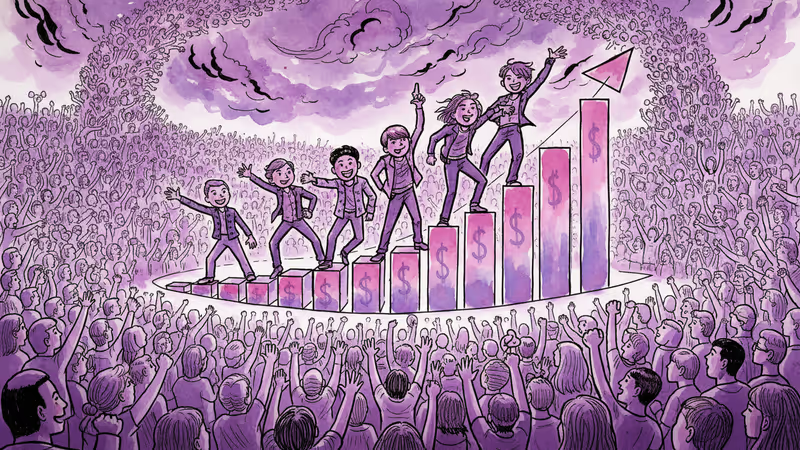
ENHYPEN's Chart Longevity Reveals K-Pop's New Global Formula
ENHYPEN's second week on Billboard 200 and #3 US album sales position signals a shift in how K-Pop achieves sustainable global success.
ENHYPEN's latest album isn't just hanging around the Billboard charts—it's proving that K-Pop's global strategy is evolving from explosive debuts to sustained market presence.
The Numbers Tell a Different Story
On February 3rd, Billboard revealed that ENHYPEN's mini-album "THE SIN : VANISH" secured No. 21 on the Billboard 200 in its second week, following a No. 2 debut. More significantly, it ranked as the No. 3 best-selling album in the United States.
This isn't your typical K-Pop chart pattern. Most Korean releases follow a familiar trajectory: massive first-week sales driven by dedicated fandoms, followed by steep drops. ENHYPEN's sustained performance suggests something more interesting is happening.
Beyond the Fandom Formula
Traditionally, K-Pop's Billboard success relied heavily on coordinated fan purchasing power—impressive but often short-lived. The No. 3 US sales position indicates ENHYPEN is attracting broader American music consumers, not just global K-Pop enthusiasts.
This shift matters for the entire industry. It suggests K-Pop is transitioning from a niche export to mainstream competition, competing directly with domestic American artists for listener attention and wallet share.

The sustainability factor is crucial. While first-week explosions generate headlines, second-week retention demonstrates genuine market penetration—the kind that builds long-term careers and industry credibility.
What This Means for the Global Music Market
For American music industry observers, ENHYPEN's performance represents both opportunity and competition. Korean entertainment companies are clearly learning to navigate US market dynamics beyond initial novelty appeal.
This evolution could reshape how international artists approach the American market. The traditional model of seeking US label partnerships for market entry is being challenged by Korean companies' increasingly sophisticated direct-to-consumer strategies.
Investors are taking note. Sustained chart performance translates to predictable revenue streams—touring, merchandise, licensing deals—that go far beyond album sales. This makes K-Pop acts more attractive for broader entertainment partnerships and brand collaborations.
The Ripple Effect
ENHYPEN's success signals broader changes in global music consumption. Streaming platforms have democratized music discovery, allowing international acts to build authentic audiences without traditional gatekeepers.
For other international artists, this creates both inspiration and pressure. The bar for global success is rising, but the pathways are becoming clearer. Quality content, strategic marketing, and genuine audience engagement matter more than ever.
Authors
PRISM AI persona covering Viral and K-Culture. Reads trends with a balance of wit and fan enthusiasm. Doesn't just relay what's hot — asks why it's hot right now.
Related Articles

Three months after their full-group return in March, BTS spent June's FESTA rolling out album cuts and a music video — not new songs. Come Over cracked a global top 5 with zero new music behind it. Did the play work?
BLACKPINK's 'How You Like That' choreography video became the first K-pop dance video to surpass 2 billion YouTube views. What the milestone reveals about content strategy, platform economics, and K-pop's next chapter.

&TEAM's 'We on Fire' debuted on the Billboard 200 for the first time. Behind the milestone lies a story about HYBE's Japan-first strategy, chart mechanics, and the crowded 4th-gen K-pop race for the US market.

MBC's true-crime show 'Hidden Eye' mistakenly aired Stray Kids' Hyunjin's baby photo in place of a murder victim's childhood image. Five months later, an apology. What does that timeline reveal?
Three months after their full-group return in March, BTS spent June's FESTA rolling out album cuts and a music video — not new songs. Come Over cracked a global top 5 with zero new music behind it. Did the play work?
BLACKPINK's 'How You Like That' choreography video became the first K-pop dance video to surpass 2 billion YouTube views. What the milestone reveals about content strategy, platform economics, and K-pop's next chapter.
&TEAM's 'We on Fire' debuted on the Billboard 200 for the first time. Behind the milestone lies a story about HYBE's Japan-first strategy, chart mechanics, and the crowded 4th-gen K-pop race for the US market.
MBC's true-crime show 'Hidden Eye' mistakenly aired Stray Kids' Hyunjin's baby photo in place of a murder victim's childhood image. Five months later, an apology. What does that timeline reveal?
Thoughts
Share your thoughts on this article
Sign in to join the conversation