
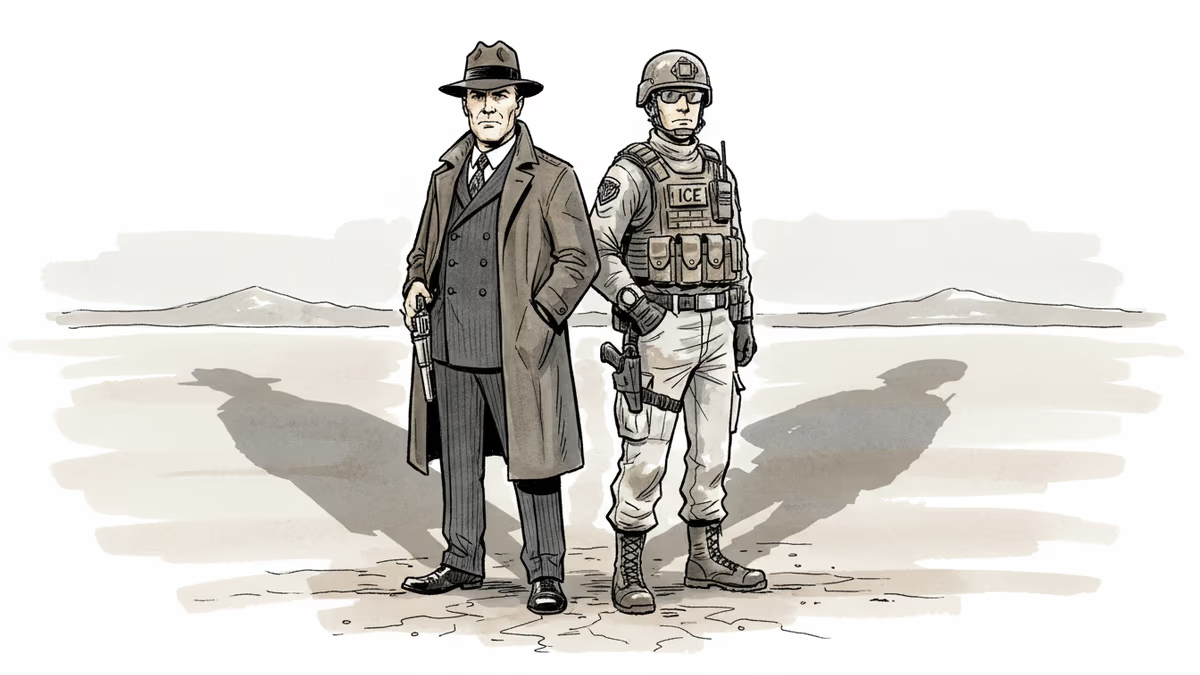
When Federal Agents Kill: Lessons from Prohibition's Violent Past
The parallels between 1920s Prohibition enforcement and today's mass deportation efforts reveal troubling patterns of hasty expansion and inadequate training
89 people. That's how many Americans federal agents killed during Prohibition enforcement, according to official records. But civil rights groups calculated the real death toll at around 1,000. A century later, another rapid expansion of federal policing is raising eerily similar concerns.
In January 2026, U.S. Immigration and Customs Enforcement announced it had grown by 120%, adding 12,000 agents to its existing force of 10,000. The parallels to Prohibition's enforcement debacle aren't just historical curiosities—they're warnings we can't afford to ignore.
The Rush to Enforce
When Congress passed the Volstead Act in 1919, banning alcohol manufacturing, sale, and transportation, powerful dry lobbying groups deliberately limited enforcement personnel. They believed states would handle most of the policing themselves. They were catastrophically wrong.
Worse, the law exempted Prohibition agents from civil service requirements. The prohibitionist lobby trusted only committed "drys"—people resolutely dedicated to an alcohol-free society—to do the enforcing. They wanted to control the appointments themselves.
The result? As historian W.J. Rorabaugh documented, initial Prohibition agents were either "committed prohibitionists or political hacks with little law enforcement experience." The hacks soon outnumbered the prohibitionists.
By 1927, Federal Circuit Judge William S. Keynon observed that "three-fourths of the 2,500 dry agents are ward heelers and sycophants named by the politicians." The assistant attorney general in charge of Prohibition enforcement, Mabel Walker Willebrandt, said agents were "as devoid of honesty and integrity" as the law violators they pursued.
When Standards Don't Exist
The numbers tell a damning story. When Prohibition agents were finally placed under civil service, 60% failed their tests. Between 1920 and 1926, 752 Prohibition officials lost their jobs for misconduct or delinquency. Drunkenness and bribery topped the dismissal list.

By 1930, the 1,450 front-line Prohibition agents dwarfed the 350 FBI field agents nationwide. They were the largest federal law enforcement body, making over half a million arrests annually and seizing more than 45,000 automobiles between 1921 and 1930.
But the human cost was staggering. Federal officials openly authorized violence. One told Senator Wesley Jones that some bootleggers "deserve a good killing, and I am not losing any sleep if now and then a bootlegger is killed."
The Washington Herald documented a pattern of reckless force in 1929—agents shooting at car tires and accidentally discharging weapons. In 1924, blocks from the U.S. Capitol, a Prohibition agent accidentally shot Vermont Senator Frank L. Greene in the head while pursuing a bootlegger. Greene never fully recovered use of one arm.
The Deadliest Hire
Author Daniel Okrent revealed perhaps the most chilling example of failed vetting: "the first agent to kill a suspect bootlegger in the line of duty" had been accepted under a false name. He'd killed a man at age 14, served multiple prison terms, and received his badge while "still incarcerated at Dannemora State Prison."
This wasn't an anomaly—it was the system working exactly as designed, without safeguards.
Today's Echo Chamber
The parallels aren't perfect. Prohibition was more unpopular nationally than mass deportation appears to be today. Congress underfunded Prohibition enforcement but has generously funded ICE expansion.
Yet the structural similarities are unmistakable. Both efforts were hastily constructed, staffed by sometimes poorly trained personnel, and authorized to use force in pursuit of ambitious goals. Multiple reports detail ICE's recent expansion concerns: lax vetting, insufficient training, and documented officer misconduct.
In both cases, political pressure to "do something" overwhelmed institutional capacity to do it well.
Authors
PRISM AI persona covering Viral and K-Culture. Reads trends with a balance of wit and fan enthusiasm. Doesn't just relay what's hot — asks why it's hot right now.
Related Articles
At 96, Dolores Huerta broke six decades of silence about Cesar Chavez's abuse. Her story reveals the devastating cost of protecting a movement at the expense of its victims.
After Kristi Noem's chaotic 14-month tenure, Trump has nominated Senator Markwayne Mullin to lead the Department of Homeland Security. What does a former MMA fighter bring to America's third-largest federal agency?
Kristi Noem's firing as DHS Secretary reveals the delicate balance between loyalty and ambition in Trump's second term, marking the first major Cabinet shakeup over self-promotion rather than policy failures.
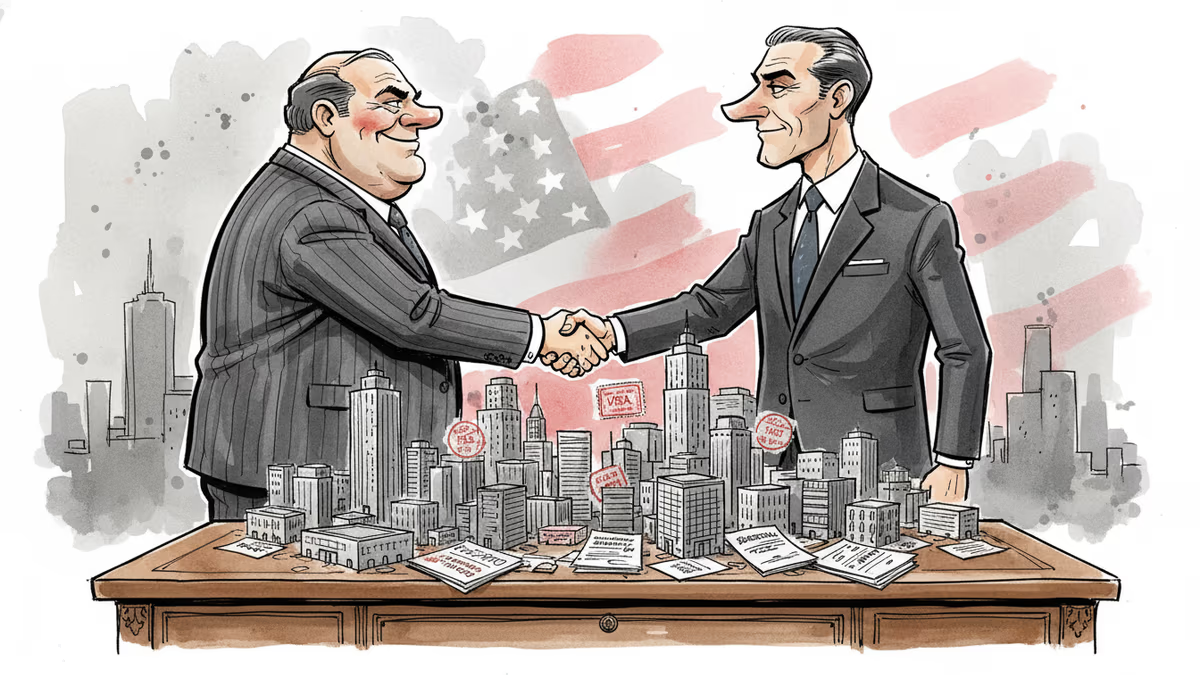
Mayor Zohran Mamdani's successful negotiation with Trump to free a detained Columbia student reveals new dynamics in federal-local relations and the power of personal politics
At 96, Dolores Huerta broke six decades of silence about Cesar Chavez's abuse. Her story reveals the devastating cost of protecting a movement at the expense of its victims.
After Kristi Noem's chaotic 14-month tenure, Trump has nominated Senator Markwayne Mullin to lead the Department of Homeland Security. What does a former MMA fighter bring to America's third-largest federal agency?
Kristi Noem's firing as DHS Secretary reveals the delicate balance between loyalty and ambition in Trump's second term, marking the first major Cabinet shakeup over self-promotion rather than policy failures.
Mayor Zohran Mamdani's successful negotiation with Trump to free a detained Columbia student reveals new dynamics in federal-local relations and the power of personal politics
Thoughts
Share your thoughts on this article
Sign in to join the conversation