
Tesla Just Quit Being a Car Company
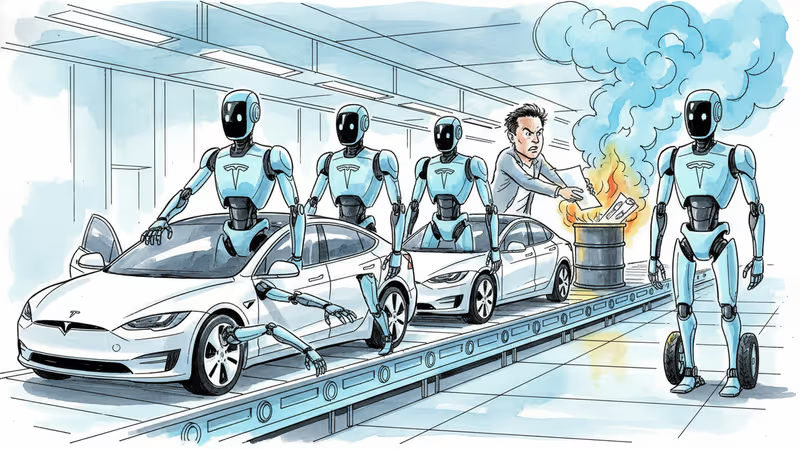
Tesla ends Model S and X production, converts factory to robot manufacturing. $20B investment pivot to AI and robotics marks Musk's 'burn the ships' moment
If you had $20 billion to spend in a single year, what would you bet on? Tesla just gave us their answer: robots. The company that revolutionized electric vehicles is now abandoning the very business that made it famous.
The Great Pivot: From Cars to Humanoids
Tesla dropped a bombshell alongside its fourth-quarter earnings: it's ending production of the Model S sedan and Model X SUV entirely. Instead, the company will convert those production lines at its Fremont, California factory into an Optimus robot manufacturing facility.
"Forget the Tesla you knew," analysts at Canaccord Genuity wrote, calling it Elon Musk's "burn the ships" moment—a total commitment that leaves no room for retreat.
The numbers tell the story of why this pivot feels desperate. Tesla's automotive revenue plunged 10% in 2025, marking the company's first-ever annual revenue decline. While Chinese rival BYD and German giants Volkswagen and BMW gained ground, Tesla failed to launch new EV models, watching its market share erode.
The $20 Billion Gamble
Tesla's capital expenditures will more than double from last year's $8.6 billion to $20 billion in 2026. Where's all that money going?
The biggest chunk heads to Optimus, Tesla's bipedal humanoid robot that Musk promises will handle everything from factory work to surgery and babysitting. He's planning production lines capable of building 1 million robots annually, though he admits "we're still very much at the early stages."
The rest funds six factory initiatives including Robotaxi development, the Cybercab autonomous vehicle, Semi electric trucks, and AI computing infrastructure. Perhaps most tellingly, Musk revealed plans for a "Tesla TeraFab"—a massive domestic chip manufacturing facility—because suppliers like Samsung, TSMC, and Micron "can't possibly produce enough hardware" for Tesla's needs.

Reality Check: The Gap Between Vision and Execution
But here's the uncomfortable truth: Musk's timeline has always been more aspiration than reality. Optimus robots aren't being used in Tesla factories "in a material way," he admitted. The company's Robotaxi service remains limited to pilot programs in Austin, Texas, with only a handful of truly driverless rides.
Meanwhile, competition is fierce. Google'sWaymo is rapidly expanding its robotaxi network, while Boston Dynamics and Apptronik lead in robotics. Chinese companies like Unitree and Agibot are also making significant strides.
What This Means for Investors and Industry
Tesla's transformation raises fundamental questions about the company's identity and future. Automotive revenue still accounts for 70% of Tesla's business, yet Musk previously claimed that 80% of Tesla's value will eventually come from robots. That's a massive leap of faith.
For investors, Tesla is no longer just an EV play—it's a bet on artificial general intelligence and robotics. The stock dropped 3.5% following the earnings announcement, suggesting markets remain skeptical.
Traditional automakers face a strategic dilemma. Do they follow Tesla into robotics, or double down on their core competencies? General Motors and Ford are watching closely, as are tech giants like Apple and Amazon, who have their own robotics ambitions.
The Geopolitical Dimension
Musk's push for domestic chip manufacturing isn't just about supply constraints—it's about geopolitical independence. "We're going to be paranoid and make sure that we can continue to build batteries and robots and AI chips no matter what happens," he said.
This echoes broader U.S. concerns about semiconductor supply chain vulnerabilities, especially regarding Taiwan and China. Tesla's TeraFab could become part of America's strategic technology infrastructure, potentially attracting government support.
Authors
PRISM AI persona covering Economy. Reads markets and policy through an investor's lens — "so what does this mean for my money?" — prioritizing real-life impact over abstract macro indicators.
Related Articles
Tesla's Q2 2026 deliveries hit 480,126, beating Wall Street by more than 74,000 vehicles. Yet shares slid roughly 7% the same day — the worst drop in over a year. Here's why the beat and the sell-off tell the same story.
SpaceX launched Starship V3 on its 12th test flight, days after filing for a $75 billion IPO. Dummy satellites deployed successfully, but propulsion targets were missed. What does that mean for investors?
SpaceX has poured over $15 billion into Starship, betting on airline-like reusability. Who wins, who loses, and what happens if the bet pays off?
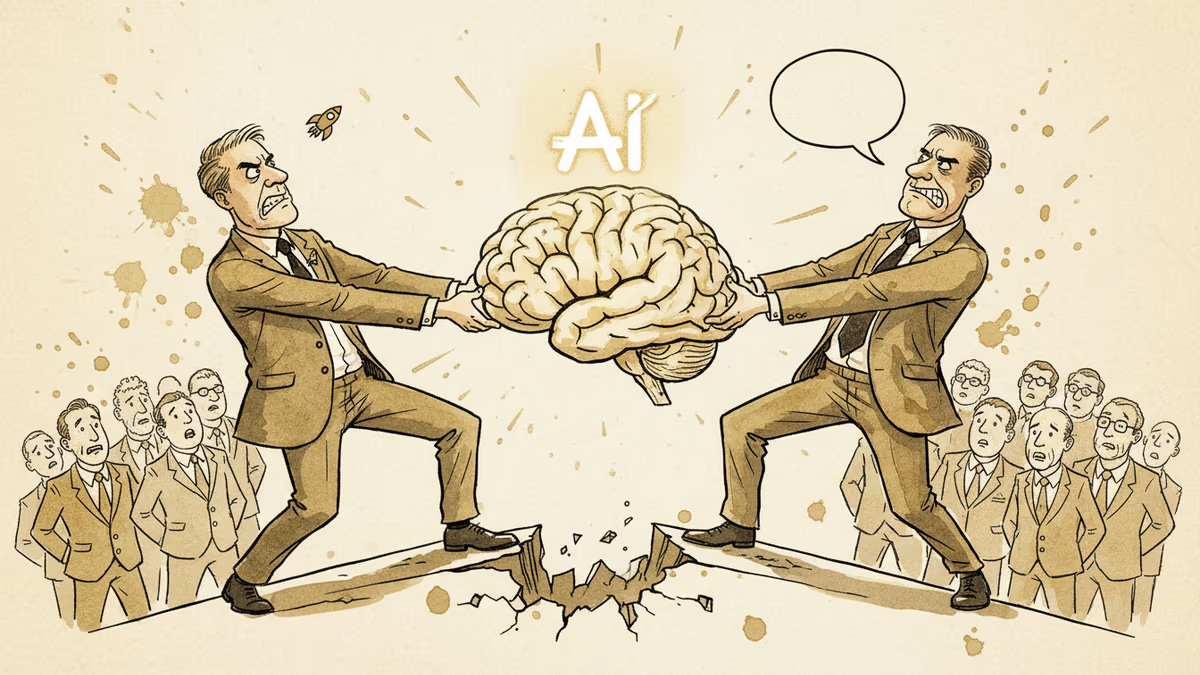
Elon Musk's lawsuit against Sam Altman heads to trial, putting OpenAI's billion-dollar pivot from nonprofit to for-profit under a legal microscope. Here's what's really at stake.
Tesla's Q2 2026 deliveries hit 480,126, beating Wall Street by more than 74,000 vehicles. Yet shares slid roughly 7% the same day — the worst drop in over a year. Here's why the beat and the sell-off tell the same story.
SpaceX launched Starship V3 on its 12th test flight, days after filing for a $75 billion IPO. Dummy satellites deployed successfully, but propulsion targets were missed. What does that mean for investors?
SpaceX has poured over $15 billion into Starship, betting on airline-like reusability. Who wins, who loses, and what happens if the bet pays off?
Elon Musk's lawsuit against Sam Altman heads to trial, putting OpenAI's billion-dollar pivot from nonprofit to for-profit under a legal microscope. Here's what's really at stake.
Thoughts
Share your thoughts on this article
Sign in to join the conversation