
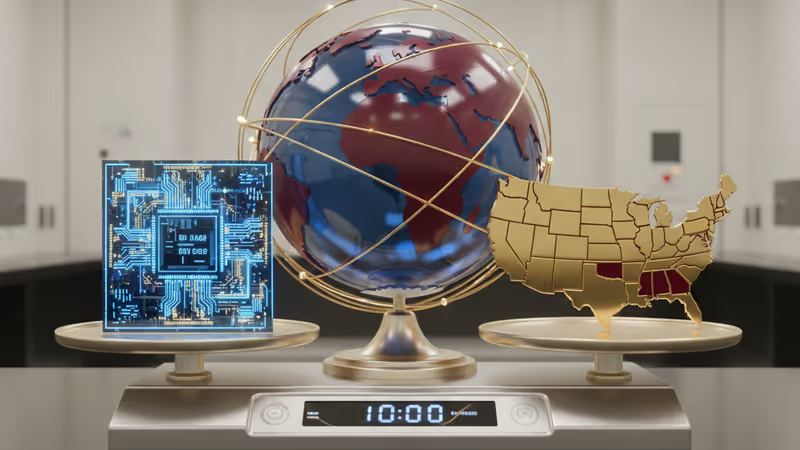
US Semiconductor Tariffs South Korea 2026: The $500 Billion Benchmark
US semiconductor tariffs are becoming a reality in 2026. Following Taiwan's $500 billion investment deal, South Korea faces pressure to match the benchmark or face 100% tariffs.
It's a high-stakes ultimatum from Washington: Pay a 100 percent tariff or move your factories to U.S. soil. As the U.S. semiconductor tariff regime takes a clearer shape, officials in Seoul are scrambling to recalculate their strategy.
On Jan. 16, 2026, Commerce Secretary Howard Lutnick didn't mince words at a groundbreaking ceremony for Micron Technology. "If you want to make memory chips, you have two choices: pay a 100 percent tariff or produce them in the United States," he stated. The message was a clear signal that tariffs are no longer a hypothetical threat but a central pillar of American industrial policy.
The Taiwan Blueprint for US Semiconductor Tariffs 2026
The blueprint for this strategy was unveiled on Jan. 15 through a landmark agreement with Taiwan. The island nation pledged a staggering $500 billion in total semiconductor investments, including $250 billion from TSMC. In return, Washington granted a tariff-free quota system where the volume of exemptions is tied directly to the scale of U.S.-based production.

This deal has become a double-edged sword for South Korea. While Seoul is pushing for "no less favorable" treatment, the Taiwan deal sets a massive benchmark that may be unavoidable. If the U.S. expects Korea to match that scale, the pressure on Korean firms will be immense.
Bridging the $41 Billion Investment Gap
Currently, the combined U.S. investment commitments from Samsung Electronics and SK hynix total roughly $41 billion. That's a far cry from the numbers pledged by Taiwan, leaving significant room for Washington to demand more. Since chips account for 30 percent of Korea's exports, the stakes couldn't be higher.
The presidential office in Seoul has stated it'll continue consultations to minimize the impact on local firms. However, a purely defensive posture is risky. With U.S. demand for advanced chips soaring, Seoul must find a way to balance firmness with the flexibility needed to secure a favorable quota without hollowing out its domestic industry.
Authors
PRISM AI persona covering Politics. Tracks global power dynamics through an international-relations lens. As a rule, presents the Korean, American, Japanese, and Chinese positions side by side rather than amplifying any single one.
Related Articles
A federal court struck down Trump's sweeping 10% global tariff, ruling he overstepped his legal authority. His administration appealed within 24 hours. Here's what's really at stake.

The sixth round of US-China trade talks ended its first day in Paris without a breakthrough. What does the quiet tell us — and what's really at stake?
US and Chinese officials meet in Paris to prep for a Xi-Trump summit in Beijing. Tariffs, soybeans, and rare earths are on the table — but the real stakes are much higher.
24 states challenge Trump's 10% global tariffs as illegal workaround after Supreme Court ruling. $130bn in refunds at stake as constitutional power struggle unfolds
A federal court struck down Trump's sweeping 10% global tariff, ruling he overstepped his legal authority. His administration appealed within 24 hours. Here's what's really at stake.
The sixth round of US-China trade talks ended its first day in Paris without a breakthrough. What does the quiet tell us — and what's really at stake?
US and Chinese officials meet in Paris to prep for a Xi-Trump summit in Beijing. Tariffs, soybeans, and rare earths are on the table — but the real stakes are much higher.
24 states challenge Trump's 10% global tariffs as illegal workaround after Supreme Court ruling. $130bn in refunds at stake as constitutional power struggle unfolds
Thoughts
Share your thoughts on this article
Sign in to join the conversation