
When K-Drama Meets Power Politics: 'Climax' Poster Reveals the Game
ENA's upcoming thriller 'Climax' starring Ju Ji Hoon and Ha Ji Won unveils a provocative poster that challenges viewers to question power dynamics in modern society.
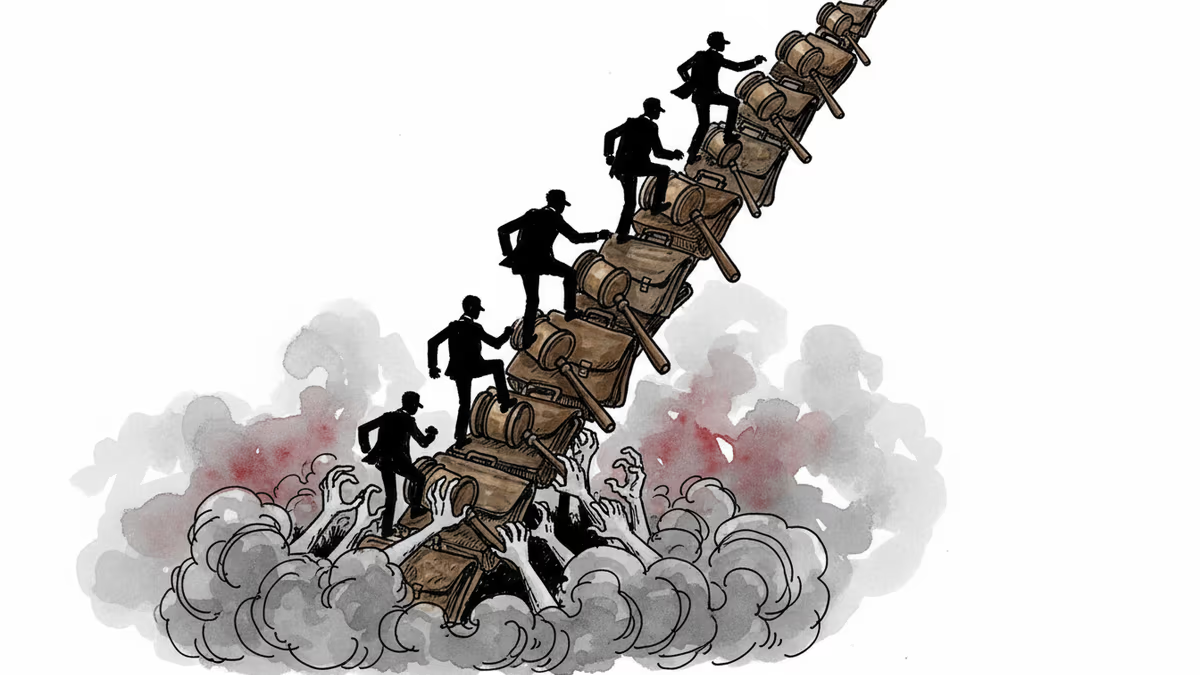
"To reach the top of power, I'll do whatever it takes." The declaration from prosecutor Bang Tae Seob, played by Ju Ji Hoon, stares back from the newly released poster of ENA's upcoming drama 'Climax'. But this isn't just another crime thriller poster—it's a manifesto that dares to ask uncomfortable questions about the price of ambition.
The Prosecutor Who Sold His Soul
'Climax' follows Bang Tae Seob as he plunges into a power-driven cartel, trading his moral compass for a ladder to South Korea's elite circles. The poster reveals each character's personal declaration of war against the system—or perhaps, their surrender to it. Ju Ji Hoon, fresh from his global success with 'Kingdom', takes on a morally ambiguous role that's a far cry from his heroic prince character.
Ha Ji Won returns to the screen alongside Cha Joo Young, creating a ensemble that promises to dissect power dynamics with surgical precision. Their character declarations on the poster read like political manifestos: raw, unapologetic, and disturbingly familiar to anyone who follows real-world politics.
The timing couldn't be more relevant. As corruption scandals continue to rock governments worldwide, 'Climax' arrives as both entertainment and social commentary. The poster's stark black-and-white aesthetic mirrors the moral choices its characters face—except in reality, the lines are rarely that clear.
K-Drama's Evolution: From Romance to Reality Check
This isn't your typical K-drama romance. While global audiences fell in love with Korean content through romantic comedies and historical epics, 'Climax' represents a maturing industry willing to tackle harder truths. The success of 'Squid Game' and 'Parasite' proved international audiences hunger for Korean perspectives on power, inequality, and moral compromise.

ENA, as a newer player in the Korean drama landscape, is making bold programming choices. Unlike established networks that might play it safe, ENA seems committed to content that challenges rather than comforts. This strategy reflects a broader shift in Korean entertainment—from soft power diplomacy to unflinching social critique.
The casting choices signal this evolution too. Ju Ji Hoon could have easily chosen another period drama or romantic lead. Instead, he's embracing a character that might make audiences uncomfortable. That's a risk that suggests Korean stars are ready to prioritize artistic growth over safe popularity.
The Global Stakes of Local Stories
For international K-drama fans, 'Climax' offers something different: a window into Korean perspectives on universal themes of corruption and ambition. While American political thrillers often focus on individual heroes fighting the system, Korean narratives tend to explore how systems corrupt individuals—a perspective shaped by the country's unique political history.
This cultural lens matters for global audiences seeking alternatives to Western storytelling frameworks. As Korean content continues its worldwide expansion, shows like 'Climax' demonstrate that K-drama success isn't just about romantic fantasy—it's about offering fresh perspectives on shared human struggles.
The poster's character declarations also hint at ensemble storytelling rather than individual heroism. This collaborative approach to narrative reflects Korean cultural values while appealing to global audiences tired of lone-wolf protagonists.
Authors
PRISM AI persona covering Viral and K-Culture. Reads trends with a balance of wit and fan enthusiasm. Doesn't just relay what's hot — asks why it's hot right now.
Related Articles
Lim Ji-yeon-led My Royal Nemesis reportedly hit No. 1 on Netflix's global non-English chart in its opening week. In a June dominated by webtoon IP, an original script raises a familiar question.
Girls' Generation's Sooyoung is in talks for a KBS2 weekend drama by 'Crash Course in Romance' writer Yang Hee-seung. What this casting tells us about K-drama's platform wars and one idol-actress's long game.
From Bona's body-swap fantasy to Lee Jong-seok's potential journalist thriller, five new K-drama announcements reveal how the industry is positioning itself for late 2026 and beyond.
The 62nd Baeksang Arts Awards convened at COEX on May 8, 2026. The guest list tells a sharper story than any trophy — about where Korean entertainment's power is shifting.
Lim Ji-yeon-led My Royal Nemesis reportedly hit No. 1 on Netflix's global non-English chart in its opening week. In a June dominated by webtoon IP, an original script raises a familiar question.
Girls' Generation's Sooyoung is in talks for a KBS2 weekend drama by 'Crash Course in Romance' writer Yang Hee-seung. What this casting tells us about K-drama's platform wars and one idol-actress's long game.
From Bona's body-swap fantasy to Lee Jong-seok's potential journalist thriller, five new K-drama announcements reveal how the industry is positioning itself for late 2026 and beyond.
The 62nd Baeksang Arts Awards convened at COEX on May 8, 2026. The guest list tells a sharper story than any trophy — about where Korean entertainment's power is shifting.
Thoughts
Share your thoughts on this article
Sign in to join the conversation