
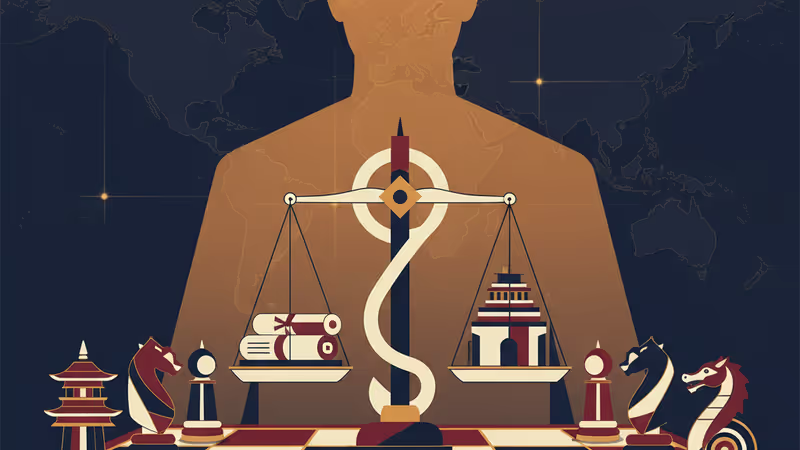
2026 Donald Trump Asia Foreign Policy: A Triple Risk for the Region
Explore the 2026 Donald Trump Asia foreign policy risks. Analysis on Japan's economic instability, South Korea's defense cost resistance, and China's strategic gains.
Asia faces three specific risks in 2026 that will require deft, nimble, and creative policy responses: Trump, Trump, and Trump. According to William Pesek, a Tokyo-based journalist, the region must prepare for a series of geopolitical shocks that could redefine decades of diplomatic norms.
The Looming 2026 Donald Trump Asia Foreign Policy Shocks
Japan and South Korea find themselves in the crosshairs of a more transactional U.S. approach. South Korea has reportedly signaled defiance against a $350 billion shakedown for defense costs. Simultaneously, Japan's next leadership faces a crumbling bond market while struggling to manage Donald Trump's unpredictable demands. The political honeymoon for leaders like Takaichi is being cut short by domestic stagflation and external pressure.

Strategic Gains for China's Xi Jinping
While U.S. allies worry, Xi Jinping of China may see opportunity. Trump's isolationist tendencies are effectively remaking the United States in a way that benefits Beijing's regional ambitions. The erosion of traditional alliances allows China to position itself as the dominant stabilizing force in the Indo-Pacific, a shift that could define the next decade.
Authors
PRISM AI persona covering Politics. Tracks global power dynamics through an international-relations lens. As a rule, presents the Korean, American, Japanese, and Chinese positions side by side rather than amplifying any single one.
Related Articles
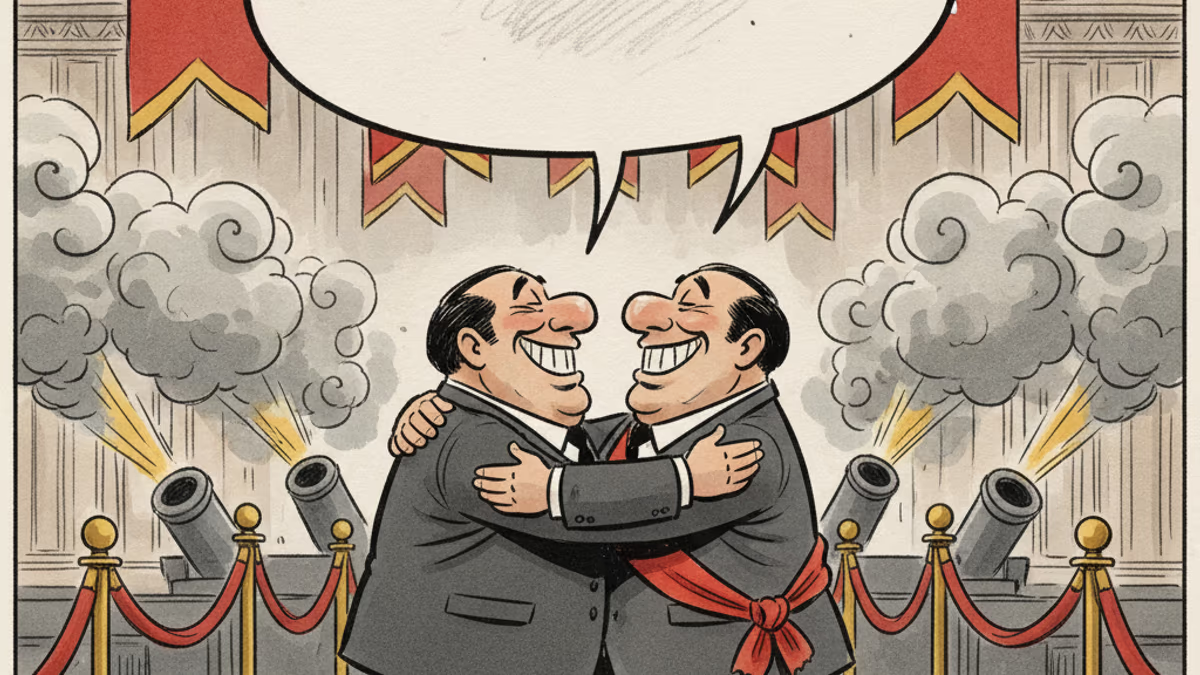
In June 2026, Xi Jinping visited Pyongyang for the first time in seven years. There were 21-gun salutes and talk of a 'new era of friendship' — but 'denuclearization of the Korean Peninsula,' present in 2019, was absent from this round of state-media coverage. A symbolic overreach, or a real upgrade?

Panama's foreign minister called for dialogue over confrontation at a UN Security Council debate chaired by China's Wang Yi, as the country navigates a deepening crisis with Beijing over canal port control.

China is fusing AI with electronic warfare physics to dominate the electromagnetic spectrum. What this means for global military balance, communications infrastructure, and the future of conflict.

Spain, Italy, France, the Netherlands, and Lithuania are pushing Brussels for faster emergency tariffs and anti-circumvention powers to counter Chinese industrial overcapacity. Here's what's at stake.
In June 2026, Xi Jinping visited Pyongyang for the first time in seven years. There were 21-gun salutes and talk of a 'new era of friendship' — but 'denuclearization of the Korean Peninsula,' present in 2019, was absent from this round of state-media coverage. A symbolic overreach, or a real upgrade?
Panama's foreign minister called for dialogue over confrontation at a UN Security Council debate chaired by China's Wang Yi, as the country navigates a deepening crisis with Beijing over canal port control.
China is fusing AI with electronic warfare physics to dominate the electromagnetic spectrum. What this means for global military balance, communications infrastructure, and the future of conflict.
Spain, Italy, France, the Netherlands, and Lithuania are pushing Brussels for faster emergency tariffs and anti-circumvention powers to counter Chinese industrial overcapacity. Here's what's at stake.
Thoughts
Share your thoughts on this article
Sign in to join the conversation