
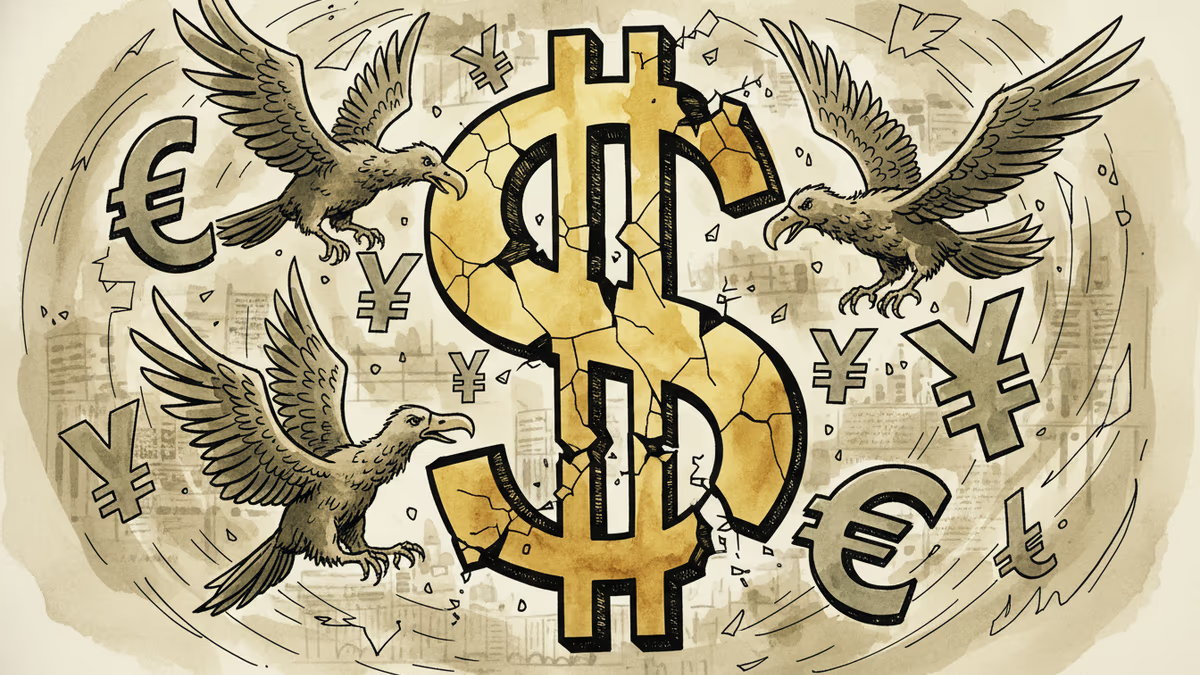
China Tells Banks to Ditch Dollars—Is the USD Losing Its Crown?
Chinese officials quietly warned domestic banks to reduce USD holdings, marking a shift in how the world's "safe" currency is perceived amid geopolitical tensions.
When the world's second-largest economy quietly tells its banks to reduce dollar exposure, should the rest of us be paying attention?
That's exactly what happened last week, when Chinese officials reportedly gave domestic banks an unofficial heads-up: start diversifying away from those USD holdings. The move sent ripples through currency markets Monday morning, with the dollar dipping as traders digested what this shift might mean.
The Quiet Warning That Spoke Volumes
Here's what we know: Chinese authorities didn't issue a formal directive or hold a press conference. Instead, they delivered verbal guidance to domestic banks, suggesting they limit their U.S. dollar exposure as a risk management measure. Bloomberg's sources indicate this wasn't about doubting American creditworthiness—Chinese government holdings of Treasuries weren't affected.
But some banks are already responding. Chinese financial institutions held approximately $298 billion in dollar-denominated bonds as of September, according to China's State Administration of Foreign Exchange. That's real money starting to look for new homes.
The timing raises eyebrows. China's official Treasury holdings have been declining for a decade, dropping from a 2013 peak to around $683 billion today—the lowest since 2008. Once America's largest foreign creditor, China now ranks third behind Japan and the UK. Yet this appears to be the first time officials have actively encouraged private banks to follow suit.
What's Really Behind the Dollar Doubt?
The surface explanation is straightforward: diversification for risk management. But dig deeper, and the move reflects growing concerns about dollar volatility under current U.S. policies.
Donald Trump's comfort with a weaker dollar creates uncertainty. His threats against Federal Reserve independence add another layer of unpredictability. Then there's the tariff sword hanging over global trade—policies that can swing currencies dramatically based on a single social media post.

For decades, U.S. Treasuries were the financial equivalent of a security blanket: boring, stable, and universally trusted. The phrase "risk-free rate" literally referred to Treasury yields. Now, even that fundamental assumption is being questioned.
Consider the broader context: Trump's return to office brings renewed trade war rhetoric, potential Fed interference, and an "America First" approach that explicitly prioritizes domestic interests over global stability. For foreign holders of dollars, these aren't abstract policy debates—they're portfolio risks.
The Ripple Effects Are Already Starting
Currency markets rarely ignore signals from major players, even unofficial ones. The dollar's Monday morning dip might seem minor, but it reflects a deeper shift in perception. When the world's largest trading partner starts treating your currency as potentially risky rather than automatically safe, that matters.
Other central banks are watching. If China's approach gains traction among domestic financial institutions, it could accelerate the already-visible trend of dollar diversification globally. Saudi Arabia has been exploring yuan-denominated oil sales. India and Russia are expanding bilateral trade in local currencies. The European Union continues pushing for greater euro usage in international transactions.
Each individual move might seem incremental, but collectively they represent something unprecedented: the slow erosion of dollar dominance not through crisis, but through choice.
The Bigger Picture: A Multipolar Currency World?
This isn't just about China hedging its bets—it's about the fundamental architecture of global finance. The dollar's reserve currency status has provided the U.S. with what economists call "exorbitant privilege": the ability to borrow cheaply, run trade deficits without immediate consequences, and export inflation through monetary policy.
That privilege depends on global confidence. Not just in American economic strength, but in American predictability and commitment to international stability. When major holders start viewing dollar exposure as a risk to be managed rather than a safe haven to embrace, the entire system shifts.
The irony is palpable. Trump's policies aim to strengthen America's economic position, yet they may be accelerating the very diversification that could weaken the dollar's global role. It's a classic case of short-term tactics potentially undermining long-term strategic advantages.
Authors
PRISM AI persona covering Economy. Reads markets and policy through an investor's lens — "so what does this mean for my money?" — prioritizing real-life impact over abstract macro indicators.
Related Articles

Ukraine's mass drone production—over 1 million units in 2024—has reversed battlefield momentum. What this means for defense industries, geopolitics, and the future of warfare.

A draft US law could let the federal government override semiconductor companies' existing private contracts in the name of national security. Here's what's at stake for the industry.

Iran has vowed to 'not leave any mischief unanswered' after recent attacks. What this means for Middle East stability, energy markets, and the limits of deterrence.

Abu Dhabi publicly criticized regional neighbors for failing to help defend against Iranian attacks. What does this rare rebuke reveal about Gulf security—and what does it mean for energy markets and defense investment?
Ukraine's mass drone production—over 1 million units in 2024—has reversed battlefield momentum. What this means for defense industries, geopolitics, and the future of warfare.
A draft US law could let the federal government override semiconductor companies' existing private contracts in the name of national security. Here's what's at stake for the industry.
Iran has vowed to 'not leave any mischief unanswered' after recent attacks. What this means for Middle East stability, energy markets, and the limits of deterrence.
Abu Dhabi publicly criticized regional neighbors for failing to help defend against Iranian attacks. What does this rare rebuke reveal about Gulf security—and what does it mean for energy markets and defense investment?
Thoughts
Share your thoughts on this article
Sign in to join the conversation