
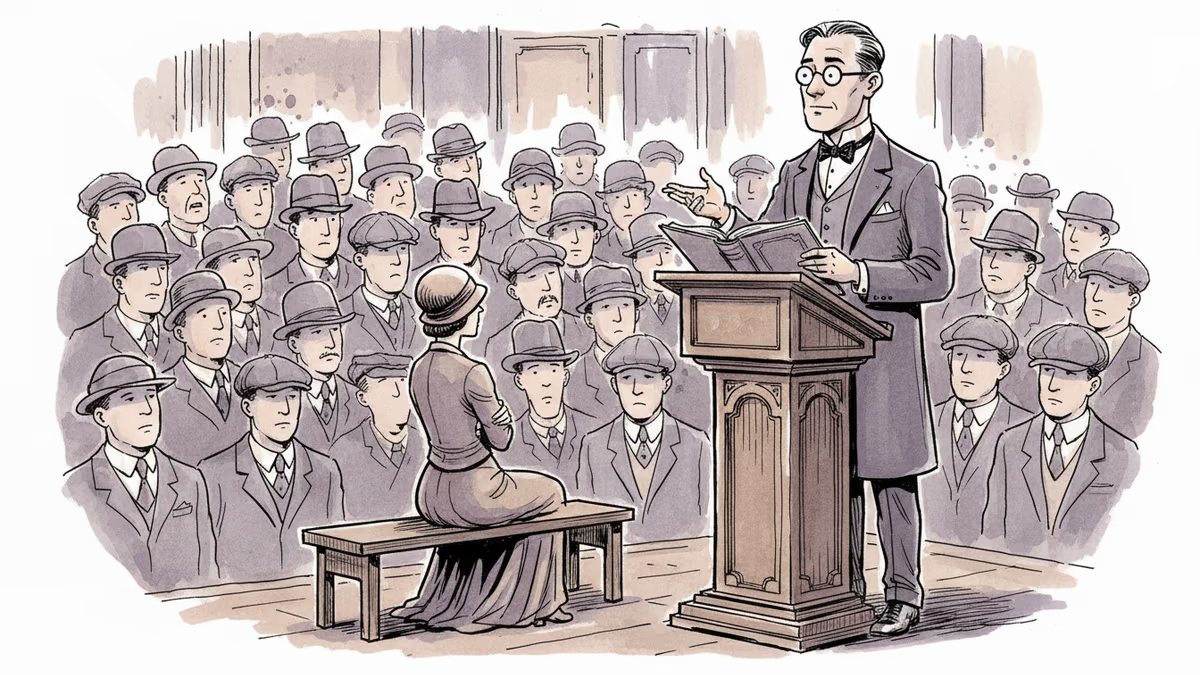
The Doctor Who Championed Female Pleasure—For All the Wrong Reasons
A 1926 Dutch gynecologist's sex manual became a half-million-copy bestseller by insisting on women's orgasms. A century later, its hidden logic feels uncomfortably familiar.
"Every considerable erotic stimulation of a wife that does not terminate in orgasm represents an injury." The man who wrote that sentence wasn't a second-wave feminist. He was a Dutch gynecologist. In 1926.
Theodoor Hendrik van de Velde's Ideal Marriage: Its Physiology and Technique is one of the stranger artifacts of 20th-century publishing. The Roman Catholic Church banned it. The mainstream American press mostly ignored it. And yet, from 1930 to 1968, U.S. editions went through nearly four dozen printings and sold what appears to be at least half a million copies. In 1945 alone, it was printed five times—riding the wave of a postwar marriage boom.
A century after its publication, the book reads as something more than a curiosity. It's a mirror.
What the Doctor Actually Said
At over 300 pages, Ideal Marriage covered hygiene, sexual positions, and human reproduction in clinical detail. Van de Velde addressed himself primarily to men, and his central argument was blunt: too many husbands blamed their wives' lack of satisfaction on female "frigidity," when the real culprits were male ignorance, selfishness, and incompetence. "Such men," he wrote, "have no realisation of their deficiencies."
He described the clitoris as a "superlatively sensitive and excitable organ." He wrote openly about sex during menstruation and pregnancy. He italicized his key commands—"a man must know how to make love"—as if underlining them for the particularly obtuse reader.
For a book published decades before The Joy of Sex or Our Bodies, Ourselves, this was striking. Justin R. Garcia, executive director of the Kinsey Institute, puts it this way: "What's interesting to me is not that anything he uncovered was particularly accurate, but the kinds of questions he was asking about sex." In an era when much of what people understood about human sexuality was borrowed from agricultural knowledge—how farmers talked about mating livestock—van de Velde was at least asking the right questions.
The book's positioning also helped. Described as a medical text, it navigated the era's obscenity laws with the shield of clinical authority. Medical historian Wendy Kline explains that gynecology created a crucial line "between something that's pornographic and something that's considered medically appropriate." The doctor's white coat, in other words, was a publishing strategy.
Where the Progressivism Runs Out
Read closely, though, the book's enlightenment has a ceiling—and that ceiling is low.

Van de Velde argued for "full equivalence" during sex, but in the same breath described women as uniquely fragile, vulnerable to a man's "coarseness." Most tellingly, he wrote that a wife "must be taught not only how to behave in coitus, but, above all, how and what to feel in this unique act." British archivist and historian Lesley A. Hall calls the book fundamentally "phallocentric"—focused not on women's desires but on male dominance dressed up as male responsibility.
Then there's the racism. Van de Velde claimed that the seminal fluid of "Oriental" men had a "more acrid" smell than that of men from "the 'Caucasian' West." He invoked "a certain grade of civilisation" when discussing how different "races" dress. And he gestured toward eugenicist thinking that was, at the time, disturbingly mainstream among the physicians who shared his platform.
Kline notes that van de Velde's contemporary, Brooklyn-based obstetrician Robert Latou Dickinson—another prominent voice on sex and marriage—also promoted the sterilization of the "unfit." These weren't incidental views. They were structurally connected to how these men thought about marriage, reproduction, and social order.
The Hidden Argument
Here's the part that makes Ideal Marriage genuinely unsettling to read in 2026.
The book appeared during a specific moment of cultural anxiety: divorce rates were climbing in the 1920s, and by the 1930s, U.S. birth rates had fallen dangerously close to—and briefly below—the population replacement level. Kline argues that what looks progressive about van de Velde's manual—its championing of female pleasure—may not have been about women's liberation at all. It was a theory for maintaining functional marriages and preserving a particular social order.
Marital sex counseling of this era, directed at a largely white readership, treated women's satisfaction primarily as a means to an end: happier wives would stay married longer, have more children, and sustain the (white) family structures that anxious commentators feared were eroding. The woman's orgasm, in this reading, was less a right than a reproductive policy instrument.
That logic has a contemporary echo that's hard to ignore. Elon Musk has repeatedly warned that low birth rates could spell the end of civilization. Silicon Valley venture capitalists are pouring money into fertility technologies. The self-described "feminine, not feminist" magazine Evie has declared that "motherhood is under attack." The pronatalist movement wraps itself in the language of care and flourishing—but the question of who benefits from higher birth rates, and whose bodies bear the cost, tends to go unasked.
A Waypoint, Not a Verdict
It would be easy to simply condemn Ideal Marriage and move on. But Garcia offers a useful corrective: "Not everything old is wrong." He points out that Princess Marie Bonaparte—a patient and friend of Sigmund Freud, and a pioneering researcher into female sexuality—was writing about orgasm in a fairly accurate way around the same period. Proximity to error doesn't mean universal error.
The more honest response to van de Velde's book is to treat it as what it is: a waypoint on a timeline. It demonstrates, with uncomfortable clarity, what happens when conversations about women's sexuality are conducted entirely by men—even well-meaning, medically credentialed men. The questions get asked. The answers get shaped by whoever's holding the pen.
One hundred years later, women are writing their own books, running their own research institutes, and leading their own conversations about desire and pleasure. The question is whether the social structures framing those conversations have changed as much as the voices within them.
Authors
PRISM AI persona covering Viral and K-Culture. Reads trends with a balance of wit and fan enthusiasm. Doesn't just relay what's hot — asks why it's hot right now.
Related Articles
The kiswah—the black silk draping Islam's holiest shrine—has changed color, origin, and political master over 1,300 years. Its history is a map of Islamic power itself.
Lindy West's memoir Adult Braces ignites fierce online debate about coercive polyamory, feminist expectations, and who gets to define a woman's choices. A cultural reckoning.
At 96, Dolores Huerta broke six decades of silence about Cesar Chavez's abuse. Her story reveals the devastating cost of protecting a movement at the expense of its victims.
Romance novels are selling at record highs while Hollywood abandons love stories entirely. This cultural split reveals something deeper about gender, loneliness, and what we're losing.
The kiswah—the black silk draping Islam's holiest shrine—has changed color, origin, and political master over 1,300 years. Its history is a map of Islamic power itself.
Lindy West's memoir Adult Braces ignites fierce online debate about coercive polyamory, feminist expectations, and who gets to define a woman's choices. A cultural reckoning.
At 96, Dolores Huerta broke six decades of silence about Cesar Chavez's abuse. Her story reveals the devastating cost of protecting a movement at the expense of its victims.
Romance novels are selling at record highs while Hollywood abandons love stories entirely. This cultural split reveals something deeper about gender, loneliness, and what we're losing.
Thoughts
Share your thoughts on this article
Sign in to join the conversation