
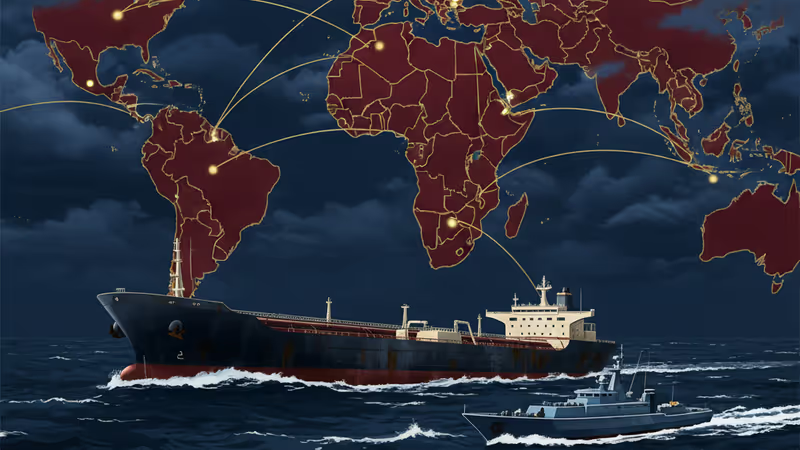
Sanction or Piracy? US Seizure of Venezuelan Oil Tanker Ignites International Legal Firestorm
The recent U.S. seizure of a Venezuelan oil tanker has sparked a fierce debate over international law, pitting claims of legitimate sanction enforcement against accusations of state-sponsored piracy. We analyze the legal and geopolitical fallout.
In the choppy waters of the Caribbean, a U.S. Coast Guard interception of a Venezuelan state-owned oil tanker has escalated into a full-blown international dispute. The incident puts a sharp focus on a critical question: Was it a legitimate enforcement of economic sanctions, or a modern-day act of piracy on the high seas?
According to reports, the confrontation occurred in early December 2025 in international waters. The Venezuelan-flagged tanker, 'El Libertador,' owned by state oil company PDVSA and bound for Asia, was stopped by a U.S. Coast Guard cutter. U.S. authorities claim the vessel was engaged in an illicit crude oil shipment, violating stringent sanctions against Venezuela. The tanker was subsequently seized and diverted to a port in Texas.
The seizure marks one of the most assertive actions taken by the Biden administration this year, following a period of re-tightening sanctions aimed at pressuring the Maduro regime. Washington's long-standing position is that cutting off the government's oil revenue is crucial for restoring democracy in the nation.
We will continue to use all available tools to prevent the illegitimate Maduro regime from using state assets to finance its oppressive activities. This action is part of our lawful and ongoing sanction enforcement efforts to uphold international norms.
Caracas's response was swift and furious. The Venezuelan government condemned the seizure as an act of 'economic terrorism' and 'imperialist aggression.' In a fiery statement, Venezuela's Ministry of Foreign Affairs accused the U.S. of flagrantly violating the UN Convention on the Law of the Sea (UNCLOS), which guarantees freedom of navigation, and called for international condemnation of the act.
The core of the dispute lies in a gray area of international law: the extraterritorial application of a nation's domestic sanctions. UNCLOS firmly establishes freedom of navigation on the high seas for all states. The right to board a foreign ship is strictly limited to exceptional cases like piracy, slave trading, or unauthorized broadcasting. Legal experts argue that unilaterally enforcing domestic sanctions in international waters is a highly contentious practice that risks undermining the rules-based maritime order. This seizure could set a significant precedent, potentially encouraging similar actions and escalating maritime tensions globally.
This content is AI-generated based on source articles. While we strive for accuracy, errors may occur. We recommend verifying with the original source.
Related Articles

Rep. Adam Smith, the leading Democrat on the Armed Services Committee, says the Trump administration's oil blockade on Venezuela is primarily a tool for regime change against President Maduro, challenging the official U.S. justification.
In December 2025, the Cambodia-Thailand border conflict has reignited, shattering a recent peace deal. Explore the 100-year-old dispute rooted in a French colonial map, the 1962 ICJ ruling, and why diplomacy failed.
The U.S. Coast Guard is pursuing a third sanctioned oil tanker near Venezuela, escalating a pressure campaign that could impact global oil prices and heighten geopolitical tensions with the 'shadow fleet.'

US naval forces intercepted a vessel off Venezuela, signaling heightened pressure on Maduro. Dive into the geopolitical implications, regional stability, and global impact of this escalating standoff.