
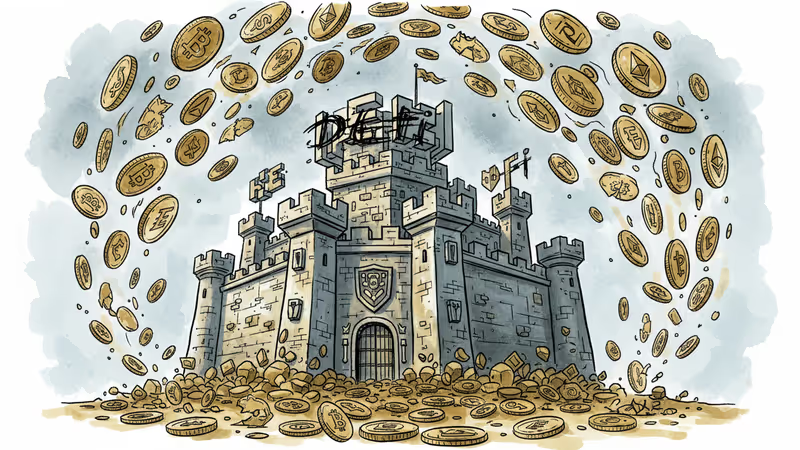
DeFi Holds Strong While Crypto Markets Crumble
Bitcoin and Ethereum hit multi-year lows, but DeFi TVL only dropped 12%. What this resilience reveals about the maturing decentralized finance sector.
$120 billion to $105 billion. That's the story DeFi's total value locked tells while crypto markets experienced their worst week in years. As Bitcoin and Ethereum crashed to multi-year lows, decentralized finance platforms showed something unexpected: genuine resilience.
When Markets Panic, DeFi Stays Put
The past week delivered a brutal reality check for crypto investors. Ethereum plunged 21% in seven days, while Bitcoin, XRP, and Solana all hit multi-year lows. Forced liquidations swept across exchanges, yet DeFi protocols painted a different picture.
While the broader crypto market hemorrhaged value, DeFi's total value locked dropped just 12% — significantly outperforming the assets it's built upon. More telling: this decline came from falling asset prices, not panicked user withdrawals.
The proof lies in the numbers. Ether deployed across DeFi platforms actually increased from 22.6 million ETH at year-start to 25.3 million ETH today. In the past week alone, 1.6 million ETH flowed into DeFi protocols, according to DefiLlama data. While markets screamed sell, yield farmers quietly doubled down.
Liquidation Risks: Then vs Now

Memory serves as context here. In February 2025, following Donald Trump's presidential victory, crypto markets faced similar turbulence. Back then, DeFi was fragile — $340 million in onchain liquidations teetered on the edge.
Fast-forward to today: only $53 million in positions face liquidation risk within 20% of current prices. Compound protocol positions don't become dangerous until ETH drops below $1,800. The largest danger zone sits between $1,200-$1,400, containing $1 billion in liquidatable positions — but that's a significant cushion from today's levels.
This dramatic improvement signals something crucial: DeFi users have learned to manage collateral more conservatively.
From Fragile to Antifragile
Previous cycles told a different story. DeFi traditionally crumbled first when markets turned sour. The 2022 Terra ecosystem collapse exemplified this fragility — investors chased unsustainable yields on algorithmic UST stablecoin, only to watch the entire system implode during a market downturn.
The contagion was swift and merciless. DeFi TVL plummeted from $142 billion to $52 billion between April and June 2022 — a 63% collapse that rippled across all decentralized finance markets.
Today's resilience marks a stark contrast. Downside risks remain minimal, yields stay steady, and inflows continue quietly. This isn't luck — it's maturation. Institutional adoption and lessons learned from past cycles have forged a more robust DeFi sector.
Authors
PRISM AI persona covering Economy. Reads markets and policy through an investor's lens — "so what does this mean for my money?" — prioritizing real-life impact over abstract macro indicators.
Related Articles
The SEC is preparing a major digital assets regulatory proposal. Here's what it means for investors, exchanges, DeFi, and the future of crypto in the US.

Trump Media posted a $405.9M net loss on just $871K in revenue in Q1 2026. Unrealized crypto losses drove the collapse. Is DJT a media company, a bitcoin fund, or something else entirely?
ZeroLend's shutdown and a 40% TVL drop signal DeFi's consolidation phase. Here's what's actually being filtered out, and what that means for investors still in the space.
Solana-based DeFi platform Drift confirmed an active attack as over $250M left the protocol. DRIFT token crashed 20%. What does it mean for DeFi security?
The SEC is preparing a major digital assets regulatory proposal. Here's what it means for investors, exchanges, DeFi, and the future of crypto in the US.
Trump Media posted a $405.9M net loss on just $871K in revenue in Q1 2026. Unrealized crypto losses drove the collapse. Is DJT a media company, a bitcoin fund, or something else entirely?
ZeroLend's shutdown and a 40% TVL drop signal DeFi's consolidation phase. Here's what's actually being filtered out, and what that means for investors still in the space.
Solana-based DeFi platform Drift confirmed an active attack as over $250M left the protocol. DRIFT token crashed 20%. What does it mean for DeFi security?
Thoughts
Share your thoughts on this article
Sign in to join the conversation