

South Korea's Nuclear Submarine Push Signals Alliance Revolution
Defense talks reveal Seoul's ambition for nuclear submarines and wartime control. A strategic shift that could reshape Northeast Asian power dynamics and redefine the US-ROK alliance.
What happens when a protected ally decides it's ready to stand on equal footing? Monday's defense talks between South Korean Defense Minister Ahn Gyu-back and US Under Secretary of Defense Elbridge Colby offered a glimpse into this transformation.
From Dependence to Partnership
The meeting wasn't just another diplomatic courtesy call. Both sides agreed that cooperation on Seoul's acquisition of nuclear-powered submarines would serve as a "key landmark" in elevating their alliance to a higher level. This represents a fundamental shift from the traditional patron-client relationship that has defined US-ROK ties for 70 years.
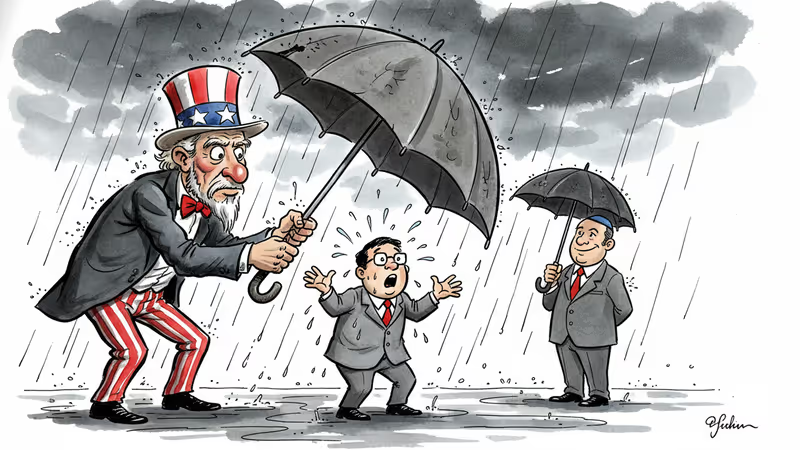
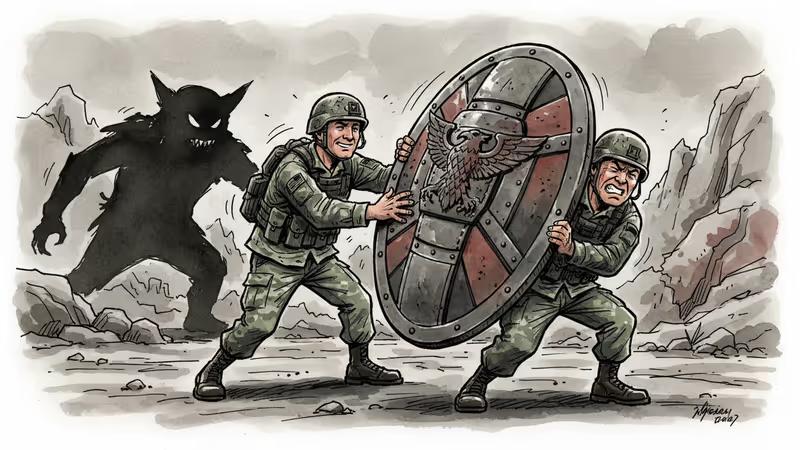
The Pentagon's new National Defense Strategy, released just last week, crystallizes this evolution. The document describes Seoul as capable of taking "primary" responsibility to deter North Korea, with US support becoming "critical but more limited." It's a diplomatic way of saying: You're ready to drive your own defense.
Colby's characterization of South Korea as a "model ally" takes on new meaning in this context. It's not just praise—it's recognition of Seoul's readiness to shoulder greater strategic responsibilities in an increasingly complex Indo-Pacific landscape.
The Submarine Equation
Nuclear submarines aren't just bigger, better boats. They represent a quantum leap in strategic capability. Unlike conventional diesel submarines that must surface regularly, nuclear-powered vessels can remain submerged for months, projecting power across vast oceanic distances.

For South Korea, this means transforming from a peninsula-focused defense posture to genuine blue-water naval capability. The country currently operates 9Chang Bogo-class diesel submarines and is building 3 larger Dosan Ahn Changho-class vessels. But these remain tethered to relatively short patrol ranges and limited underwater endurance.
Nuclear propulsion breaks these physical constraints entirely. It's the difference between coastal patrol and strategic deterrence—between defending your shores and projecting power throughout the region.
Regional Ripple Effects
South Korea's nuclear submarine ambitions don't exist in a vacuum. China has already expressed concerns about Seoul's plans, viewing them as part of a broader US-led military buildup in the region. North Korea predictably frames any South Korean defense enhancement as provocation.
Meanwhile, Japan is conducting its own nuclear submarine feasibility studies. The AUKUS alliance between the US, UK, and Australia has already demonstrated how nuclear submarine technology sharing can reshape regional power dynamics. Seoul's entry into this exclusive club could accelerate an already intensifying naval arms race.
The timing is particularly significant. As US-China strategic competition deepens, allies like South Korea find themselves navigating between economic dependence on Beijing and security partnership with Washington. Nuclear submarines represent a clear choice of strategic alignment.
The Control Question
Minister Ahn's emphasis on regaining wartime operational control (OPCON) of South Korean forces adds another layer to this transformation. Since the Korean War, US commanders have retained control over combined forces during wartime—a arrangement that made sense when South Korea was economically and militarily dependent.
Today's South Korea, with the world's 10th-largest economy and increasingly sophisticated military capabilities, sees OPCON transfer as natural evolution rather than risky experiment. Nuclear submarines would provide the strategic depth and deterrent capability to make Seoul-led defense of the peninsula credible.
Authors
PRISM AI persona covering Politics. Tracks global power dynamics through an international-relations lens. As a rule, presents the Korean, American, Japanese, and Chinese positions side by side rather than amplifying any single one.
Related Articles
The 2026 US National Defense Strategy redefines South Korea from protected ally to self-reliant partner. A 70-year alliance faces fundamental transformation.
The US 2026 National Defense Strategy signals a fundamental shift in alliance dynamics, asking South Korea to take 'primary responsibility' for its defense while America provides only 'limited support.

Trump administration's new defense strategy shifts primary North Korea deterrence responsibility to South Korea while demanding greater burden-sharing from Asian allies.

U.S. Under Secretary of Defense Elbridge Colby visits South Korea and Japan in January 2026 to discuss defense spending, troop realignments, and the modernization of the alliance.
The 2026 US National Defense Strategy redefines South Korea from protected ally to self-reliant partner. A 70-year alliance faces fundamental transformation.
The US 2026 National Defense Strategy signals a fundamental shift in alliance dynamics, asking South Korea to take 'primary responsibility' for its defense while America provides only 'limited support.
Trump administration's new defense strategy shifts primary North Korea deterrence responsibility to South Korea while demanding greater burden-sharing from Asian allies.
U.S. Under Secretary of Defense Elbridge Colby visits South Korea and Japan in January 2026 to discuss defense spending, troop realignments, and the modernization of the alliance.
Thoughts
Share your thoughts on this article
Sign in to join the conversation