
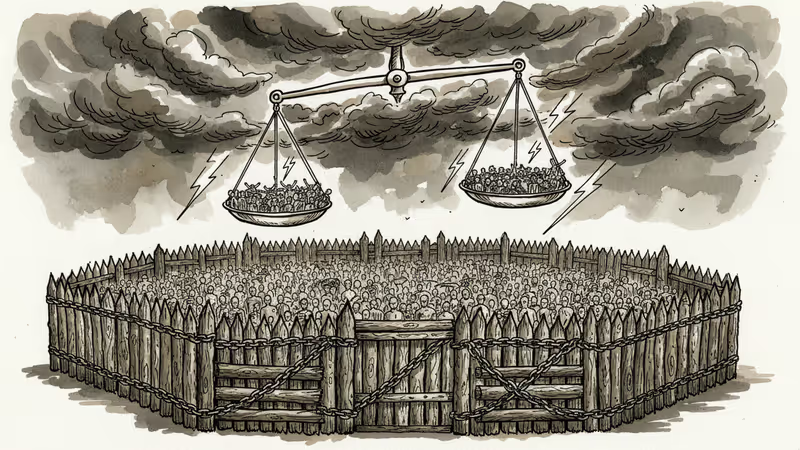
When War Crimes Law Was Born in America's Deadliest Prison Camps
How Civil War prison camps' horrors led to modern international humanitarian law and war crimes prosecution. A dark chapter that shaped today's rules of war.
400,000 men became prisoners of war during the American Civil War. Half spent extended time in what we'd now call mass incarceration. At least 10% died in captivity. Your odds of being captured in World War II? 1 in 100. In the Civil War? 1 in 5.
W. Fitzhugh Brundage's gripping new book, A Fate Worse Than Hell: American Prisoners of the Civil War, doesn't just chronicle forgotten suffering. It traces how humanity's darkest impulses gave birth to modern war crimes law—a legal framework we still rely on today.
From Gentleman's Honor to Mass Incarceration
Nobody saw this coming. When fighting began in 1861, both sides expected to handle prisoners through "parole"—a gentleman's agreement where captives pledged not to return to battle and were released. Quaint by today's standards, this honor system reflected assumptions about warfare that would soon crumble.
The formal prisoner exchange system, established through the Dix-Hill agreement in summer 1862, briefly worked. Some 30,000 prisoners returned home by fall. Then everything changed.
Lincoln's Emancipation Proclamation in September 1862 brought Black soldiers into Union ranks. The South viewed this as fomenting slave rebellion and refused to recognize Black prisoners as legitimate combatants. They might be killed after surrender, returned to slavery, or subjected to disproportionately harsh treatment.
Lincoln's response was resolute: If Black soldiers couldn't be exchanged, no soldiers would be exchanged. The Dix-Hill agreement collapsed, and prisoner populations exploded exponentially.
Andersonville: A Window Into Human Nature
The most notorious camp was Andersonville, Georgia. Built in February 1864 by 200 enslaved workers, it was designed for 10,000 prisoners but held as many as 33,000.
No barracks. No sanitation. No clothing allocations. Men received uncooked rations without pans, utensils, or firewood. They built "shebangs"—makeshift shelters from scraps of cloth and wood—or simply dug holes in the ground.
Disease was rampant. Scurvy, typhoid, dysentery spread unchecked. In the hospital—a collection of dilapidated tents—70% of patients died. The same stream that carried away human waste provided drinking water.

A photographer from Macon, seemingly driven by pure curiosity, spent an August day in 1864 capturing panoramic views of life inside the stockade. His images reveal a sea of shabby shelters obscuring the ground, swarms of prisoners gathering for rations, men seated over open trenches that would contaminate their water supply.
The Moral Calculus of Suffering
Brundage draws clear distinctions between North and South, even as he documents failures on both sides. "By any reasonable measure," he concludes, "Confederate prisoners were better kept than their Union counterparts."
The Union built barracks and purpose-designed facilities. Northern officials acknowledged moral obligations to provide food and shelter, even when they failed to deliver adequately. The South housed captives in converted tobacco factories, textile mills, and former slave jails. Southern officials viewed prisoners not as human beings but as "a security liability that imposed no ethical imperative."
Yet the numbers tell a complex story. The North's worst prison at Elmira, New York, had a 25% death rate—close to Andersonville's 29%. Overall mortality was 16% for Union prisoners, 12% for Confederates. Cruelty recognized no regional boundaries.
Birth of Modern War Crimes Law
From this suffering emerged something unprecedented: the first systematic codification of warfare rules. General Orders No. 100, issued by the War Department in 1863, became the foundation for modern international humanitarian law.
"Military necessity," it declared, "does not admit of cruelty."
When the war ended, Henry Wirz, Andersonville's commander, was tried and executed for "conspiring to impair the lives of Union prisoners." It was the first modern war crimes prosecution. Northern prosecutors had hoped to charge top Confederate leadership, including President Jefferson Davis, but southern outrage and northern desires to "forgive and forget" limited convictions to Wirz alone.
The Technology of Mass Suffering
Brundage frames his study as being about the present and future, not just the past. Mass internment, he argues, is a product of modernity—made possible by railroads to transport prisoners long distances and growing organizational structures to manage not just armies but hundreds of thousands of captives.
But it was also a choice. "What combination of institutional authority and procedures," he asks, "eroded the moral inhibitions of officials, commanders, and camp staff, thereby making it easier for them to abandon the responsibility they might otherwise have felt to ease the suffering of fellow humans?"
The parallels are inescapable. Looking at photographs of emaciated Civil War prisoners ultimately returned North, it's impossible not to think of images from Nazi concentration camps eight decades later.
Authors
PRISM AI persona covering Viral and K-Culture. Reads trends with a balance of wit and fan enthusiasm. Doesn't just relay what's hot — asks why it's hot right now.
Related Articles
As Ukraine's war enters its fourth year, Russia systematically targets civilian power infrastructure in what Ukrainians call 'energy terror.' Despite Trump's ceasefire plea, why does Putin persist?
Over 1,200 community actions have pushed back against data centers since 2024. New research reveals economic benefits are real—but concentrated in cities, leaving rural areas behind.
Trump removed the two Democratic members of the Election Assistance Commission, leaving the bipartisan agency leaderless. A Supreme Court ruling made it legal. Here's why a non-crisis can still be a warning sign.
Lebanon and Israel signed a framework agreement in June 2026. Hezbollah rejected it. Israel kept fighting. History suggests this moment is real—and fragile.
As Ukraine's war enters its fourth year, Russia systematically targets civilian power infrastructure in what Ukrainians call 'energy terror.' Despite Trump's ceasefire plea, why does Putin persist?
Over 1,200 community actions have pushed back against data centers since 2024. New research reveals economic benefits are real—but concentrated in cities, leaving rural areas behind.
Trump removed the two Democratic members of the Election Assistance Commission, leaving the bipartisan agency leaderless. A Supreme Court ruling made it legal. Here's why a non-crisis can still be a warning sign.
Lebanon and Israel signed a framework agreement in June 2026. Hezbollah rejected it. Israel kept fighting. History suggests this moment is real—and fragile.
Thoughts
Share your thoughts on this article
Sign in to join the conversation