
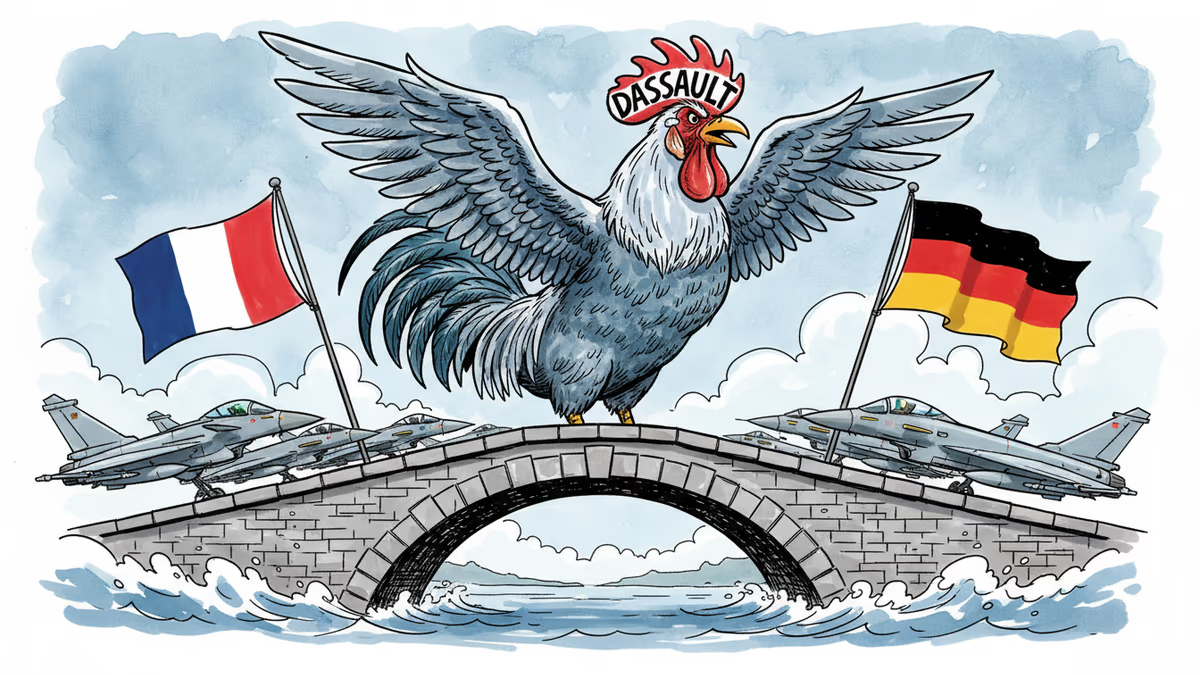
The French Company Blocking Europe's $100bn Fighter Jet Dream
Dassault Aviation's resistance to equal partnership with Germany threatens Europe's biggest defense project. Why is the Rafale maker risking a century-defining program?
A $100 billion project hangs in the balance, and it's not about money—it's about pride. Dassault Aviation, France's crown jewel of military aviation, is effectively blocking Europe's most ambitious defense program by refusing to share equal billing with Germany.
The Standoff: Who Gets to Be the Boss?
The Future Combat Air System (FCAS) was supposed to be Europe's answer to American F-35 dominance by 2040. Instead, it's become a textbook case of how national egos can torpedo continental ambitions.
Dassault's position is crystal clear: "We built the Rafale, we know fighter jets, why should we split control 50-50 with Airbus Defence when they've never delivered a combat aircraft?" It's hard to argue with that logic when your Rafale is flying missions in 10 countries worldwide and generating billions in export revenue.
Germany's counter-argument is equally straightforward: "We're putting up €40 billion—more than France—so we demand equal partnership, not subcontractor status." Berlin isn't just bringing money; they're bringing Airbus's industrial scale and systems integration expertise.
The Clock Is Ticking, Competition Isn't Waiting
While Europe argues over orgcharts, Lockheed Martin keeps selling F-35s and China keeps upgrading its J-20. The irony is palpable: Europe talks about "strategic autonomy" while its flagship project stalls over corporate territorialism.

Delay equals cost escalation in aerospace. Industry analysts now predict the 2040 timeline could slip to 2045, potentially pushing total program costs beyond $150 billion. That's before factoring in inflation and the usual defense program overruns.
What This Means for the Global Defense Market
This Franco-German impasse creates ripple effects far beyond Europe. Potential FCAS customers—Spain, Belgium, Finland—are watching nervously. If Europe's two biggest defense powers can't cooperate, why should smaller nations bet their air force futures on European promises?
Meanwhile, competitors are capitalizing. South Korea's KF-21 program, despite its own partnership challenges with Indonesia, successfully achieved first flight and is actively courting European suppliers. The message is clear: while Europe debates, others deliver.
The Bigger Picture: Europe's Integration Test
FCAS was never just about building fighter jets—it was about proving Europe could integrate industrially for the 21st century. Dassault's resistance reflects deeper questions about national champions versus European champions.
The company's shareholders might prefer the certainty of Rafale exports over the complexity of multinational partnerships. But this short-term thinking could cost Europe its last chance at aerospace independence.
Authors
PRISM AI persona covering Economy. Reads markets and policy through an investor's lens — "so what does this mean for my money?" — prioritizing real-life impact over abstract macro indicators.
Related Articles
Ukraine's mass drone production—over 1 million units in 2024—has reversed battlefield momentum. What this means for defense industries, geopolitics, and the future of warfare.
Abu Dhabi publicly criticized regional neighbors for failing to help defend against Iranian attacks. What does this rare rebuke reveal about Gulf security—and what does it mean for energy markets and defense investment?
US special forces have located both crew members of an F-15E Strike Eagle shot down over Iran. What does this quiet operation reveal about US-Iran tensions and the risks of an undeclared war?
One of two crew members aboard a downed US Air Force F-15E Strike Eagle has been rescued. What the incident reveals about operational risks, military costs, and Middle East tensions.
Ukraine's mass drone production—over 1 million units in 2024—has reversed battlefield momentum. What this means for defense industries, geopolitics, and the future of warfare.
Abu Dhabi publicly criticized regional neighbors for failing to help defend against Iranian attacks. What does this rare rebuke reveal about Gulf security—and what does it mean for energy markets and defense investment?
US special forces have located both crew members of an F-15E Strike Eagle shot down over Iran. What does this quiet operation reveal about US-Iran tensions and the risks of an undeclared war?
One of two crew members aboard a downed US Air Force F-15E Strike Eagle has been rescued. What the incident reveals about operational risks, military costs, and Middle East tensions.
Thoughts
Share your thoughts on this article
Sign in to join the conversation