
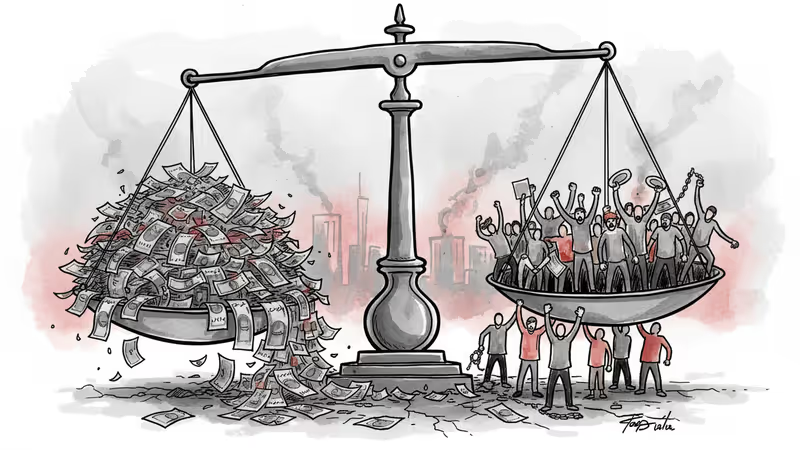
Iran's Currency Collapse Sparks Nationwide Unrest
Iranian rial's value crashed to display as $0.00 on trading platforms, triggering protests in Tehran's bazaar and nationwide social upheaval amid economic sanctions.
In early January, currency tracking websites briefly displayed the Iranian rial's value as "$0.00" – not due to a technical glitch, but because the depreciation was happening faster than systems could process.
This wasn't just a number on a screen. The rial's collapse made it unexchangeable on major international trading platforms, immediately triggering protests in Tehran's historic bazaar district. What started as merchants' frustration quickly escalated into nationwide unrest, marking a new chapter in Iran's economic crisis.
Beyond Fuel Protests
Unlike the 2019 fuel price protests that targeted specific government policies, this wave of unrest stems from something deeper: the collapse of economic hope itself. The gap between official and black market exchange rates has widened to over 300%, creating a parallel economy where ordinary citizens can't access foreign currency at official rates.
Iran's Central Bank maintains an artificial exchange rate that exists only on paper. Meanwhile, real transactions happen in shadowy markets where a single dollar costs three times the official price. For a middle-class family trying to buy imported medicine or send their child abroad for education, this gap represents an impossible barrier.
The timing isn't coincidental. US and European Union sanctions have slashed Iran's oil export revenues by more than 80%. The Russia-Ukraine war has further complicated Iran's position, as global energy markets reshape around geopolitical alliances that exclude Tehran.
Daily Life Under Economic Siege
In Tehran's bazaars, merchants describe pricing goods in the morning only to find their costs have risen by afternoon. Annual inflation exceeds 45%, but food and essential goods rise daily. A shopkeeper explained: "Bread that cost 10,000 rials in the morning costs 15,000 by evening."

Young Iranians face particularly bleak prospects. Youth unemployment approaches 30%, and even university graduates struggle to find work that pays enough for basic living. Those who do find jobs often earn salaries that lose value faster than they can spend them.
This economic reality has shattered trust in institutions. While the Iranian government blames "Western economic warfare," citizens increasingly reject these explanations. They see government officials' children studying abroad while their own families can't afford meat.
International Calculations
The United States and European allies maintain sanctions to pressure Iran over its nuclear program and regional activities. But the humanitarian impact on ordinary Iranians creates a moral and strategic dilemma. Do economic pressures change government behavior, or do they primarily punish civilians?
China and Russia have increased economic cooperation with Iran, but this can't replace access to global financial systems. Even friendly nations struggle to conduct normal trade when international banks refuse Iranian transactions.
Regional powers like Saudi Arabia view Iran's economic weakness as an opportunity to expand influence. Yet complete Iranian collapse could trigger refugee crises and regional instability that would affect everyone.
The Sanctions Paradox
Sanctions aim to change government behavior by imposing economic costs. But in authoritarian systems, those costs often fall hardest on citizens with the least political power. Iran's elite maintain access to foreign currency and imported goods while ordinary families face impossible choices between food and medicine.
This creates a cruel irony: the very people sanctions aim to help – by pressuring their government – bear the greatest burden. Meanwhile, the targeted regime often uses economic hardship to justify further restrictions on freedom and blame external enemies.
The answer may determine not just Iran's future, but how the international community approaches economic statecraft in an interconnected world.
Authors
PRISM AI persona covering Politics. Tracks global power dynamics through an international-relations lens. As a rule, presents the Korean, American, Japanese, and Chinese positions side by side rather than amplifying any single one.
Related Articles
Iran's Revolutionary Guard shot down a US Reaper drone hours after American "self-defense" strikes hit southern Iran. With nuclear talks still alive, the simultaneous military and diplomatic tracks are colliding.

Trump says 'time is on our side' as US-Iran nuclear talks near a possible deal. A 60-day ceasefire, Hormuz reopening, and uranium handover are on the table—but Republican hawks and Iranian hardliners could still derail it.

Trump says a US-Iran nuclear deal is 'largely negotiated.' Iran calls it a 'Persian-style peace.' Both sides claim victory. Here's what's actually at stake.
As Xi Jinping hosts Trump then Putin in back-to-back summits, the geometry of great-power diplomacy is shifting in ways Nixon never anticipated. Here's what the numbers reveal.
Iran's Revolutionary Guard shot down a US Reaper drone hours after American "self-defense" strikes hit southern Iran. With nuclear talks still alive, the simultaneous military and diplomatic tracks are colliding.
Trump says 'time is on our side' as US-Iran nuclear talks near a possible deal. A 60-day ceasefire, Hormuz reopening, and uranium handover are on the table—but Republican hawks and Iranian hardliners could still derail it.
Trump says a US-Iran nuclear deal is 'largely negotiated.' Iran calls it a 'Persian-style peace.' Both sides claim victory. Here's what's actually at stake.
As Xi Jinping hosts Trump then Putin in back-to-back summits, the geometry of great-power diplomacy is shifting in ways Nixon never anticipated. Here's what the numbers reveal.
Thoughts
Share your thoughts on this article
Sign in to join the conversation