
Microdosing Fails Where Placebo Succeeds in Depression Study
A major clinical trial found microdosing LSD performed worse than placebo for treating depression, challenging a decade of Silicon Valley hype around psychedelic wellness.
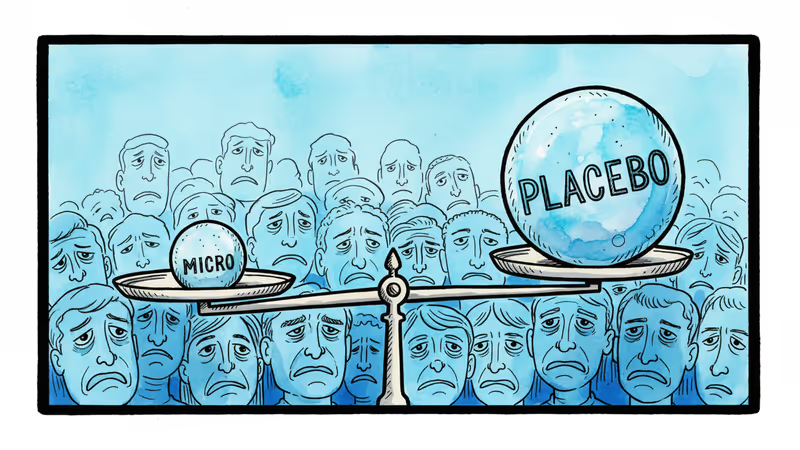
After a decade of Silicon Valley evangelism, microdosing has hit its first major scientific roadblock. A clinical trial of 89 adults with major depression found that tiny doses of LSD performed worse than a sugar pill.
The results from MindBio Therapeutics, an Australian biopharma company, represent the most rigorous test yet of microdosing's most promising claim: that it can treat clinical depression. Over 8 weeks, researchers used the Montgomery-Åsberg Depression Rating Scale (MADRS) to track symptoms. The outcome wasn't just disappointing—it was the opposite of what microdosing advocates predicted.
The Rise of Psychedelic Minimalism
Microdosing emerged around 2015 as the "have your cake and eat it too" approach to psychedelics. Instead of full-blown trips with melting walls and kaleidoscopic visions, practitioners sought what they called "sub-perceptual" doses—typically 5-10% of a recreational amount of LSD or psilocybin mushrooms.
The promise was intoxicating: all the benefits of psychedelics with none of the risks. Improved focus for the morning meeting, enhanced creativity for the afternoon brainstorm, better mood for the evening dinner party. Tech workers, entrepreneurs, and wellness enthusiasts embraced it as a "psychedelic Swiss Army knife."
Anecdotal reports flooded Reddit forums and biohacking communities. Users claimed everything from increased libido to breakthrough insights about their relationships. But the most compelling testimonials centered on mental health—people reporting dramatic improvements in depression and anxiety after starting a microdosing regimen.
When Science Meets Hype
The MindBio study represents a crucial reality check. Unlike previous research that relied heavily on self-reported surveys or observational studies, this was a proper Phase 2B clinical trial with a control group and standardized depression measurements.

The results were stark. Not only did microdosing fail to outperform placebo, it actually showed inferior outcomes on the MADRS scale. This suggests that for clinical depression—as opposed to general mood enhancement—microdosing may be actively counterproductive.
This finding is particularly significant because depression was microdosing's most medically credible application. While claims about enhanced creativity or productivity are hard to measure objectively, depression has well-established clinical markers and treatment protocols.
The Placebo Problem
The study highlights a fundamental challenge in psychedelic research: the placebo effect is exceptionally strong when people believe they're taking a "revolutionary" treatment. Many microdosers report feeling different within hours of their first dose—but this study suggests that feeling may be largely psychological.
This doesn't invalidate every positive microdosing experience, but it does raise questions about which benefits are real versus perceived. The distinction matters enormously for people suffering from clinical depression, who need treatments that work reliably, not just occasionally.
The implications extend beyond microdosing to the broader psychedelic renaissance. Companies like Compass Pathways and MAPS are pursuing FDA approval for full-dose psychedelic therapy, but they'll need to demonstrate clear superiority over placebo—something this microdosing study failed to achieve.
Rethinking the Wellness Revolution
The microdosing phenomenon reflects broader trends in how we approach mental health and optimization. In an era of biohacking and personalized medicine, the idea that a tiny pill could enhance both productivity and wellbeing was irresistible.
But the MindBio results suggest we may have been too quick to embrace anecdotal evidence over rigorous testing. Social media testimonials, no matter how compelling, can't replace controlled clinical trials when it comes to treating serious mental health conditions.
This doesn't mean microdosing is entirely without merit. Some users may genuinely benefit, whether through placebo effects or individual biochemical variations. But for treating clinical depression—a condition affecting over 280 million people worldwide—we need treatments that work consistently and measurably.
Authors
Related Articles
A Caribbean research facility uses extended DMT trips to study encounters with otherworldly entities. Are they hallucinations or something more? The quest to decode consciousness takes a radical turn.
Middle East missile strikes trigger global doomscrolling epidemic. Neuroscience reveals why we can't stop scrolling through bad news and how to break free.
Instagram's new suicide search alerts for parents raise questions about whether surveillance-based solutions truly protect teens or simply push their struggles underground.
New research shows DMT can treat depression in 15 minutes without hallucinations. Could this fast-acting psychedelic revolutionize mental healthcare and challenge Big Pharma's dominance?
A Caribbean research facility uses extended DMT trips to study encounters with otherworldly entities. Are they hallucinations or something more? The quest to decode consciousness takes a radical turn.
Middle East missile strikes trigger global doomscrolling epidemic. Neuroscience reveals why we can't stop scrolling through bad news and how to break free.
Instagram's new suicide search alerts for parents raise questions about whether surveillance-based solutions truly protect teens or simply push their struggles underground.
New research shows DMT can treat depression in 15 minutes without hallucinations. Could this fast-acting psychedelic revolutionize mental healthcare and challenge Big Pharma's dominance?
Thoughts
Share your thoughts on this article
Sign in to join the conversation